JDOT #4: AI, Jobs, and Accessibility Culture

April 1, 2025
Tags:
AI image generation, the debate over programming jobs, and why culture matters for accessibility.
Well, it’s been another eventful week in AI.
Where to even begin. Maybe right where I left off? Last week, I almost hit "send" on the newsletter multiple times, but the AI news kept pouring in. I kept adding and adding... until I finally gave up and ended with:
One more bit of news just happened before I hit send on this newsletter. OpenAI released 4o Image Generation. While it looks incredible, it seems that AI products move faster than the people who want to cover it can write.
Little did I know that this release would steal the spotlight in what was already a packed week of AI developments. If you noticed that my headshot and the main image in this edition look a bit… cartoony, that’s because they are. OpenAI’s 4o now supports native image generation, and it’s already reshaping how people create visuals.
The breakout hit? Ghibli-style transformations—turning ordinary images into dreamy, Studio Ghibli-style art. I spent so much of last week’s newsletter exploring the rise of AI-generated images, including surreal shots of Wayne Gretzky dunking on Michael Jordan. And then, right as I hit send, a model dropped that shifted the entire landscape.
You have to try these new image gen models. They’re a creative reset. Tasks that once required a designer can now be handled with a single prompt using OpenAI, Google’s Gemini, xAI’s Grok, and others. Here’s one example from Theo Browne, a popular YouTuber, who generated a thumbnail in just one prompt:
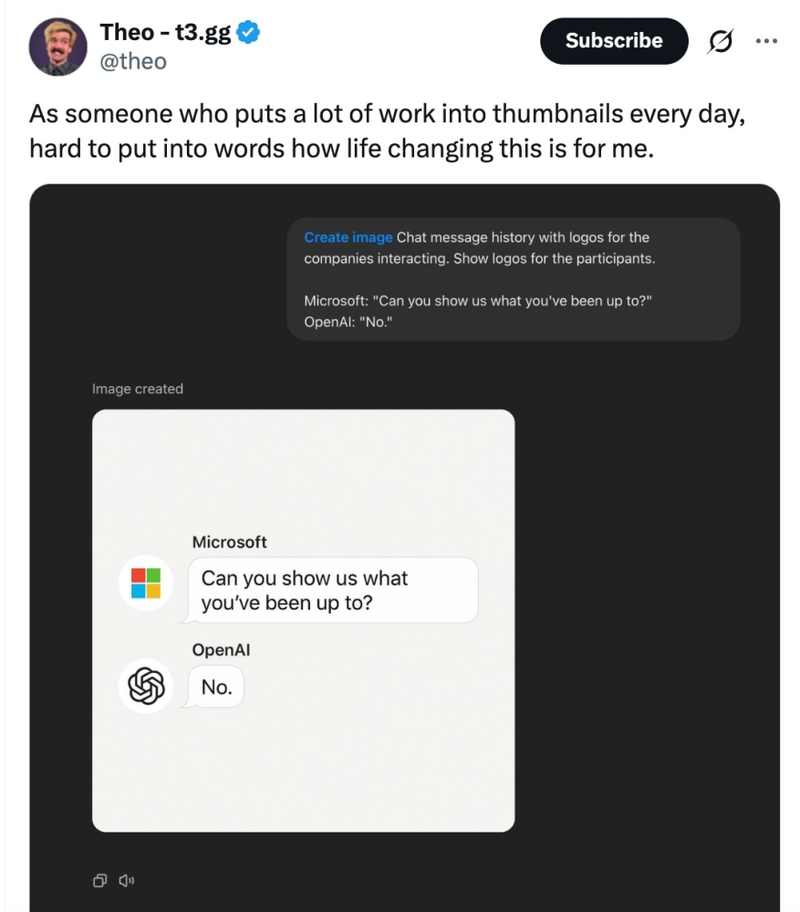 View full-size image: Tweet by Theo (@theo) with the caption: "As someone who puts a lot of work into thumbnails every day, hard to put into words how life changing this is for me." Below the tweet is an image of a user interface showing a mock chat between Microsoft and OpenAI. The prompt at the top says, "Create image Chat message history with logos for the companies interacting. Show logos for the participants." The generated conversation shows Microsoft’s logo next to the message: “Can you show us what you’ve been up to?” and OpenAI’s logo next to the reply: “No.”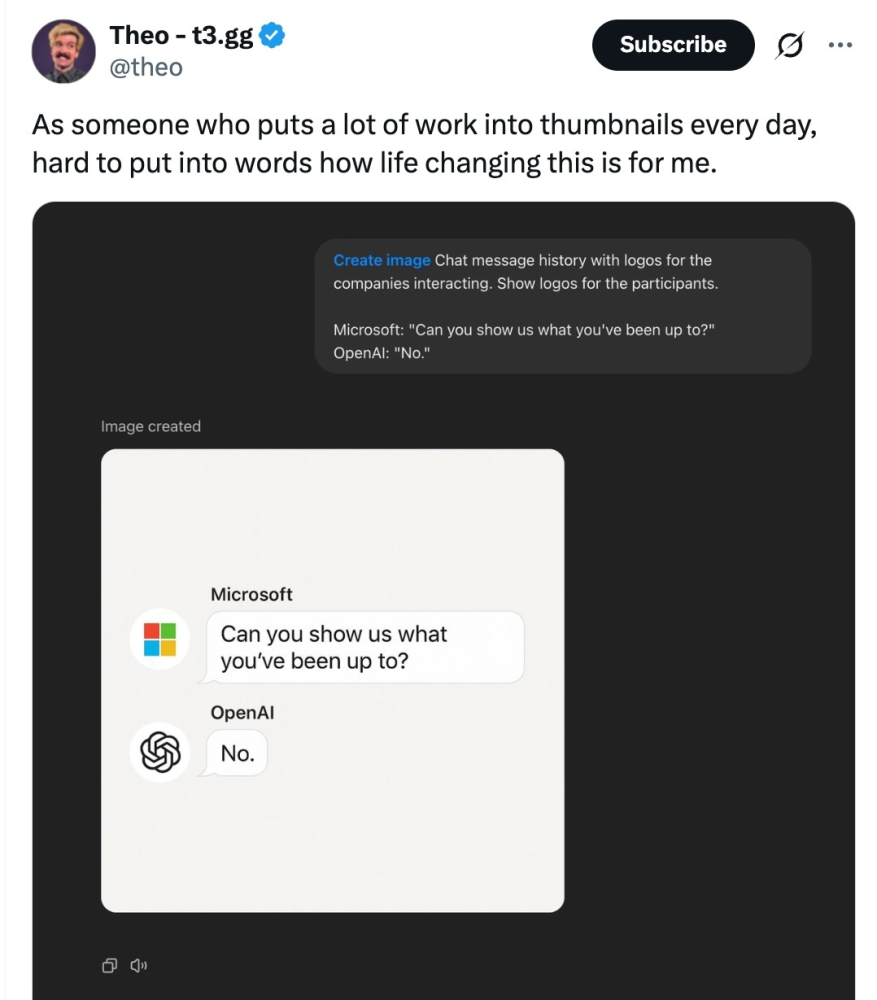
@Theo impressed by OpenAI's native image generation feature mocking up a thumbnail for him in one prompt
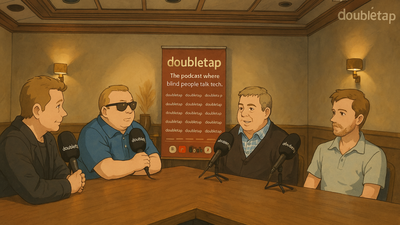
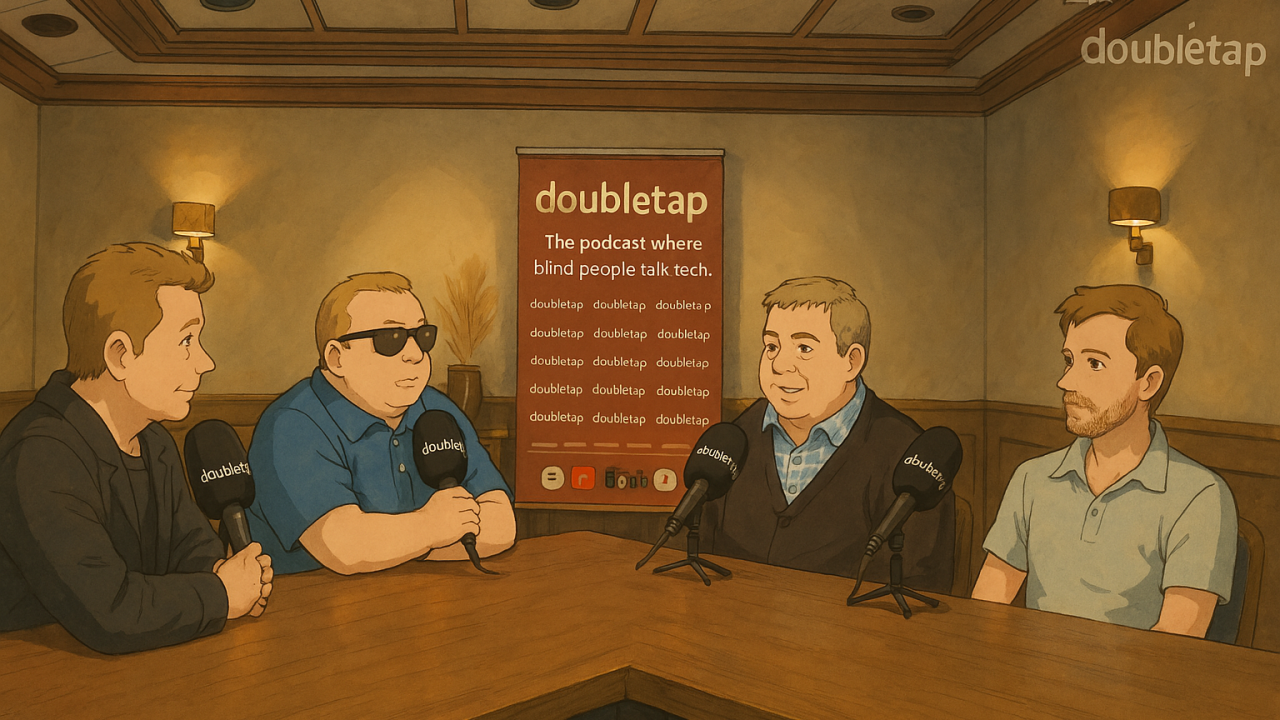
Speaking of AI and Job Loss, I joined Marc Aflalo, Steven Scott and Shaun Preece at Double Tap TV right after watching Dario Amodei predict that AI will handle 90% of coding in the next 3-6 months... and 100% within a year.
Editorial correction, October 5, 2026: The original edition said 2-3 months. In his March 10, 2025 remarks at the Council on Foreign Relations, Amodei said AI would be writing 90 percent of the code in “three to six months” and might be writing “essentially all of the code” in twelve months. The range above has been corrected.
Watch on YouTube: Joe Devon and Ben Ogilvie, A Conversation with AI Experts
Bone-chilling stuff.
So yeah, I brought that vibe to the show. Ben Ogilvie joined me to discuss ArcTouch's upcoming State of Mobile App Accessibility (SOMAA) report. Sorry, Ben, must have been tough to navigate that conversation 😬.
My dad always used to say that new technology scares people at first. It takes jobs—but creates new ones too. Historically, he’s been right.
But AI... AI feels different.
Some days I think, Maybe this time really is different. Other days I’m not so sure. I go back and forth—pretty much daily. On a good day, when I’m cranking out code in Cursor, it feels like AI is about to vaporize a gazillion programming jobs. Honestly, there is already data that scares me.
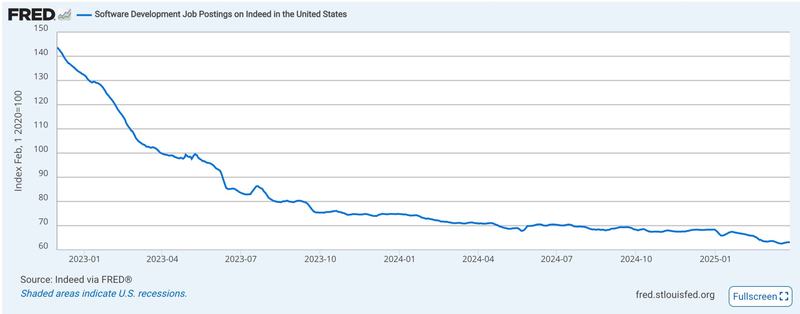 View full-size image: FRED line graph of software development job postings on Indeed in the United States. The index falls from about 142 in late 2022 to about 62 in early 2025; February 1, 2020 equals 100. Source: Indeed via FRED.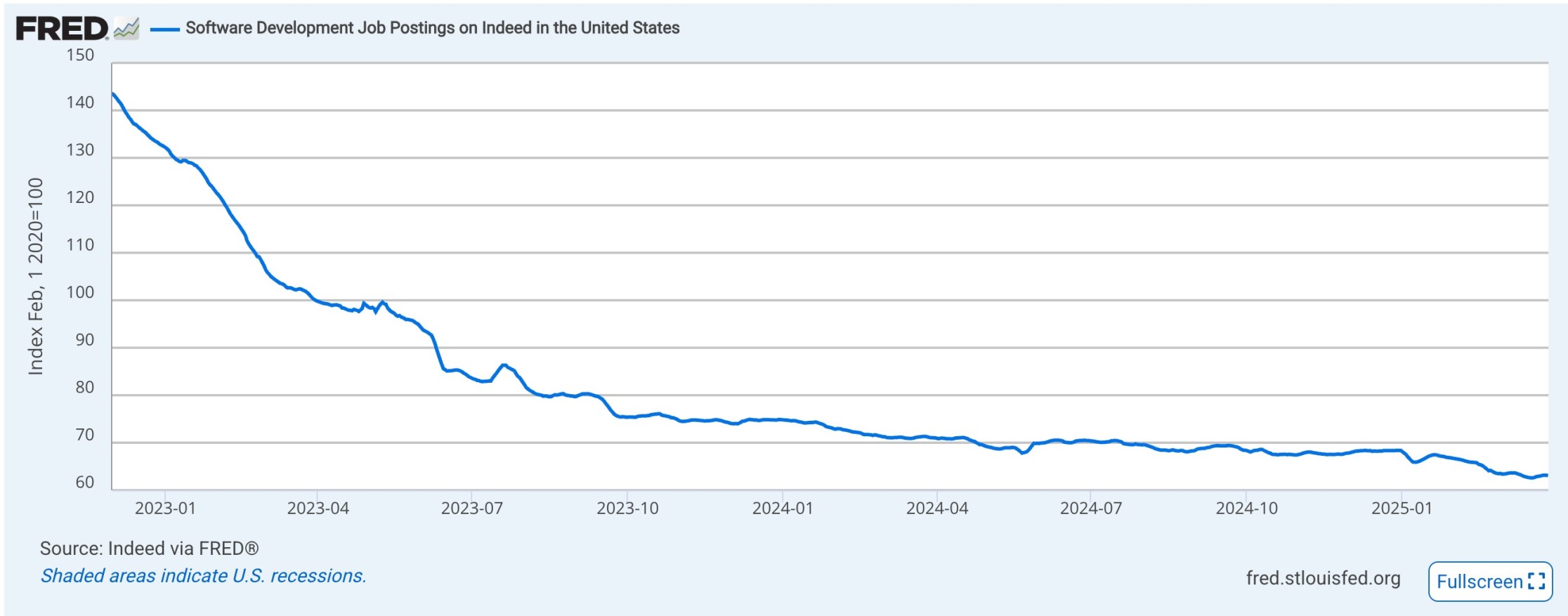
Chart of Job Postings since ChatGPT's release on Indeed via the St. Louis Fed.
Just look at this chart from FRED (Federal Reserve Economic Data)—you’ll see software engineering jobs start tumbling right after November 30, 2022: the day ChatGPT dropped.
Also, I think I can be forgiven for worrying about AI-driven job loss.
I've already been laid off by a company that went through massive cuts— right after AI disrupted their core function with a faster and cheaper product. So my concern isn't theoretical.
But here’s the twist.
On bad days, when I’m fighting with Cursor instead of flowing with it, I start thinking: Maybe AI won’t replace developers… maybe it will mint 100 Million Vibe Coders who flood the zone with garbage code. And when that happens, guess who gets hired to fix it?
Millions of real coders cleaning up after the “vibe coders”—non-techies with big ideas and LLMs doing just enough to launch something… barely.
For example, here are two vibe coding success stories, sort of, told in four social media posts:
Leo builds a successful SaaS company, all by vibe coding with Cursor.
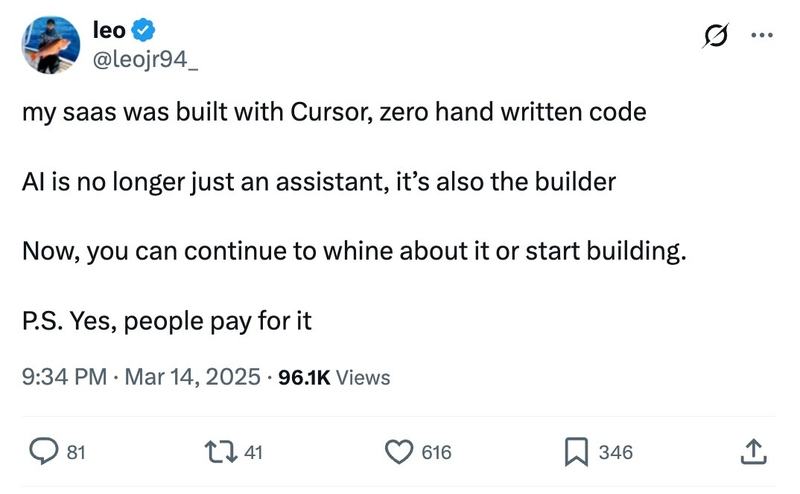 View full-size image: Tweet by user @leojr94_, posted at 9:34 PM on March 14, 2025. The tweet reads: "my saas was built with Cursor, zero hand written code. AI is no longer just an assistant, it’s also the builder. Now, you can continue to whine about it or start building. P.S. Yes, people pay for it". The tweet has 96.1K views, 81 comments, 41 retweets, 616 likes, and 346 bookmarks.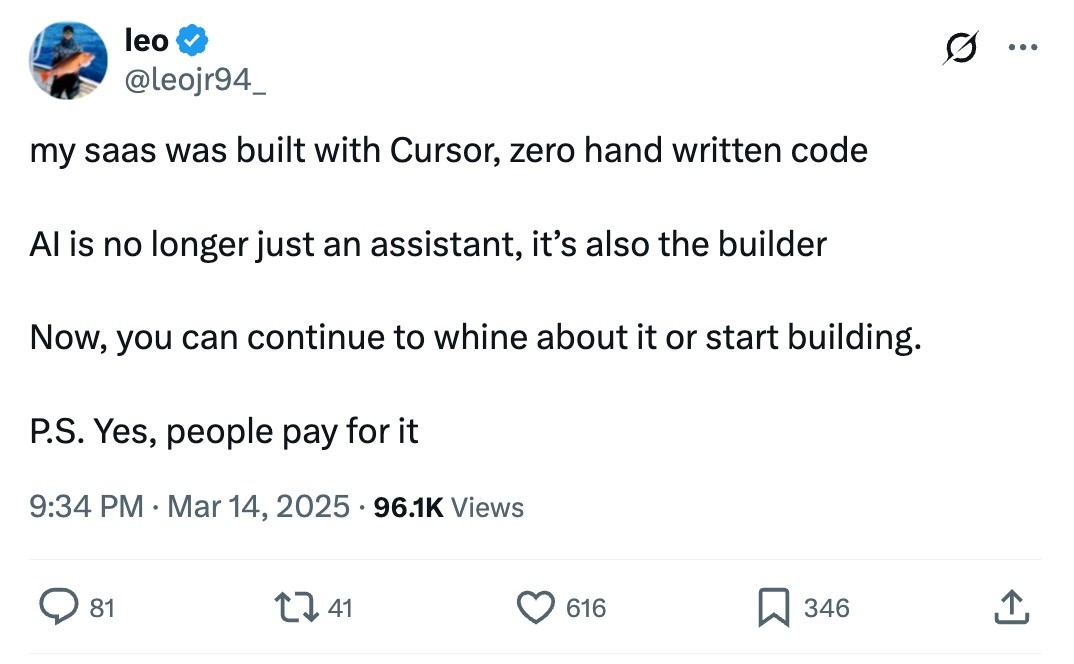
@leojr94_ boasts about his vibe coded SaaS company
But trouble brews when cursor didn’t sufficiently warn him about some security issues:
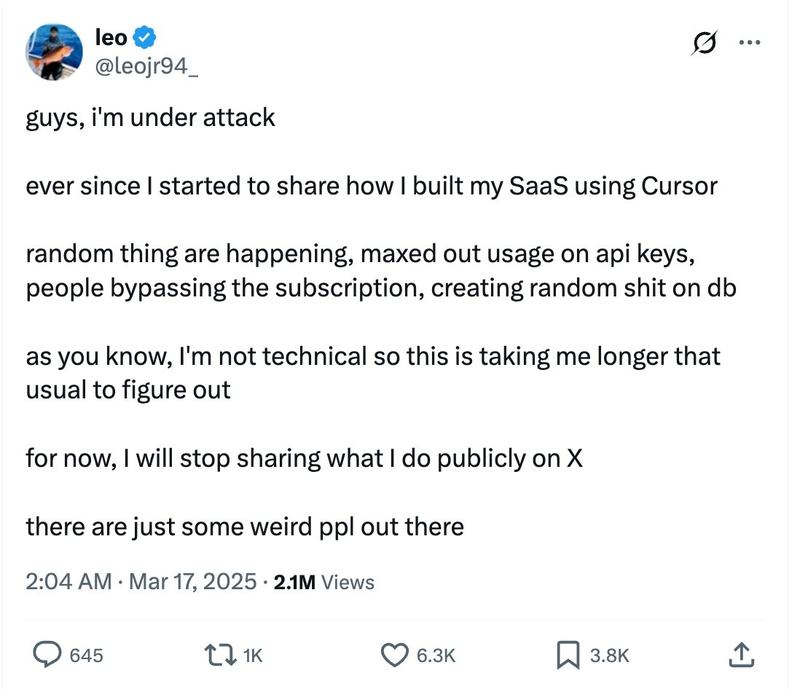 View full-size image: Tweet by @leojr94_ "guys, i’m under attack
ever since I started to share how I built my SaaS using Cursor
random thing are happening, maxed out usage on api keys, people bypassing the subscription, creating random shit on db
as you know, I’m not technical so this is taking me longer that usual to figure out
for now, I will stop sharing what I do publicly on X
there are just some weird ppl out there"
The tweet was posted at 2:04 AM on March 17, 2025, and has 2.1M views, 645 comments, 1K reposts, 6.3K likes, and 3.8K bookmarks.
View full-size image: Tweet by @leojr94_ "guys, i’m under attack
ever since I started to share how I built my SaaS using Cursor
random thing are happening, maxed out usage on api keys, people bypassing the subscription, creating random shit on db
as you know, I’m not technical so this is taking me longer that usual to figure out
for now, I will stop sharing what I do publicly on X
there are just some weird ppl out there"
The tweet was posted at 2:04 AM on March 17, 2025, and has 2.1M views, 645 comments, 1K reposts, 6.3K likes, and 3.8K bookmarks.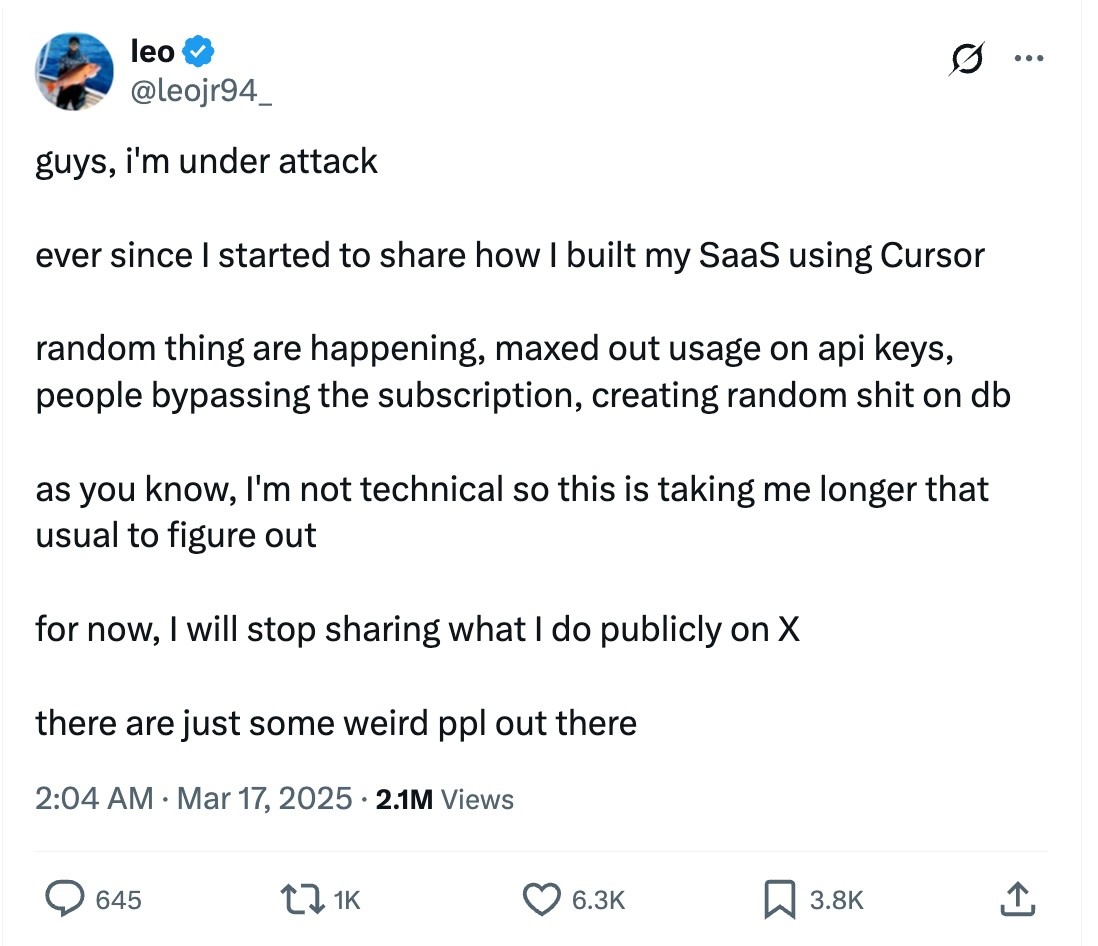
@leojr94_ has been hacked
Hot tip for Vibe Coders, limit your spend on any API Keys you create, set up an API key rotation plan to limit the damage if your key gets out into the wrong hands. If you’re committing code publicly to GitHub, look up secrets management. And make sure your API keys aren’t exposed over the wire to users.
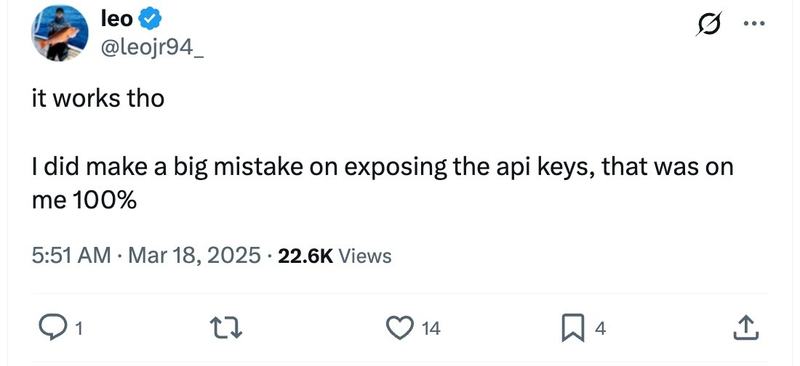 View full-size image: Tweet by @leojr94_ reads: "it works tho
I did make a big mistake on exposing the api keys, that was on me 100%"
The tweet was posted at 5:51 AM on March 18, 2025, and has 22.6K views, 1 comment, 14 likes, 4 bookmarks, and no reposts.
View full-size image: Tweet by @leojr94_ reads: "it works tho
I did make a big mistake on exposing the api keys, that was on me 100%"
The tweet was posted at 5:51 AM on March 18, 2025, and has 22.6K views, 1 comment, 14 likes, 4 bookmarks, and no reposts.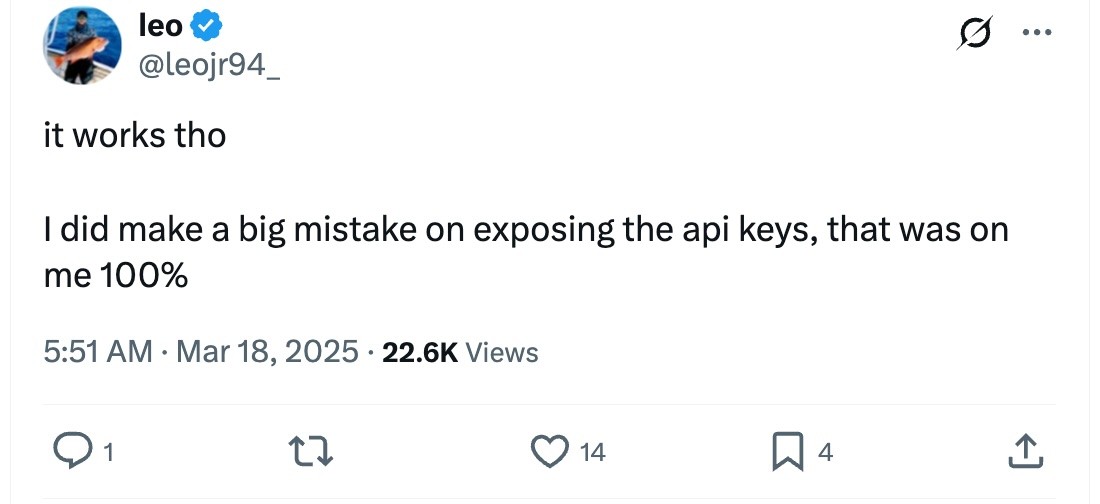
@leojr94_ exposed his API keys, which got stolen, causing expensive API bills
But every mistake is an opportunity for a new business to fix the mistake. Introducing Security Assessments for Vibe Coders.
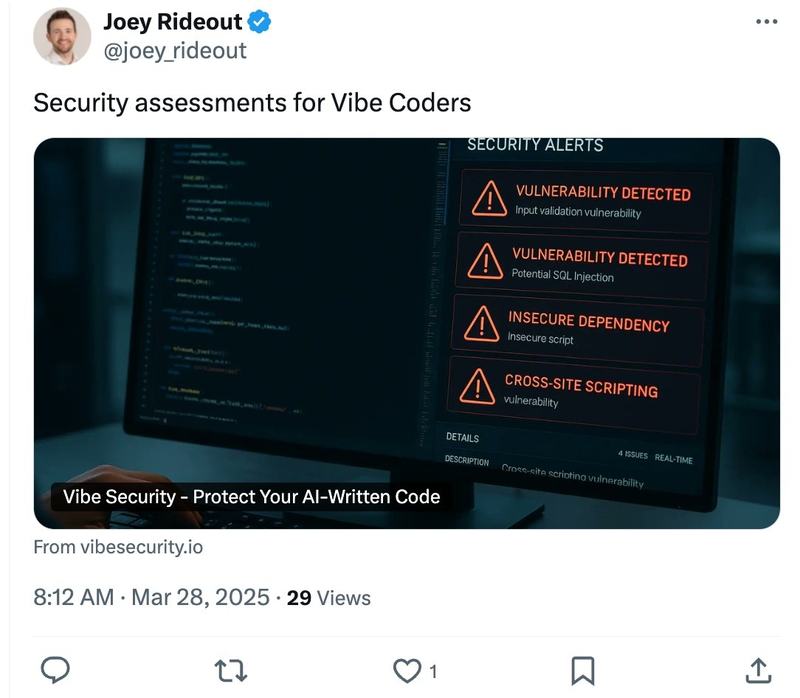 View full-size image: Tweet by @joey_rideout reads: "Security assessments for Vibe Coders." Below the tweet is a preview image from vibesecurity dot io showing a computer monitor with code on the left and a panel on the right labeled "SECURITY ALERTS." The panel lists four warnings in red and orange:
VULNERABILITY DETECTED – Input validation vulnerability
VULNERABILITY DETECTED – Potential SQL Injection
INSECURE DEPENDENCY – Insecure script
CROSS-SITE SCRIPTING – Vulnerability
At the bottom of the image is a banner that reads: "Vibe Security – Protect Your AI-Written Code." The tweet was posted at 8:12 AM on March 28, 2025, and has 29 views, 1 like, and no comments, reposts, or bookmarks.
View full-size image: Tweet by @joey_rideout reads: "Security assessments for Vibe Coders." Below the tweet is a preview image from vibesecurity dot io showing a computer monitor with code on the left and a panel on the right labeled "SECURITY ALERTS." The panel lists four warnings in red and orange:
VULNERABILITY DETECTED – Input validation vulnerability
VULNERABILITY DETECTED – Potential SQL Injection
INSECURE DEPENDENCY – Insecure script
CROSS-SITE SCRIPTING – Vulnerability
At the bottom of the image is a banner that reads: "Vibe Security – Protect Your AI-Written Code." The tweet was posted at 8:12 AM on March 28, 2025, and has 29 views, 1 like, and no comments, reposts, or bookmarks.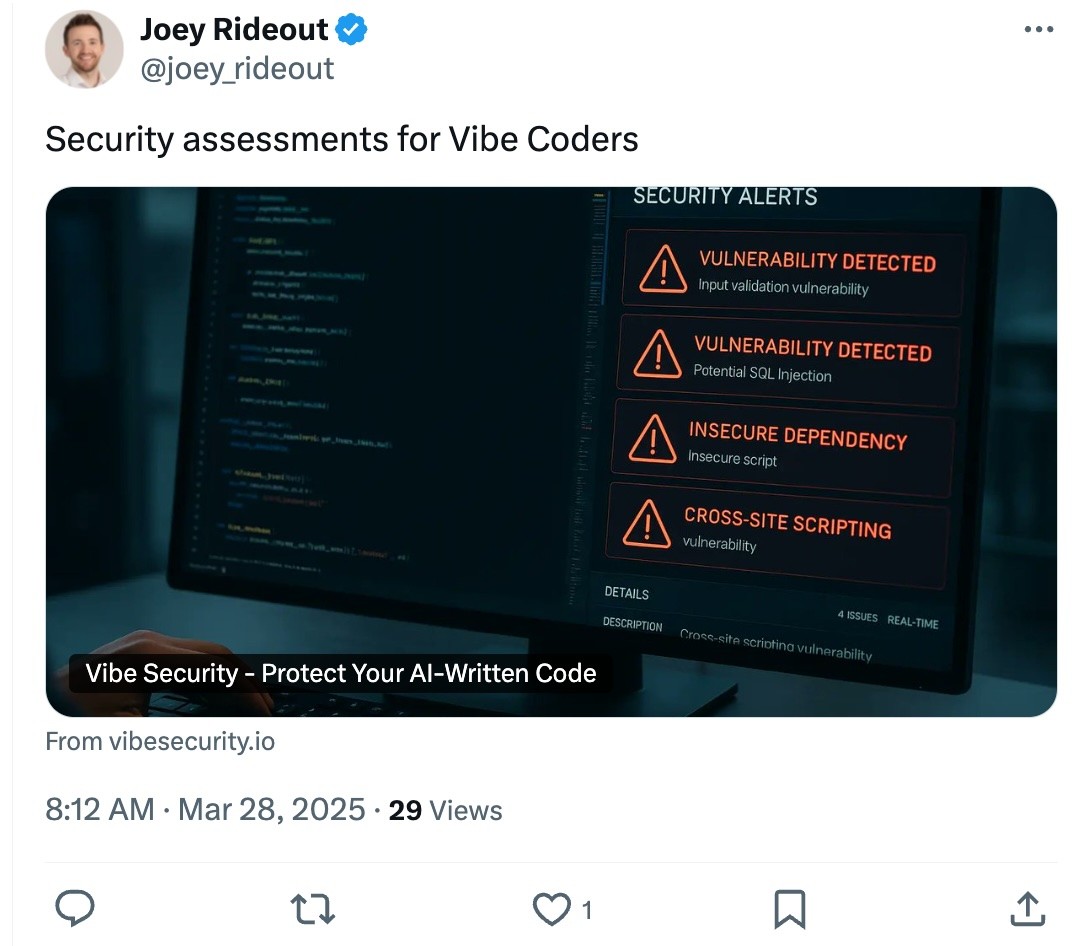
Vibe Security to the rescue!
Let’s finish our look at AI and jobs with a quote from Bill Gates, who weighed in at an Indian Express event:
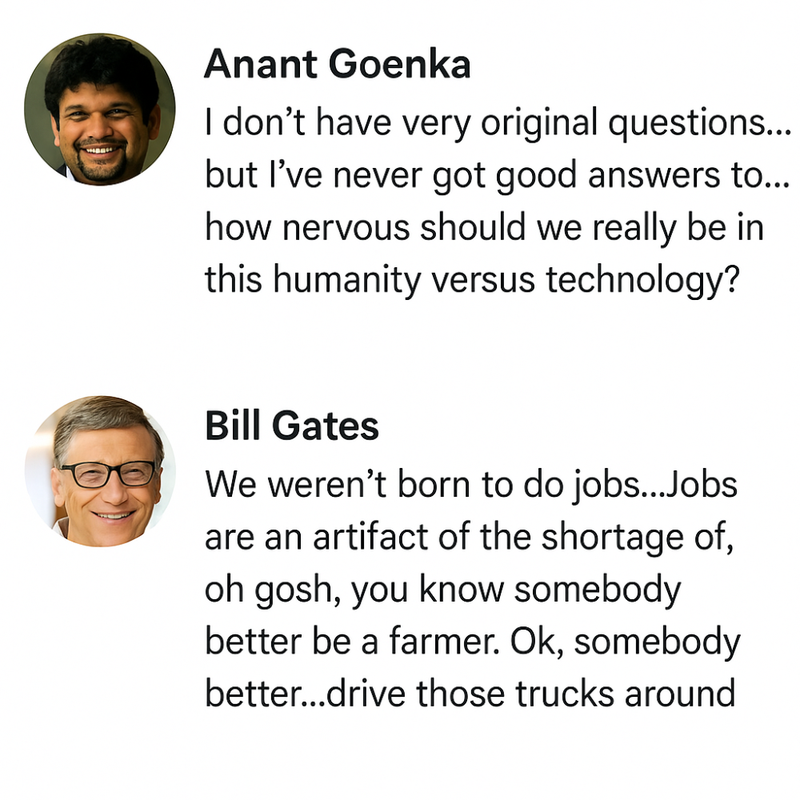 View full-size image: Two quotes are shown with profile photos and names of speakers:
Anant Goenka: "I don’t have very original questions... but I’ve never got good answers to... how nervous should we really be in this humanity versus technology?"
Bill Gates: "We weren’t born to do jobs...Jobs are an artifact of the shortage of, oh gosh, you know somebody better be a farmer. Ok, somebody better...drive those trucks around"
View full-size image: Two quotes are shown with profile photos and names of speakers:
Anant Goenka: "I don’t have very original questions... but I’ve never got good answers to... how nervous should we really be in this humanity versus technology?"
Bill Gates: "We weren’t born to do jobs...Jobs are an artifact of the shortage of, oh gosh, you know somebody better be a farmer. Ok, somebody better...drive those trucks around"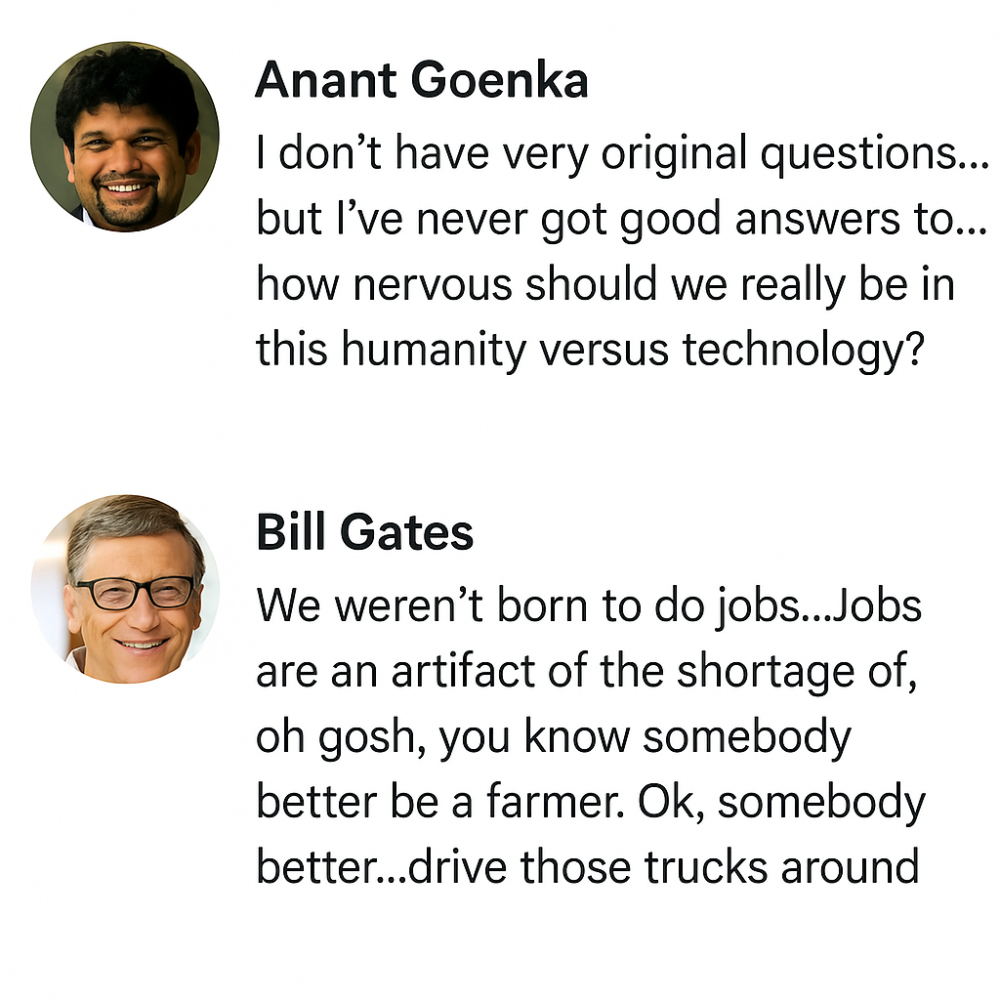
Anant Goenka and Bill Gates conversation
To be fair, the full context gives it a slightly different tone—so I’ll let you decide. The relevant segment begins around 30:05 in this video:
Watch on YouTube: Bill Gates and Anant Goenka on AI and jobs, from 30:05
For all of the momentum around GAAD (Global Accessibility Awareness Day) Foundation, it’s rare that my #GAAD Co-Founder and I are interviewed together in person. But at CSUN, we had the chance to do just that—joining Chris Maher and Kelvin Crosby’s Investing in Accessibility podcast, which dropped yesterday.
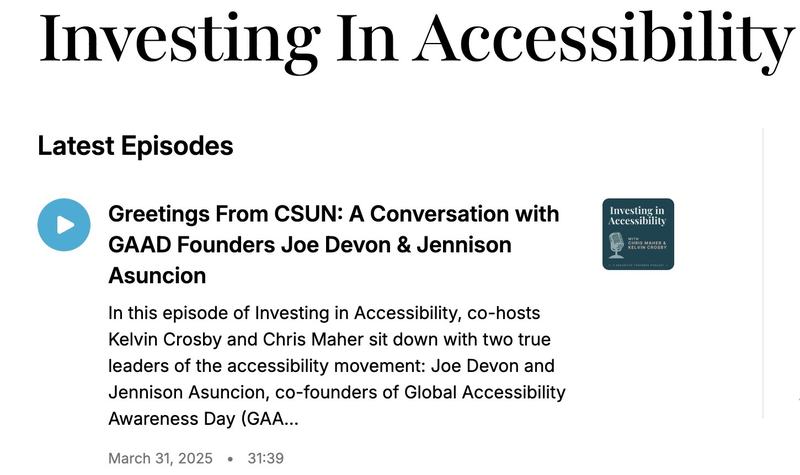 View full-size image: Podcast episode listing from "Investing In Accessibility" titled "Greetings From CSUN: A Conversation with GAAD Founders Joe Devon & Jennison Asuncion." The description reads: "In this episode of Investing in Accessibility, co-hosts Kelvin Crosby and Chris Maher sit down with two true leaders of the accessibility movement: Joe Devon and Jennison Asuncion, co-founders of Global Accessibility Awareness Day (GAA..." The episode is dated March 31, 2025, and has a runtime of 31:39. An icon to the right shows the podcast logo with text: "Investing in Accessibility with Chris Maher & Kelvin Crosby."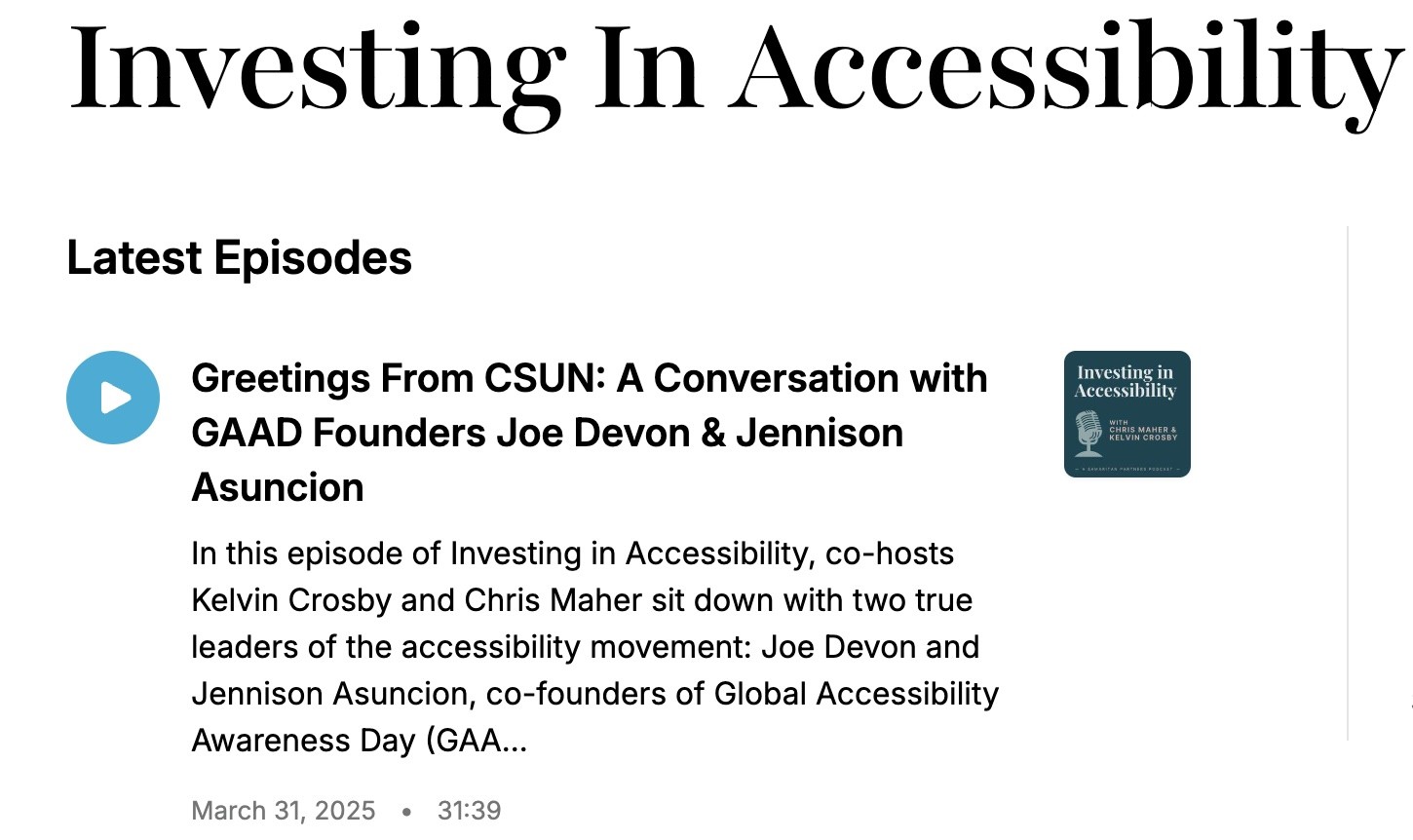
Jennison and my Episode of Investing in Accessibility at InvestingInAccessibility dot com
I just love what Chris is doing as the GP of Samaritan Partners. If you’re in the accessibility startup space, you need to connect with him. I'd also recommend reaching out to Molly Lazarus (Levitt) who heads up an accessibility incubator.
🧬 Using culture to improve accessibility
Now, a topic that explains why the GAAD Foundation talks about the culture of making Digital Projects.
If we want to make a real dent in the percentage of products that are accessible—regardless of:
- Budget from above
- Buy-in from middle management
- Civil Rights Legislation from governments
—we need to focus on culture.
When the most influential programmers treat semantic, accessible HTML as second nature…
When the best designers take pride in avoiding color-only communication because they’re just that good at their craft…
That’s when we’ll start to see real change.
More than any budget battle.
More than any middle management meetings.
More than any law that could be repealed next cycle.
There are no badges developers, designers, or PMs can wear to say “accessibility is part of my craft.” No emoji that captures code quality, empathy, and pride in the work. But there should be.
Because art is culture. And culture moves faster than policy.
We need visual symbols—badges, logos, emojis—that say:
I build accessibly not because I have to… but because I care. Because I’m great at what I do.
Yes, this is a call to action.
If you’re a designer, how would you convey that? Let’s build the symbols this movement is missing.
And yes—I have something in mind.
A few quick updates before I go:
🎤 Next week, I’ll be moderating a panel at the #NABShow. Huge thanks to Lesley Peña and #Tim for the invite, and to our amazing panelists Ariel Simms, Storm Smith, Rebecca Avery and Dan Caddigan. Drop me a line if you're attending!
🤖 I’m also excited for AI Tinkerers coming to Vegas! Massive kudos to Joe Heitzeberg for creating such a vibrant global community, to Claire Longo for launching the Vegas outpost. I’ll be presenting a new project that Eamon McErlean and I have been cooking up—join us at the inaugural event at "Las dash Vegas dot AITinkerers dot org"!
🎙️ Accessibility and Gen AI Podcast
Episode #8 drops Monday morning at 7am PST, featuring Dylan Barrell. And… we’ve got some very special guests and programming coming up—check out next week’s edition for the scoop.
With that, I’ll double tap out.
See you next Tuesday!