JDOT #5: AI's Promise and Perils

April 8, 2025
Tags:
Joe Devon explores Llama 4, image models, robot security, AI in medicine, and accessibility.

You will be shocked to hear that this has been an eventful week in the world of AI.
News from the Big AI Models
Meta AI
The top news story out of the foundational models this week was Meta's Saturday drop¹ of their Open Source LLM, Llama 4.
 View full-size image: Today is the start of a new era of natively multimodal AI innovation.
Today, we’re introducing the first Llama 4 models: Llama 4 Scout and Llama 4 Maverick — our most advanced models yet and the best in their class for multimodality.
Llama 4 Scout
• 17B-active-parameter model
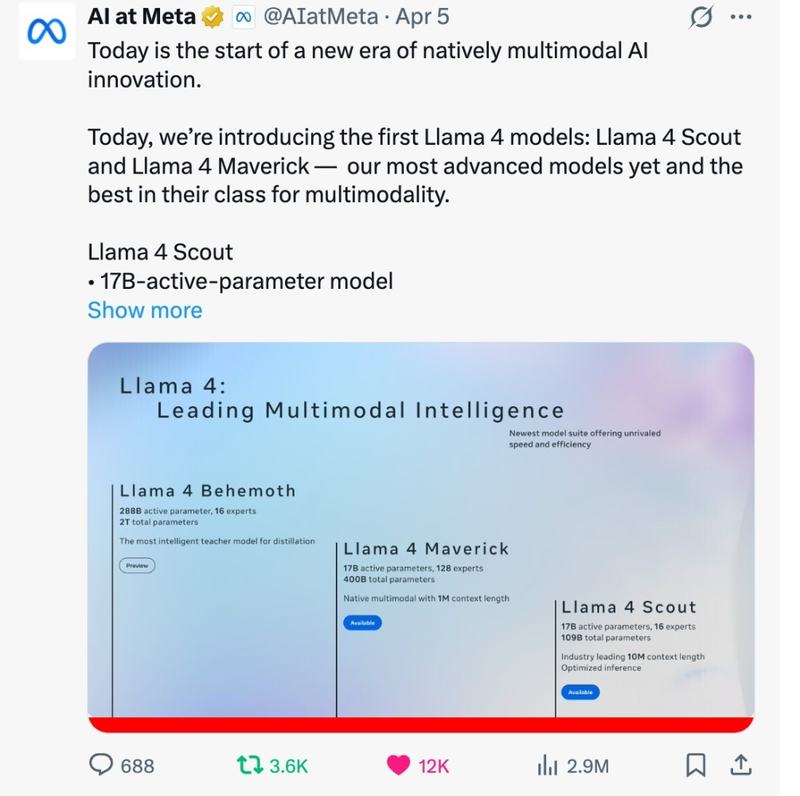
The image attached to the tweet presents a high-level comparison of three Llama 4 AI models—Behemoth, Maverick, and Scout—under the heading “Llama 4: Leading Multimodal Intelligence.” Each model is shown with its parameter count and capabilities. Behemoth is labeled as a teacher model for distillation, Maverick emphasizes native multimodality with a 1M context length, and Scout highlights optimized inference with a 10M context length.
View full-size image: Today is the start of a new era of natively multimodal AI innovation.
Today, we’re introducing the first Llama 4 models: Llama 4 Scout and Llama 4 Maverick — our most advanced models yet and the best in their class for multimodality.
Llama 4 Scout
• 17B-active-parameter model
The image attached to the tweet presents a high-level comparison of three Llama 4 AI models—Behemoth, Maverick, and Scout—under the heading “Llama 4: Leading Multimodal Intelligence.” Each model is shown with its parameter count and capabilities. Behemoth is labeled as a teacher model for distillation, Maverick emphasizes native multimodality with a 1M context length, and Scout highlights optimized inference with a 10M context length. 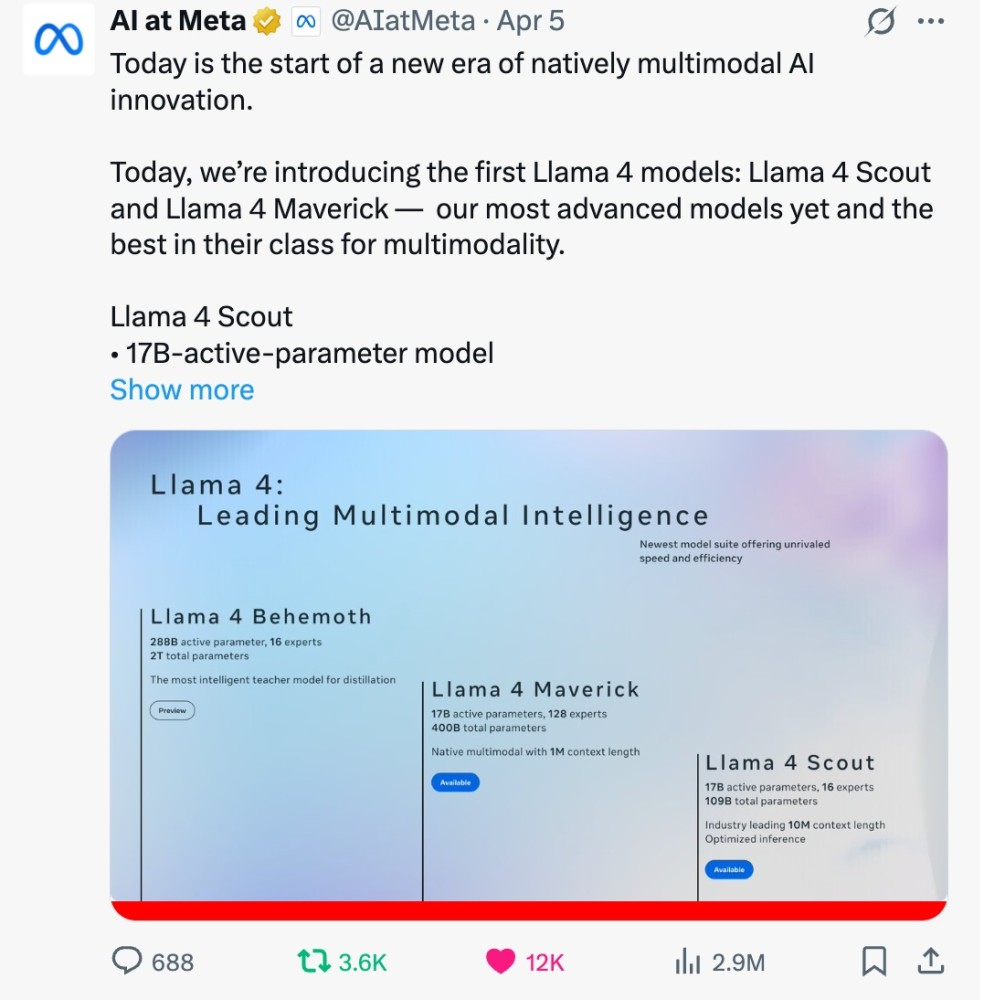
Meta AI Announcing Llama 4
People are still processing the surprisingly large 1M token context window of Gemini. Against that backdrop, Llama 4 shipped with a jaw-dropping 10M token window! That means you can attach something on the order of 100 books along with your prompt.
The model performed extremely well on benchmarks and the leaderboard in the Chatbot Arena. But soon after, developers noticed that something felt off, the model wasn't performing as well as benchmarks suggested.
Then there was a bit of drama, culminating in a post by LM Arena AI, clarifying some issues about the model they were using. Turns out, many users were testing a customized version of the model, one optimized for human preference tuning. The Chatbot Arena team stepped in to clarify:
Meta’s interpretation of our policy did not match what we expect from model providers. Meta should have made it clearer that “Llama-4-Maverick-03-26-Experimental” was a customized model to optimize for human preference.
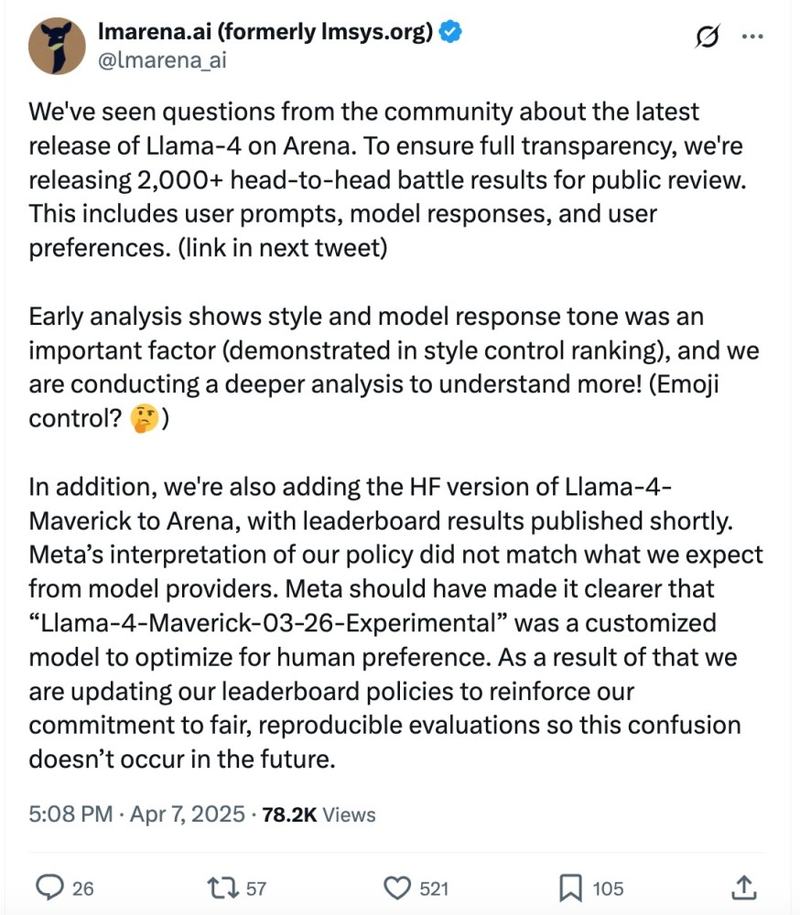 View full-size image: We’ve seen questions from the community about the latest release of Llama-4 on Arena. To ensure full transparency, we’re releasing 2,000+ head-to-head battle results for public review. This includes user prompts, model responses, and user preferences. (link in next tweet)
Early analysis shows style and model response tone was an important factor (demonstrated in style control ranking), and we are conducting a deeper analysis to understand more! (Emoji control? 🤔 )
In addition, we’re also adding the HF version of Llama-4-Maverick to Arena, with leaderboard results published shortly. Meta’s interpretation of our policy did not match what we expect from model providers. Meta should have made it clearer that “Llama-4-Maverick-03-26-Experimental” was a customized model to optimize for human preference. As a result of that we are updating our leaderboard policies to reinforce our commitment to fair, reproducible evaluations so this confusion doesn’t occur in the future.
View full-size image: We’ve seen questions from the community about the latest release of Llama-4 on Arena. To ensure full transparency, we’re releasing 2,000+ head-to-head battle results for public review. This includes user prompts, model responses, and user preferences. (link in next tweet)
Early analysis shows style and model response tone was an important factor (demonstrated in style control ranking), and we are conducting a deeper analysis to understand more! (Emoji control? 🤔 )
In addition, we’re also adding the HF version of Llama-4-Maverick to Arena, with leaderboard results published shortly. Meta’s interpretation of our policy did not match what we expect from model providers. Meta should have made it clearer that “Llama-4-Maverick-03-26-Experimental” was a customized model to optimize for human preference. As a result of that we are updating our leaderboard policies to reinforce our commitment to fair, reproducible evaluations so this confusion doesn’t occur in the future.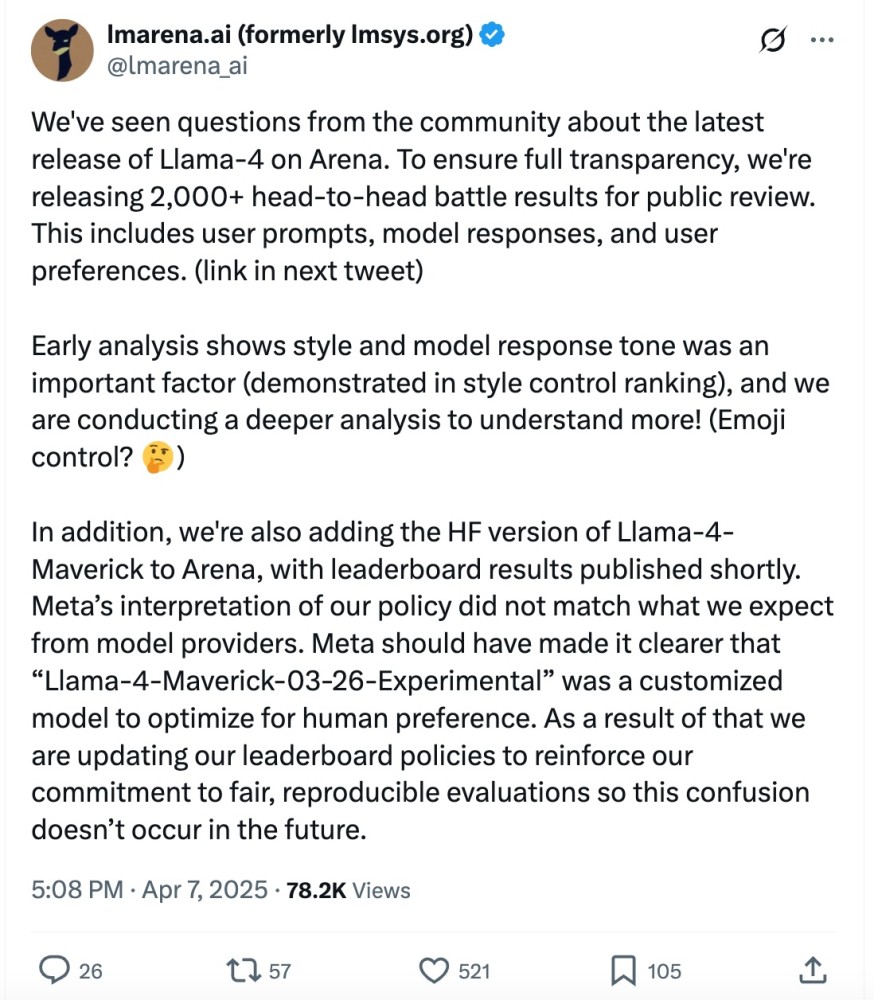
LM Arena AI commenting about the custom version of Llama 4 they were inadvertently testing
A cool side story that came out of this release was a rare nod from a competitor. Google CEO, Sundar Pichai, tweeted: "Never a dull day in the AI world! Congrats to the Llama 4 team, Onwards!" and Ahmad Al Dahle who is "Leading GenAI @ Meta" responded: "Thanks Sundar! We don’t like dull days here 😉 thanks!"
In a field known more for rivalries than compliments, Sundar's kudos and Ahmad’s playful reply were a refreshing moment of mutual respect.
Google Gemini
After a flurry of Gemini model updates the previous week, things have briefly quieted down. Aside from the release of the paid version of Gemini Pro 2.5, there haven’t been any new models in the past week. (There is some Gemini-related news further down.)
Still, something else might be cooking. Logan Kilpatrick just teased, "Should be a good week 👍".
OpenAI
Sam Altman, OpenAI's CEO, might be feeling the heat from Gemini's recent value jump. He surprised everyone with this tweet announcing an earlier than expected release of a couple of models:
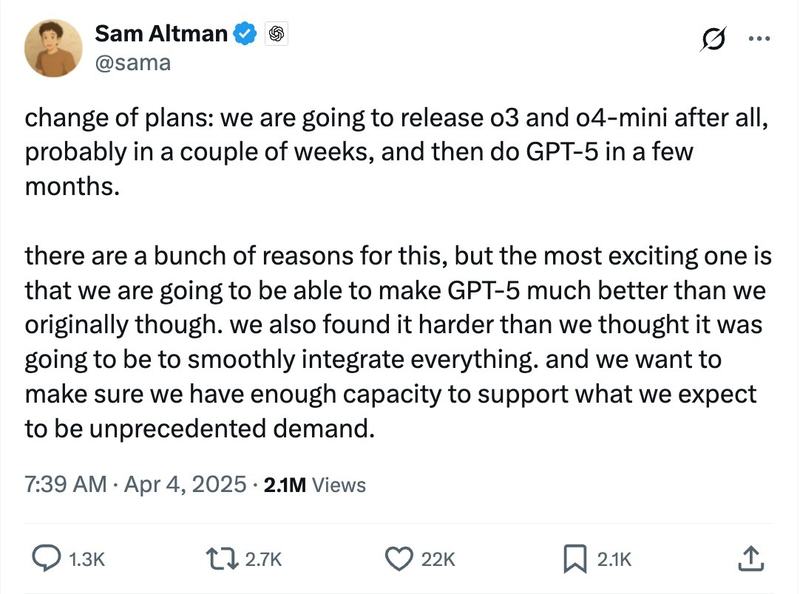 View full-size image: change of plans: we are going to release o3 and o4-mini after all, probably in a couple of weeks, and then do GPT-5 in a few months.
there are a bunch of reasons for this, but the most exciting one is that we are going to be able to make GPT-5 much better than we originally thought. we also found it harder than we thought it was going to be to smoothly integrate everything. and we want to make sure we have enough capacity to support what we expect to be unprecedented demand.
View full-size image: change of plans: we are going to release o3 and o4-mini after all, probably in a couple of weeks, and then do GPT-5 in a few months.
there are a bunch of reasons for this, but the most exciting one is that we are going to be able to make GPT-5 much better than we originally thought. we also found it harder than we thought it was going to be to smoothly integrate everything. and we want to make sure we have enough capacity to support what we expect to be unprecedented demand.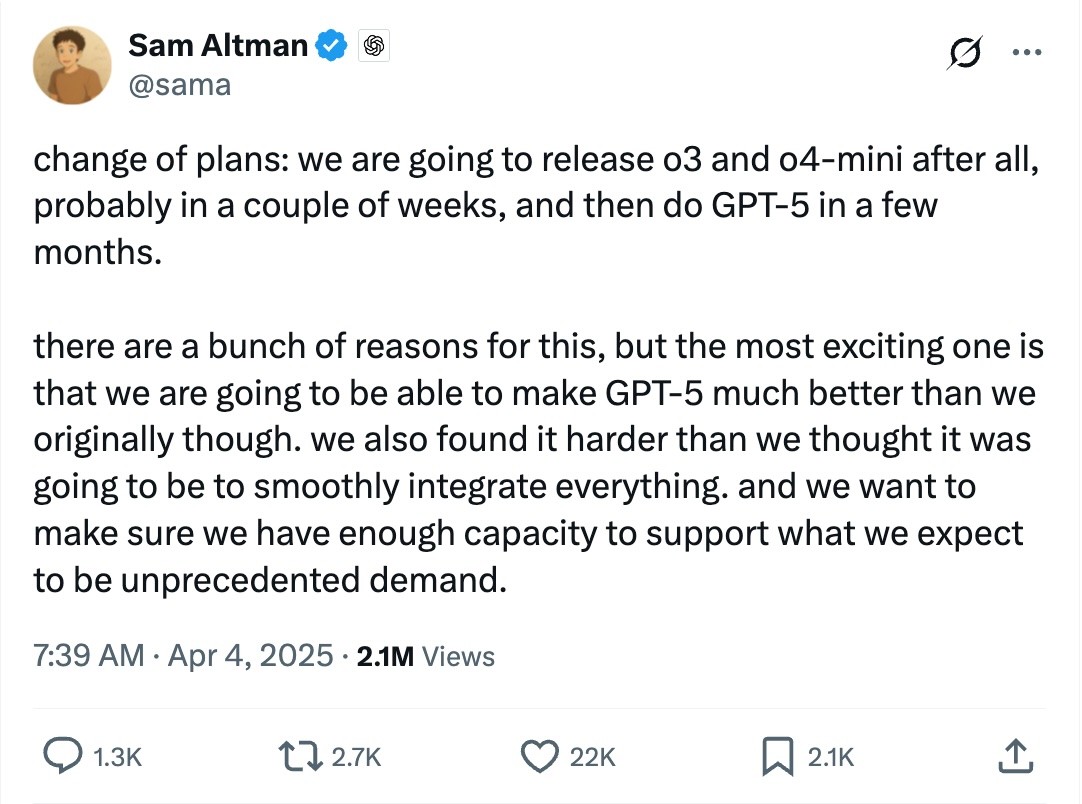
Sam Altman tweeting about plans to release two AI Models
Anthropic
Anthropic released a new paper called "Reasoning Models Don't Always Say What They Think"². Turns out, large language models often hide their real reasoning, even while presenting detailed Chain-of-Thought explanations. In other words: they might lie to us… convincingly. Uh oh!
Midjourney
Let's talk about image models. I could've sworn MidJourney CEO David Holz threw shade at OpenAI's new image model, but I can't find any trace of it. Maybe I'm the one hallucinating now.
What is definitely real is this post about Mark Zuckerberg and 4 Llamas:
i desperately want mark zuckerberg to pose with four llamas for the llama 4 release - i'll even say please - we need aesthetic moments in tech and this llama branding is good for one thing - and one thing only
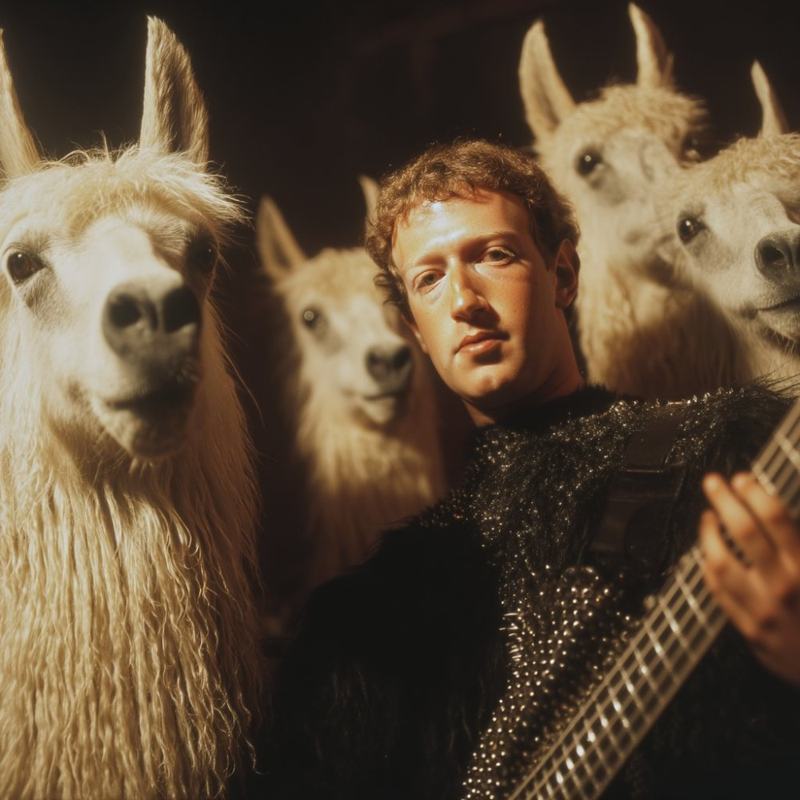 View full-size image: Mark Zuckerberg with a guitar and 4 Llamas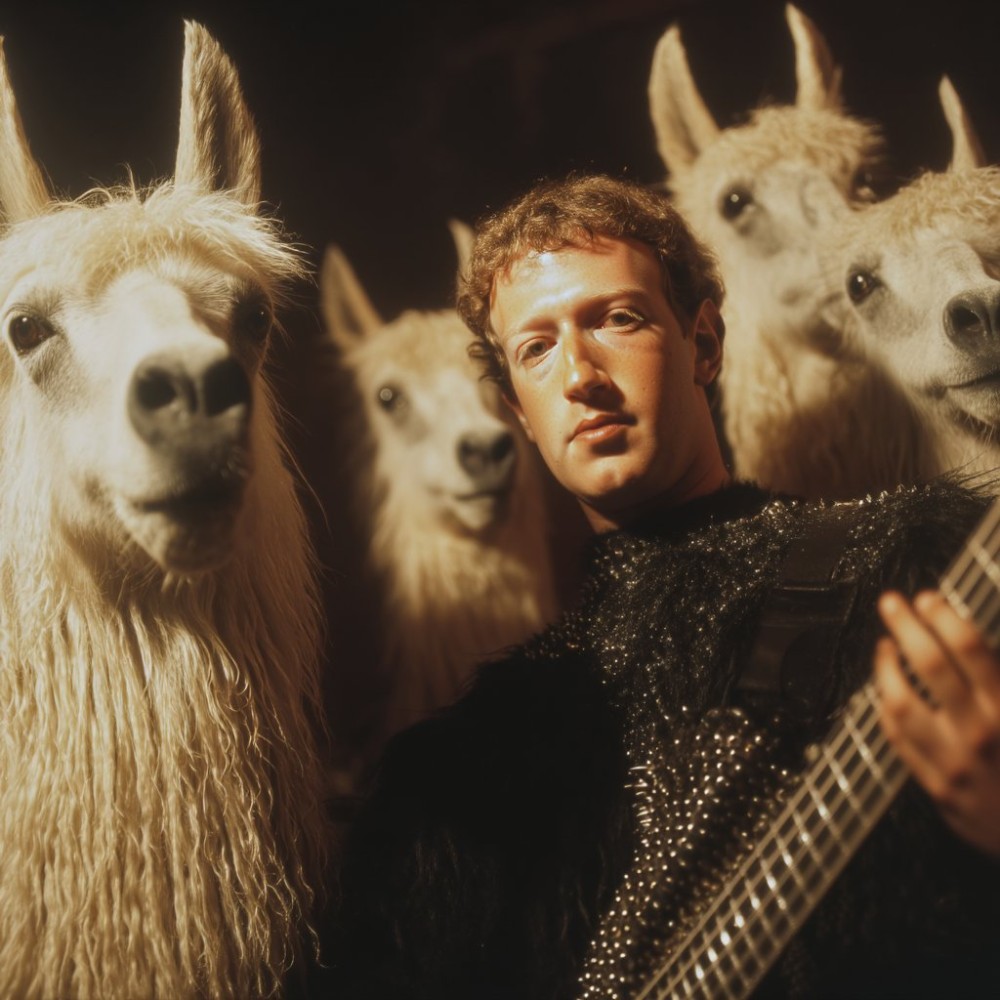
Mark Zuckerberg with 4 Llamas
I may be missing the meaning of the dig here. DM me if you cracked it.
David built an incredible company and image model in MidJourney, without taking in any outside funding. Simply incredible. That said, with OpenAI cooking, I hope there's a business model that allows MidJourney to continue to exist.
MidJourney’s had a quiet year, but in what might be a response to OpenAI’s surge, they’re dropping³ an Alpha release of V7. First major model update in a year.
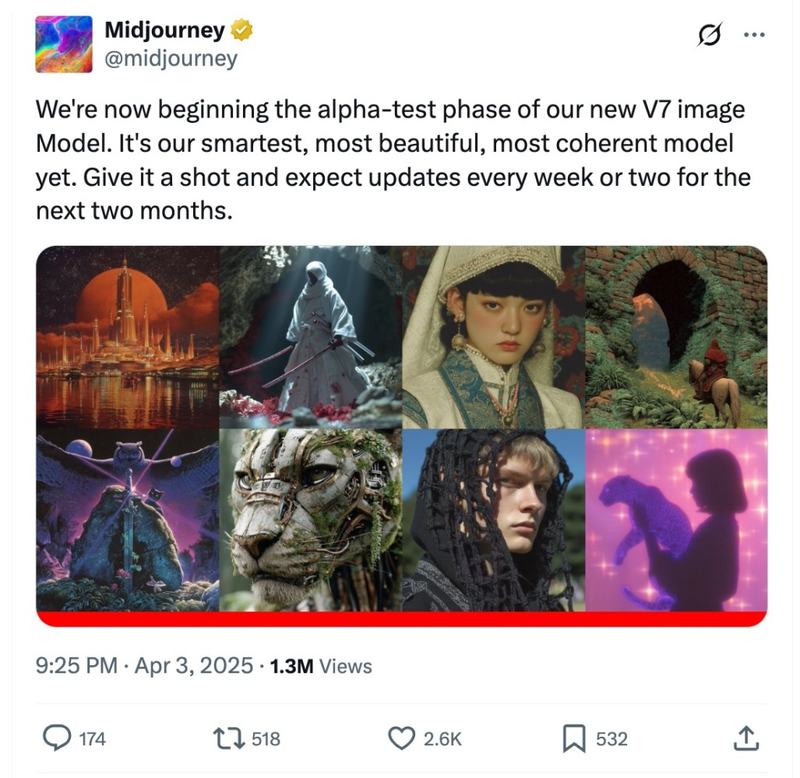 View full-size image: "We're now beginning the alpha-test phase of our new V7 image Model. It's our smartest, most beautiful, most coherent model yet. Give it a shot and expect updates every week or two for the next two months."
Below the tweet is a 3x3 grid of AI-generated images: a futuristic city under a red planet, a samurai in a white robe with two swords, a woman in traditional Asian attire, a person on horseback near an arched stone ruin, a purple-hued fantasy owl scene, a mechanical lion head, a person in black with a netted head covering, and a silhouetted girl holding a glowing purple animal.
View full-size image: "We're now beginning the alpha-test phase of our new V7 image Model. It's our smartest, most beautiful, most coherent model yet. Give it a shot and expect updates every week or two for the next two months."
Below the tweet is a 3x3 grid of AI-generated images: a futuristic city under a red planet, a samurai in a white robe with two swords, a woman in traditional Asian attire, a person on horseback near an arched stone ruin, a purple-hued fantasy owl scene, a mechanical lion head, a person in black with a netted head covering, and a silhouetted girl holding a glowing purple animal.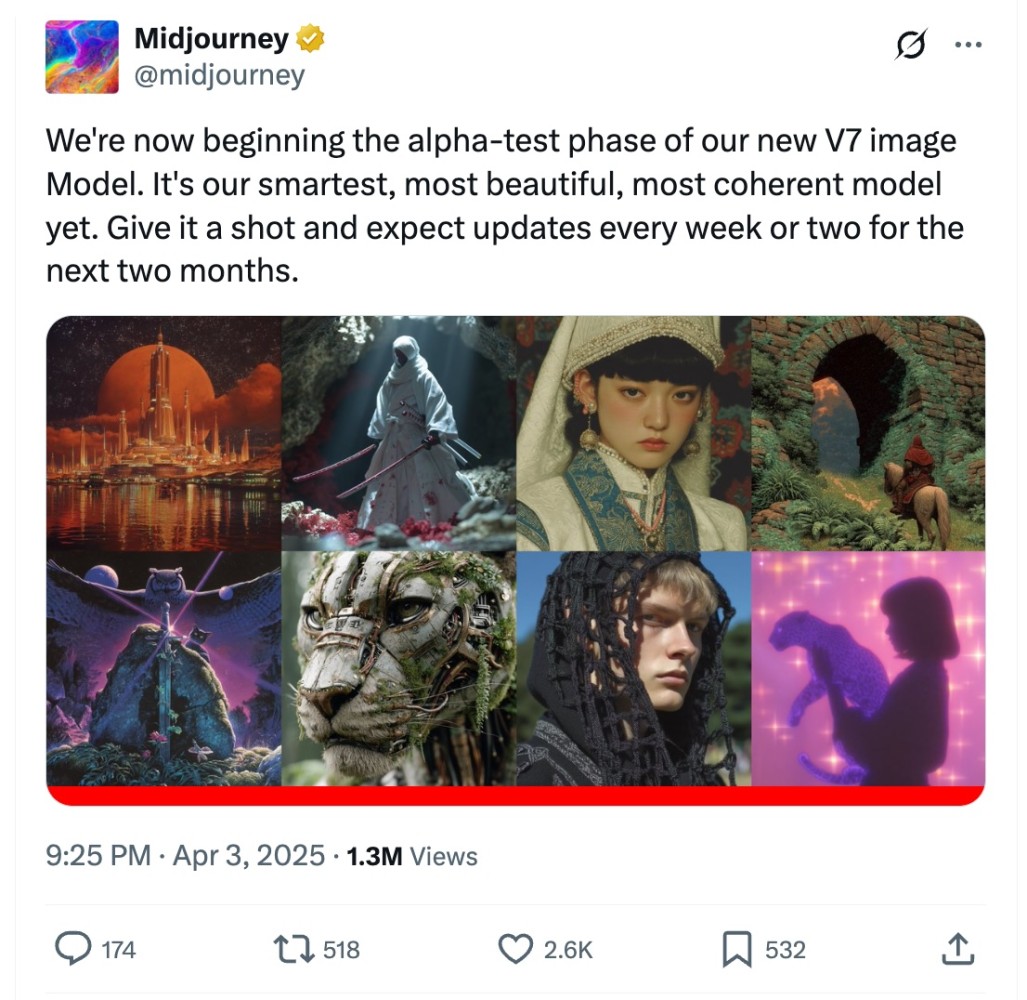
Midjourney announcing Alpha release of v7
Fun with Image Models
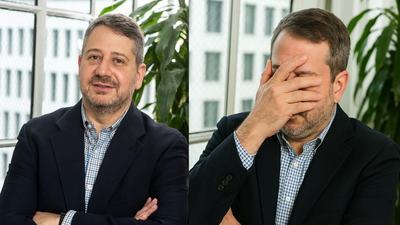
Alright, now it's time to have some fun! The Ghibli trend is over. So I thought I'd try something new. I wanted to see if OpenAI could turn my headshot into the iconic Captain Picard facepalm meme.
Here's my original headshot:
 View full-size image: Headshot of a man with short gray hair and a trimmed beard wearing a navy blazer over a blue and white checkered shirt, standing with arms crossed in front of a window and a tall green plant.
Original Headshot
And here's the result of this simple prompt, "Pose me like picard in the famous facepalm pose":
 View full-size image: Man wearing a navy blazer and checkered shirt covering his face with one hand, appearing frustrated or stressed, standing indoors near a window with a green plant in the background. Emulating the Picard Facepalm meme.
Facepalm Headshot
Next, I figured, why not take it further? Let's throw in the full red Star Trek: TNG uniform.
 View full-size image: Man in a red and black Starfleet uniform with a silver and gold Star Trek insignia pin covering his face with one hand, standing indoors near a window and a green plant.
Facepalm Headshot wearing Starfleet Gear
Grok's results? Total chaos. Nothing usable but plenty of unintentional comedy. This was the best picture, with a lot of extra fingers:
 View full-size image: Man in a navy blazer and blue checkered shirt standing with arms crossed and too many hands covering his mouth and lower face, eyes closed, appearing exasperated or overwhelmed. A green plant and window with a city building in the background. The extra hand and fingers belie the fact that this image is AI-generated.
Facepalm Headshot with too many fingers
Gemini’s experimental image model didn’t impress at first either. But after some prompt wrangling, I got this gem I’m calling Joe Picard:
 View full-size image: The top part of the face with a bald scalp looks like Captain Picard from Star Trek and the bottom half of the face looks like Joe Devon, with a short beard wearing a navy blazer and checkered shirt covering his eyes with one hand, standing with arms crossed in front of a window and green plants, appearing exasperated or stressed.
Joe Picard Bald Headshot
The Stanford HAI Index for 2025 is out!
AI legend Dr. Fei-Fei Li tweeted about a new drop⁴ from Stanford Institute for Human-Centered Artificial Intelligence (HAI):
Drum roll @StanfordHAI‘s annual #AIIndex2025 is out! This is one of the most trusted annual reports on the state of AI globally. Everyone interested in AI should read this!
Watch The AI Index: A Compass for Navigating AI’s Future on YouTube
General Agents + Gemini = Accessibility Experiment
General Agents dropped some demo videos of what looks to be a powerful new high-quality agent. It’s still early, but the UX seems promising, especially as a potential assistive technology tool for interacting with your computer.
I already shared my thoughts on LinkedIn this week, so I won’t rehash them here. But I did take the opportunity to do a quick proof of concept. Their demos are silent and I wanted my blind friends to be able to understand them. So I wondered:
Could I create an accessible version with an AI-generated audio description?
I grabbed one of their demo videos and used Gemini’s video understanding to auto-generate a script. Then I used gTTS (Google Text-to-Speech) to turn the script into speech. Then FFmpeg to stitch the audio back into the video. Here is the result:
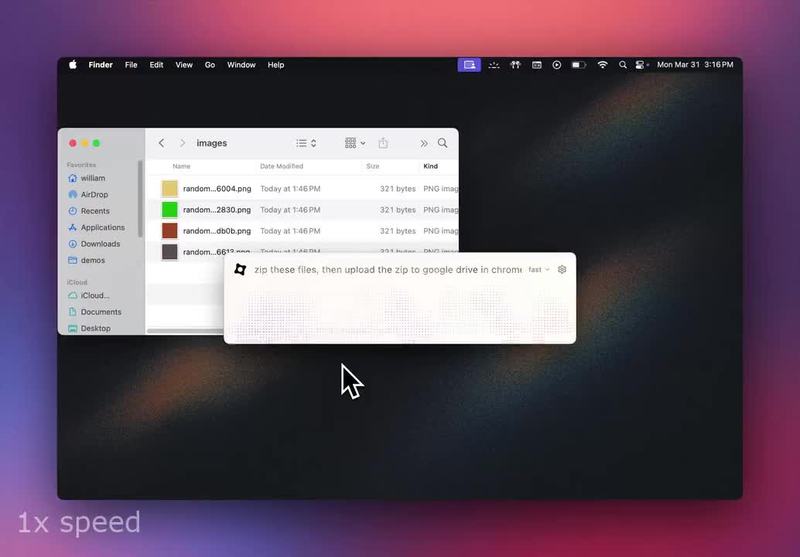 View full-size image: Poster for the General Agents demo with AI-generated audio description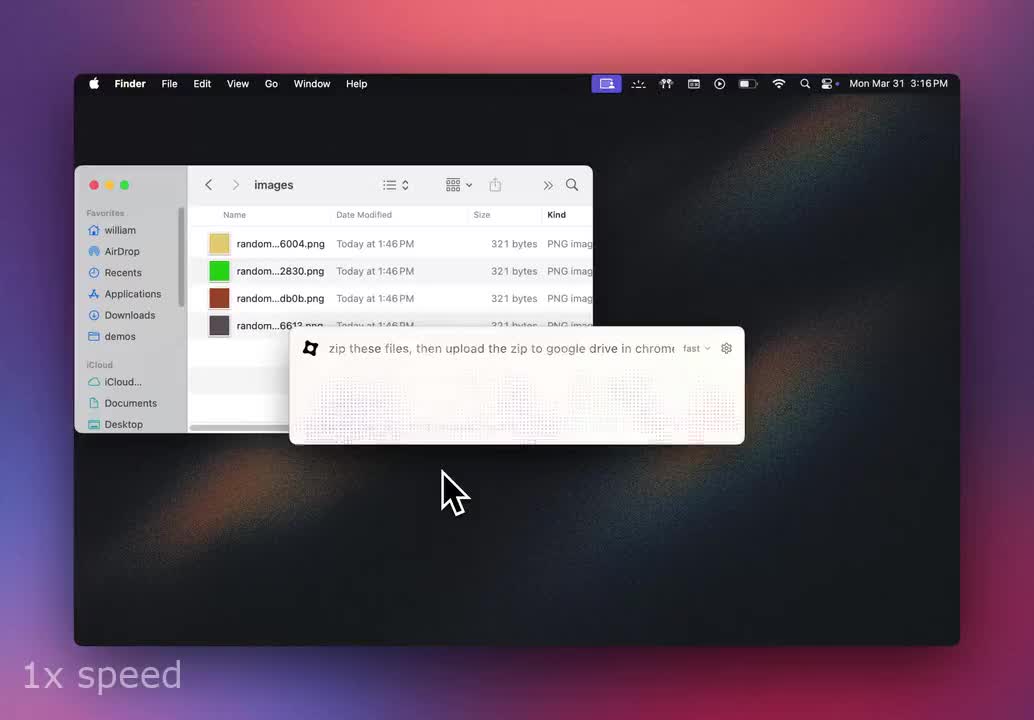
Watch the General Agents demo with AI-generated audio description (MP4). English automatic captions for the General Agents demo (VTT).
General Agents demo transcript, original automatic captions: Finder window shows 3 PNG images being zipped, zipping, uploading and sending. Link appears. A zip archive is created. The scene shifts to Google Drive. The archive is uploaded. The share button is clicked. Access is set to private for William Gus. A link is copied. A message is sent to Boss with the link. A green message bubble confirms delivery request completed appears.
Not bad for about an hour of tinkering. It’s nowhere near production-ready, so I’m not open-sourcing it yet, but it’s a fun example of what’s possible with today’s tooling, even on a tight timeline.
The Dystopian Future of Robotics
Security researchers Andreas Makris, CEO of thinkAwesome! GmbH, and Kevin Finisterre discovered a deliberate backdoor in the Unitree Go1 robot dog. Here's what they found:
- Anyone could access the robot's live camera feed without a login or alert
- Hackers could control the robot's movements remotely
- Once connected to Wi-Fi, the robot quietly opened a remote connection back to servers in China
Reporter Sam Sabin broke the story⁵ in Axios.
Forget the politics for a minute and consider the bigger picture. AI-powered robots will be part of our daily lives. But what happens when they’re not just smart, they’re watching, listening, and phoning home? This isn’t sci-fi anymore. It’s the ultimate Trojan Horse. And we urgently need to get ahead of it.
The Utopian Future of AI
Not all AI stories are dystopian. Googler Thomas Wagner used AI for something profoundly personal: helping his son.
After a diagnosis of Alexander disease (AxD), a rare, fatal neurodegenerative condition, Thomas turned to AI to interpret the overwhelming medical literature. It empowered him to reach out to leading scientists, armed with real understanding.
Watch the full story:
Watch Thomas’ story about using AI to understand Alexander disease on YouTube
Behind the Scenes of Image Understanding at Google
Google published an interesting blog post⁶ about how they use AI to understand images. Their infrastructure is impressive, and it’s unclear if other models even could replicate it.
AI Mode can understand the entire scene in an image, including the context of how objects relate to one another...Drawing on our deep visual search expertise, Lens precisely identifies each object in the image. Using our query fan-out technique, AI Mode then issues multiple queries about the image as a whole and the objects within the image, accessing more breadth and depth of information than a traditional search on Google.
Gemini Live: Now Available to All Pixel 9 Users
I've mentioned Gemini Live before. Previously limited to AI Studio, Gemini Live is now available to everyone with a Pixel 9 or Gemini Advanced subscription. Just point your phone’s camera and talk to it. The system will describe and interpret your environment in real-time.
 View full-size image: Poster for the Gemini Live demonstration
Watch the Gemini Live demonstration (MP4). English captions for the Gemini Live demonstration (VTT).
Gemini Live demonstration transcript, original English captions: [Song: "Got What You Want (instrumental)" by The Nah] ♪ ♪ Whoa. ♪ ♪ Gemini, what kind of shark is that? [Gemini]: That’s a Zebra Shark. [Gemini]: They're also sometimes called Leopard Sharks. [Gemini]: Zebra Sharks are pretty easy to spot [Gemini]: because of their unique spots and stripes. Hmm, nice. What about the black and yellow one? [Gemini]: That’s called a Batfish. And who is this big guy? [Gemini]: That is a Queensland Grouper. [Gemini]: They can grow to a length of over eight feet long [Gemini]: and weigh over 800 pounds. [Gemini]: Would you like to know anything else about the Grouper? Actually, yeah.
It's not hard to see how this product is a fantastic technology that serves everyone, including People with Disabilities.
OpenAI the Book(s)
Sam Altman tweeted:
there are some books coming out about openai and me. we only participated in two, one by keach hagey focused on me, and one by ashlee vance on openai.
Vance is the only journalist allowed behind the scenes at OpenAI.
15 Years at NAB and a Killer Accessibility Panel
This was my 15th year at NAB. Huge shout-out to Lesley Peña for organizing the Accessibility Track (with help from Tim).
I had the pleasure of moderating a panel on AI’s Potential to Revolutionize Accessibility with a fantastic crew:
- Rebecca Avery, content ops guru
- Dan Caddigan, CTO of 3Play Media, fellow AI junkie
- Ariel Simms, President and CEO of RESPECT-ABILITY
- Storm Smith, Adage 40 under 40
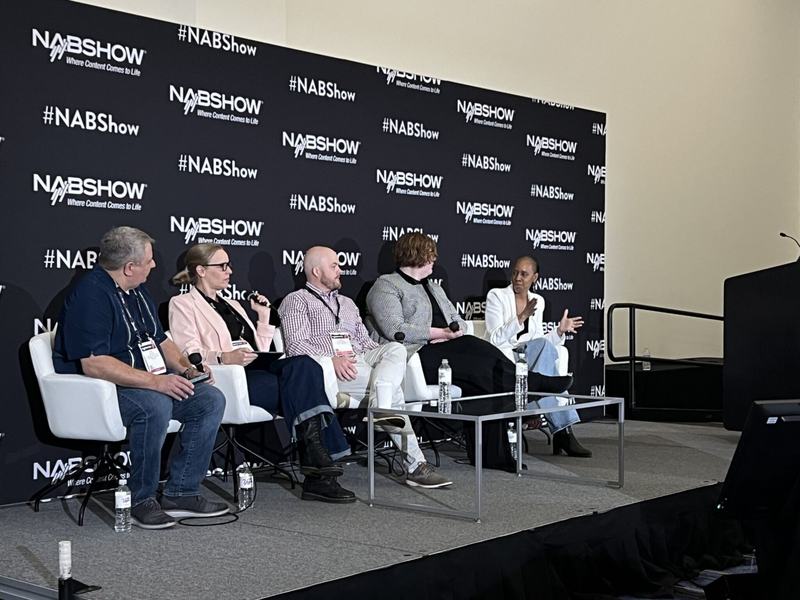 View full-size image: One moderator and four panelists sit on stage at the NAB Show in front of a black backdrop with repeated “#NABShow” and “Where Content Comes to Life” logos. The panelists are seated in white chairs with microphones and water bottles in front of them.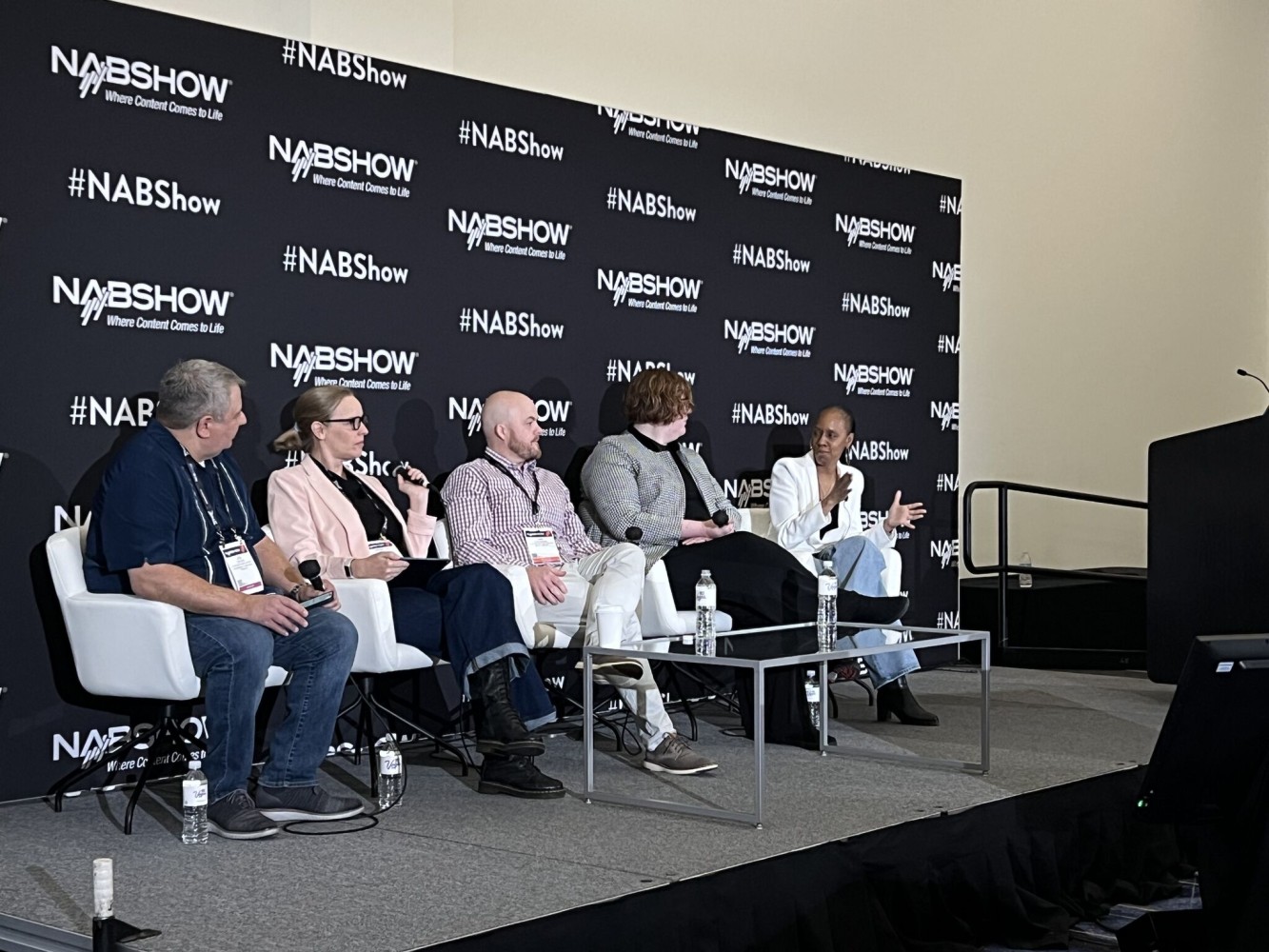
Panel at NAB
Accessibility and Gen. AI
We just dropped a new episode featuring Dylan Barrell, CTO of Deque Systems, Inc. Eamon McErlean and I really enjoyed this special conversation:
Looking ahead to Episode #9, we are going to interview the one and only Matt Ater, SVP at Vispero®. Matt is knowledgeable about everything accessibility, screen reader and AI for Accessibility.
Editorial correction, October 5, 2026: The original edition said Episode #8. Dylan Barrell’s interview above was Episode 8, and the Matt Ater interview was released as Episode 9.
Quick note
As always, I’ve got way more stories to tell than the time to share them. I’m grateful, there are now over 1,100 of you subscribing to this newsletter. Not bad for one month in.
A couple of weeks ago, I planted a little Easter Egg to see who reads to the end. Only one person played along. Eric Franzon, thank you. Let's make it a tradition. This week, try to work the phrase "Llama Drama" into the comments.