JDOT #9: AI Coding, CES, and AIMAC

January 20, 2026
Tags:
Joe Devon on AI-assisted coding, independent social media, accessibility at CES, accessible CLIs, and the AIMAC benchmark.
The Era of Human Coding is (already) over
I've been saying this moment would come in previous newsletters, but it happened way faster than I thought it would.
 View full-size image: David Heinemeier Hansson, also known as DHH, speaks passionately into a microphone on the Lex Fridman Podcast. He gestures with both hands while wearing a black Basecamp t-shirt, seated in a dimly lit studio with shelves and plants in the background. Subtitle reads: "that way of writing is I can literally feel competence."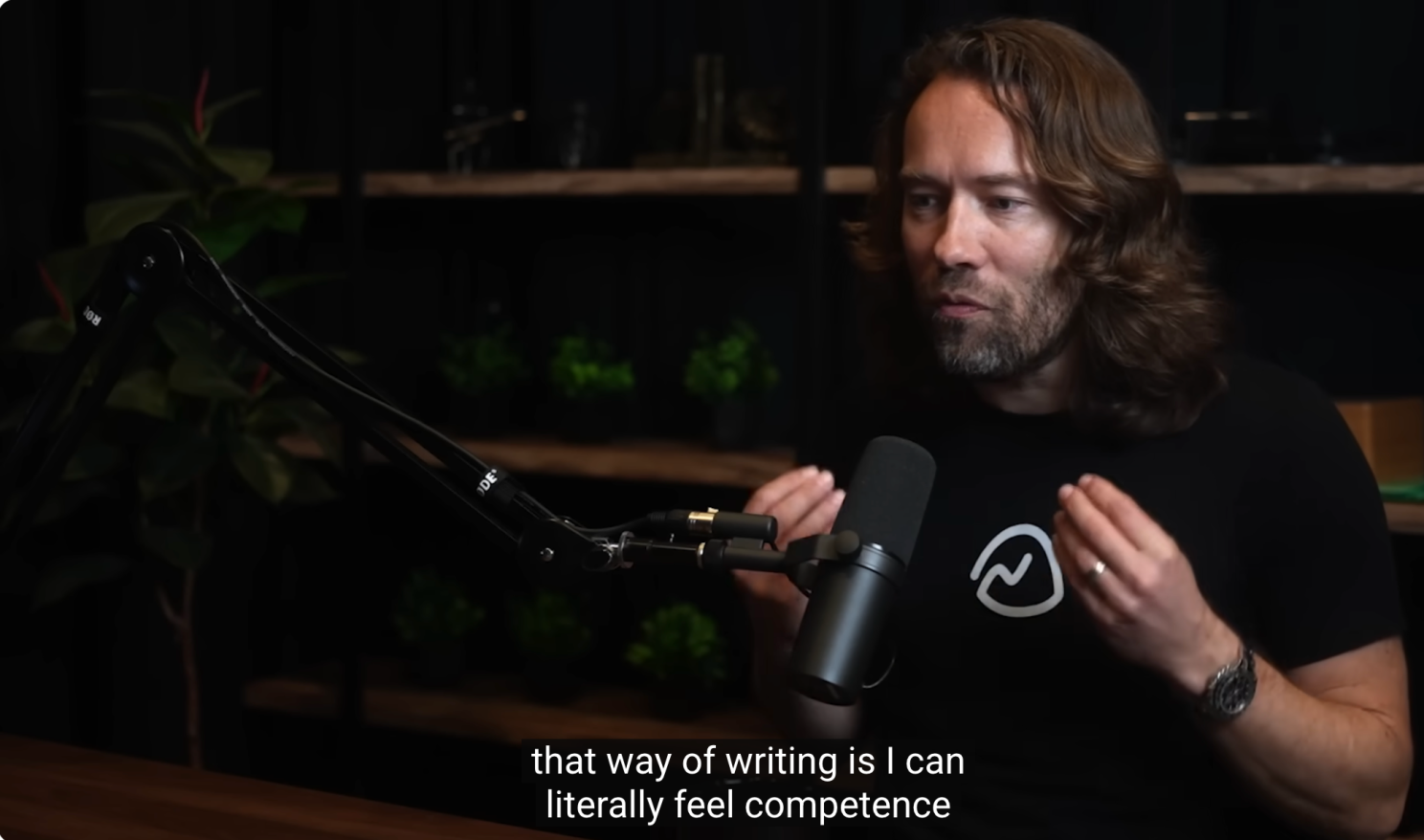
DHH on Lex's podcast
6 months ago, Ruby on Rails creator, DHH, was interviewed by Lex Fridman, saying that when he codes with AI "I can literally feel competence draining out of my fingers." ¹ Now he says:
It turns out half the resistance was simply that the models weren't good enough yet! I spent more time rewriting what it wrote than if I'd done it from scratch. That has now flipped. — DHH
Today, Ryan Dahl, the creator of node.js caused a bit of stir, saying:
The era of humans writing code is over. Disturbing for those of us who identify as SWEs, but no less true. That's not to say SWEs don't have work to do, but writing syntax directly is not it. — Ryan Dahl
Several other prominent developers chimed in with similar comments. I thought we'd have holdouts for years. That the last dominos to fall would be stubborn, hardcore, opinionated programmers. Folks like Linus Torvalds, creator of Linux. He just fixed some issues with one of his side projects with an AI commit ² that said it was written by Google's AI app called AntiGravity:
Is this much better than I could do by hand? Sure is — Linus Torvalds
Wow. You can officially put a pin in it.
What does this mean for corporations, accessibility departments and you?
2026 is the year that either your company will change their coding practices, or they will fall behind competitors who do. Based on my conversations with most accessibility SMEs, few are prepared for this moment. It's actually quite urgent.
If you have a budget for AI + Accessibility and need help, hit me up. I spent most of 2025 AI coding, and will do the same in 2026, but I do have room to take on one more client.
What I'm reading
I used to really love social media, when it was made up of protocols (rss), destinations (twitter) and apps (reader) that allowed you to build a network of like-minded individuals with whom you could share your work.
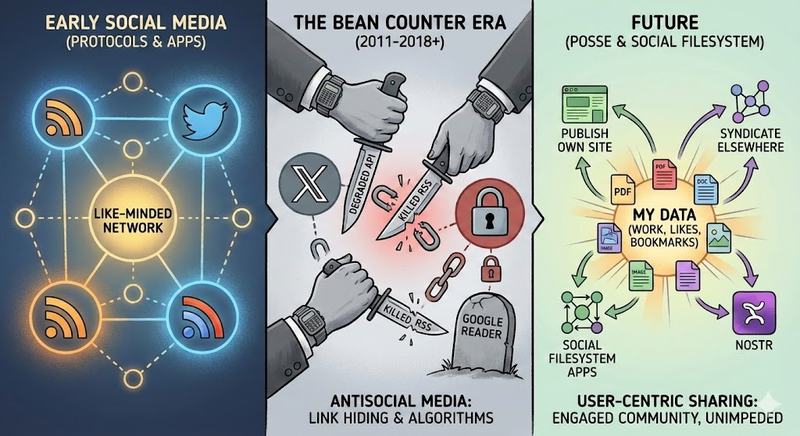 View full-size image: Three-panel illustration comparing social media evolution. Left panel shows "Early Social Media" with interconnected RSS and Twitter icons around a "Like-Minded Network." Center panel, titled "The Bean Counter Era (2011–2018+)," depicts suited hands stabbing RSS with knives labeled "Degraded API" and "Killed RSS," symbolizing control and suppression. A broken chain, padlock, and Google Reader gravestone represent lost openness. Right panel, titled "Future (POSSE & Social Filesystem)," shows user data at the center with arrows connecting to publishing, syndication, and social apps, promoting user-controlled, decentralized sharing.
AI generated image by Nano Banana that represents this section visually
We were stabbed in the back repeatedly starting in 2011. Some, like these examples, hurt more than others:
- Firefox killed the RSS icon in 2011 and core support for RSS in 2018
- Twitter discontinued its native RSS feed (June 2013) and slowly killed 3rd party apps culminating in a degraded API in August 2018
- Google killed Reader on July 1, 2013
Now "social media" is doublespeak for "antisocial media". We have to hide our links in comments in order to reach our own audience, and even those are getting dinged. Being charitable, well meaning techies create the technology companies, then once it takes off, hand it over to cheap, selfish bean counters who enshittify everything.
That's what makes POSSE ³, Publish (on your) Own Site, Syndicate Elsewhere, so appealing. It's the open source version of social media. But it takes a lot of work to set up compared to the ease of just using the popular sites. Which is a good lead in to an article ⁴ by Dan Abramov, iconic core contributor to React and creator of Redux.
He wrote about a social filesystem. I'm still absorbing it, but the general idea is that work apps feature your files at the center, like pdf files or word docs. They travel via email and shared links and are consumed by other apps.
Social media now keeps what should be your data locked in their platform. So their platform is at the center of sharing your work. He points out that our work, our likes, our bookmarks, should sit in the center and the "social" platforms should be consuming them. The article is a fun rabbit hole, featuring a variety of alternate applications with a different ethos than the antisocial media sites we frequent.
By the end of 2026, I'd like to be actively using or building on top of an approach like this, or like Nostr ⁵, which I'm fond of as well.
I'd gladly trade the 20K followers I have across a couple of platforms with 25 friends who are engaged in sharing our work with each other unimpeded.
OpenAI just released a multivendor protocol called Open Responses ⁶, which is an attempt to unify how "agentic" AI harnesses communicate. Currently, it's a big mess. The LLMs perform "Tool Calling", like reading files, surfing the web in different ways. It often eats up precious "context window" and is the cause of endless problems for the developers creating AI products like Claude Code, OpenCode, AIDER and more.
George Hotz wrote two important blog posts recently: "How do I stop participating" ⁷ and "You have three minutes to escape the perpetual underclass." ⁸
We need more builders who say "no" to building products in a manner that is unhealthy for our societies. Both great reads.
Accessibility at CES
I've been going to CES for about 15 years now, but thanks to the leadership of Stephen Ewell, the last 3 years have mostly been to see what's new in the world of accessibility.
I always felt that the industry would benefit from a conference here in Las Vegas. But now, CES serves as that conference. If you are involved in accessibility, circle CES as a must-see.
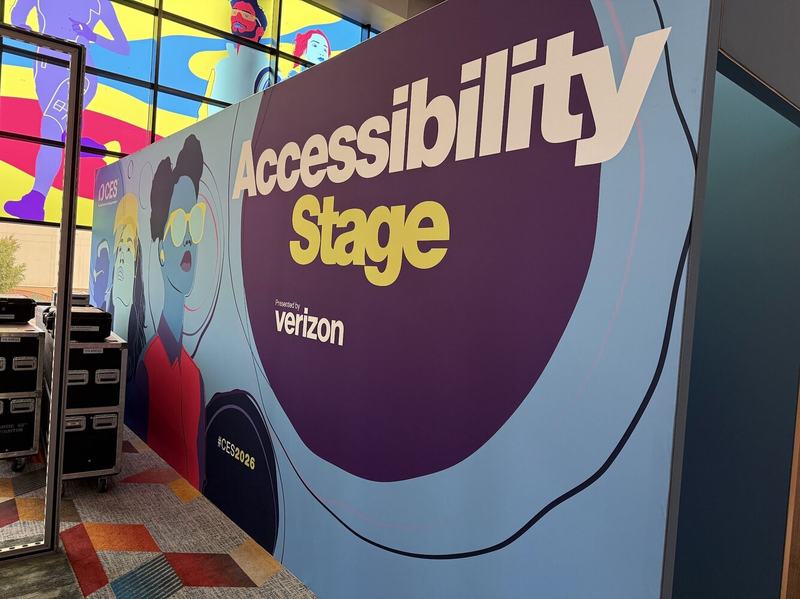 View full-size image: "Accessibility Stage" by Verizon.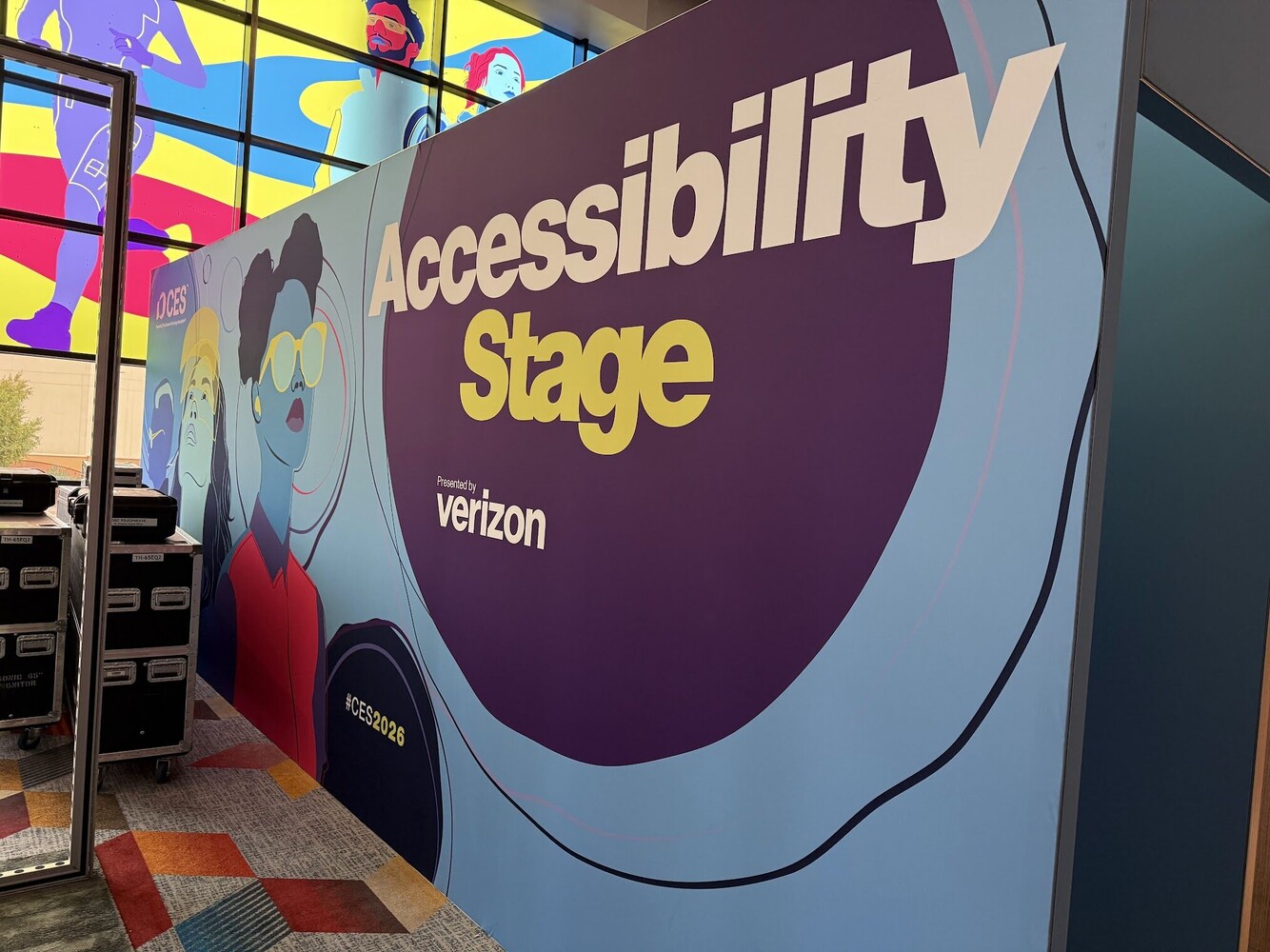
This year, to make that point even stronger, Steve partnered with Fred Moltz, the Verizon Chief Accessibility Officer, to create a dedicated accessibility stage. It was placed strategically above the popular Eureka Park area of the Venetian, where startups display their wares. It was an enormous success.
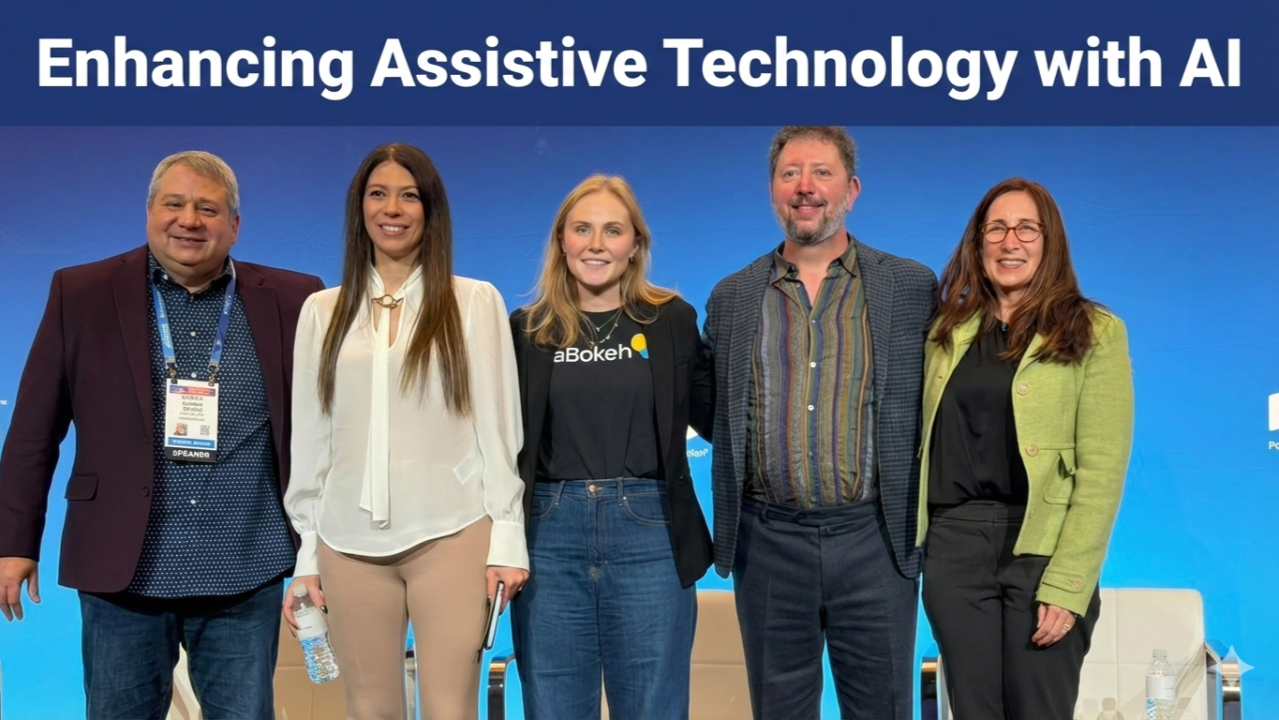
I really enjoyed CES. As announced in the last newsletter, I moderated a panel with Peter Korn, Marilyn Morgan Westner, Rebecca Rosenberg and Daniela Braga, PhD. They were as smart as advertised and if the video gets posted, I'll share the link in the next newsletter.
Another highlight was getting interviewed ⁹ by the great tech journalist Tom Merritt for Daily Tech News Show.
The Accessibility of CLIs
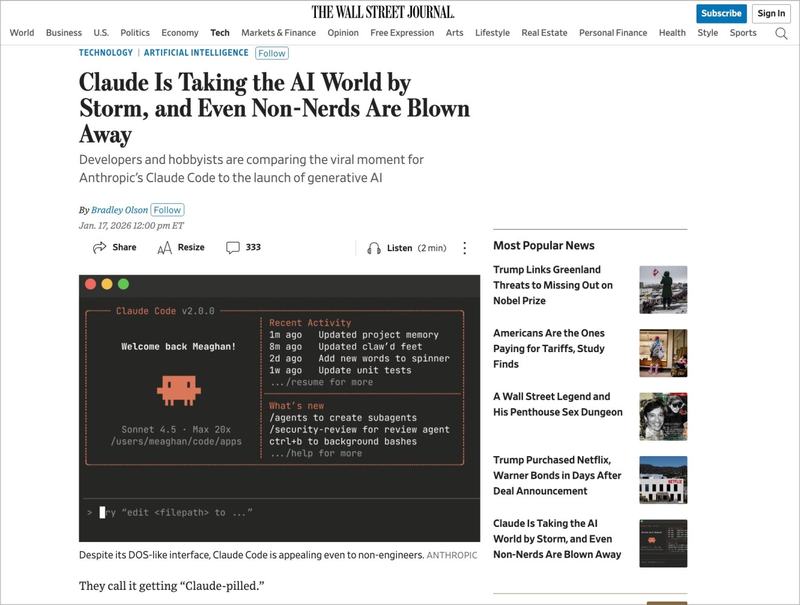 View full-size image: Wall Street Journal article titled “Claude Is Taking the AI World by Storm, and Even Non-Nerds Are Blown Away,” featuring a screenshot of a retro-style interface labeled "Claude Code v2.0.0" with a pixel art character, a terminal prompt, and activity logs such as "Updated project memory" and "Add new words to spinner." The subheadline notes Claude Code’s growing appeal beyond tech enthusiasts.
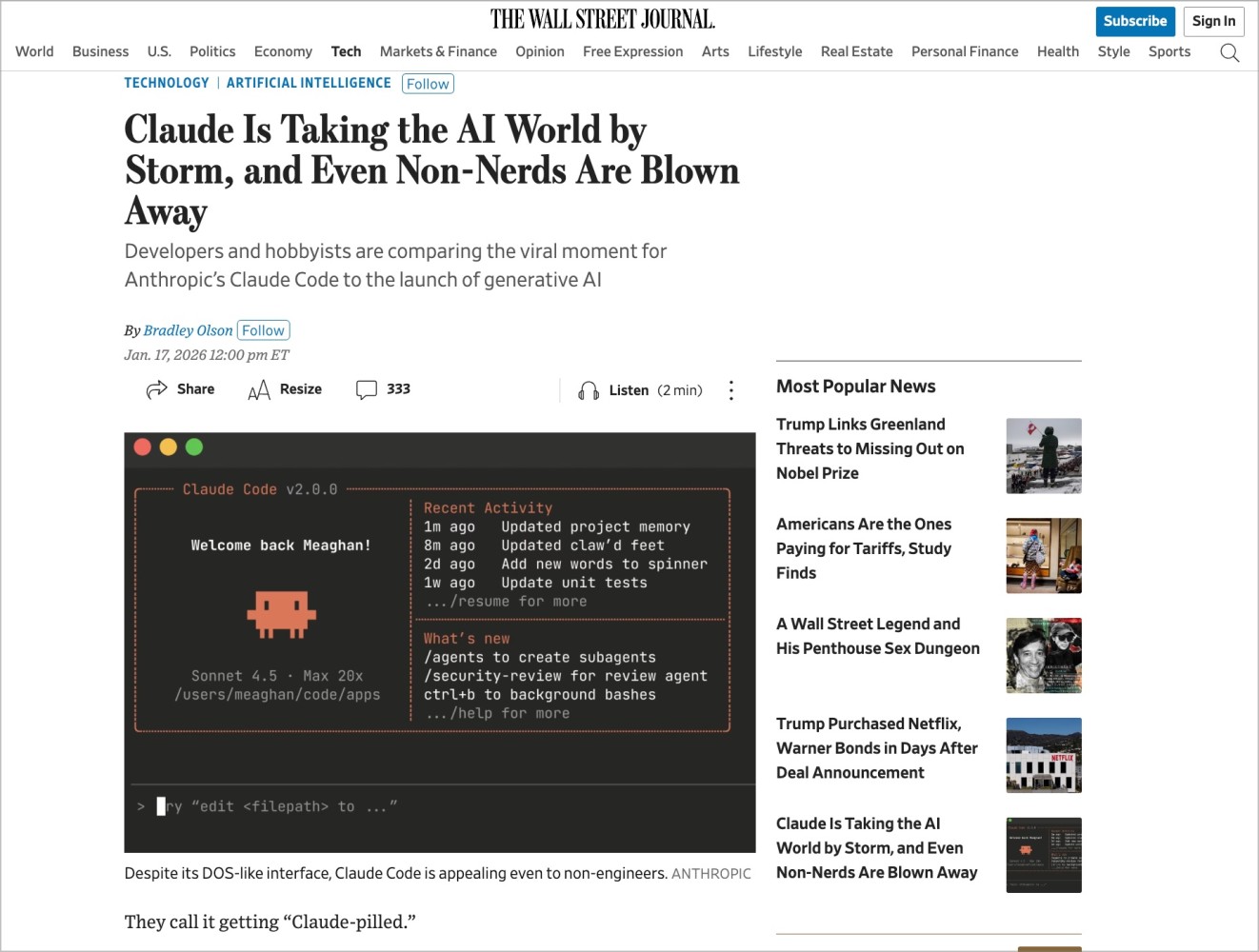
The hottest product in AI is a Command Line Interface (CLI) app called Claude Code. All the major players had to create their own CLIs because it's central to how AI-assisted coding works today. It has gotten so hot, that the Wall Street Journal covered it! For us "nerds" as their headline calls us, the last thing we'd have expected is a cover story on command line interfaces. Weird times we live in.
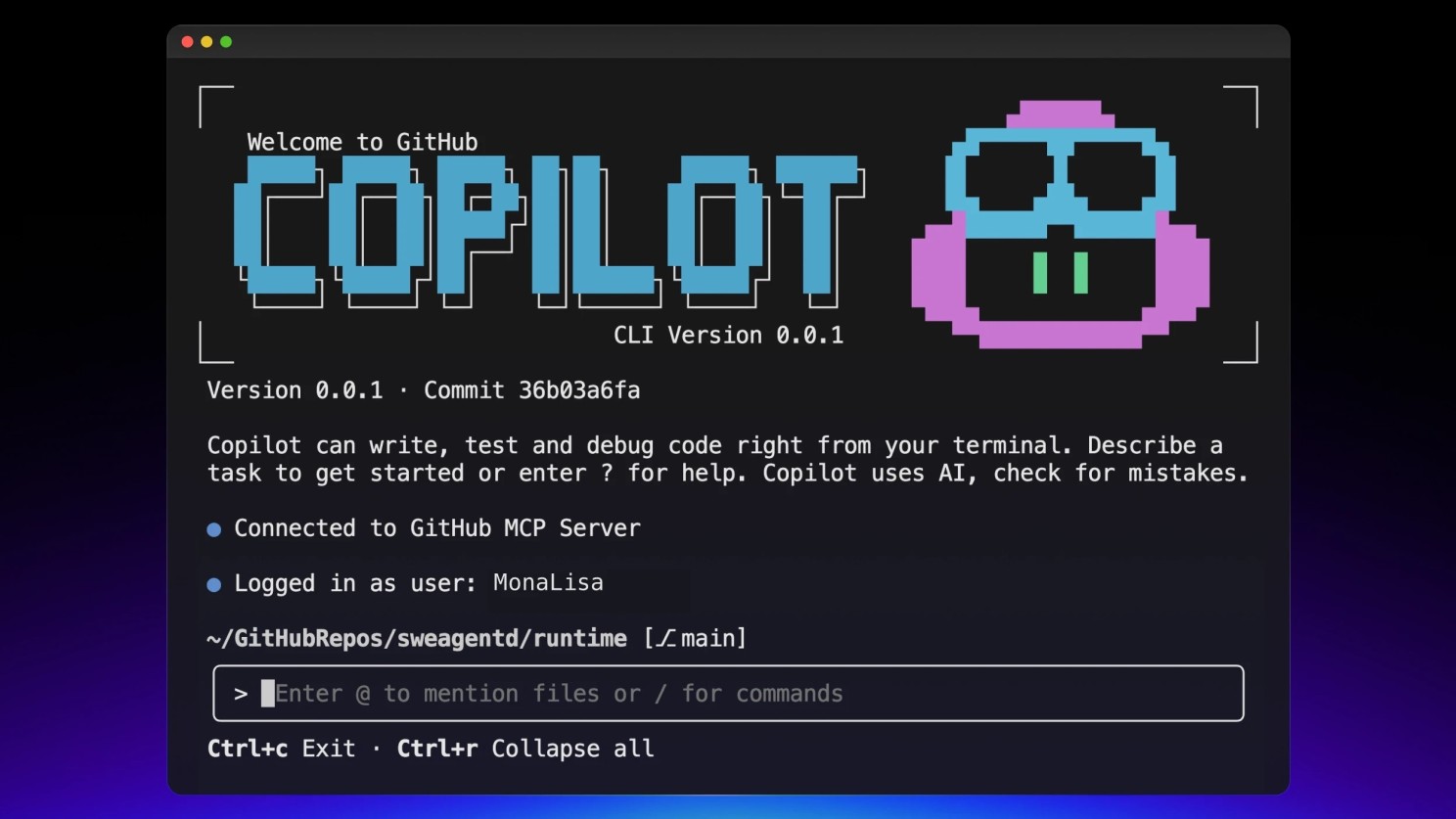
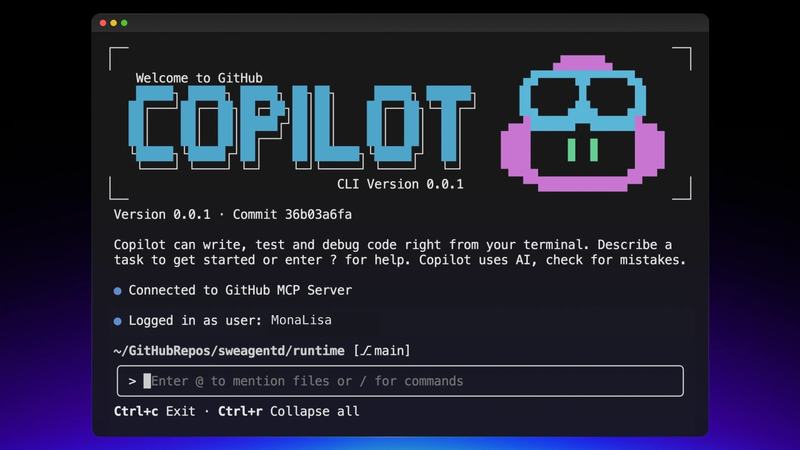 View full-size image: Terminal interface showing GitHub Copilot CLI version 0.0.1 with a pixel art logo. Text explains that Copilot can write, test, and debug code using AI. User is logged in as "MonaLisa" and connected to the GitHub MCP Server in the directory path ~/GitHubRepos/sweagentd/runtime. Input prompt and keyboard shortcuts for exit and collapse are visible.
Unfortunately, CLIs, despite being text-based interfaces, are notoriously inaccessible, as an article ¹⁰ on GitHub's blog highlighted. I've been thinking about adding some testing on the accessibility of CLIs to our AIMAC benchmark. But we'd need more sponsorship to pay for that.
At least one Screen Reader user I know uses Claude Code. But he told me it isn't very accessible. Well good news! This weekend I learned that GitHub released their own CLI ¹¹ that competes with Claude Code. It's getting great reviews on its own merit.
Knowing GitHub, I figured that Ed Summers would ensure it is accessible. But I wanted to see some metrics.
So I asked Claude Code to look at the GitHub repos of the top CLIs. This is no replacement for proper manual testing, but for a quick gut check, you can tell how much a project prioritizes accessibility by looking at how responsive they are to accessibility bug reports. After scraping the repos and looking at the open and closed accessibility issues, here is Claude Code's scoring:
"Rankings:
- GitHub Copilot CLI - Most polished: dedicated flag, persistent config, audible notifications, no critical bugs
- Gemini CLI - Feature-complete but buggy: has all the features, but P0 Windows bug and text repetition issues hurt usability
- OpenAI Codex CLI - Functional: animation controls work, but no dedicated screen reader mode
- Claude Code - Nothing: zero accessibility features, open issues ignored for months"
I haven't tried it yet, but if you're a screen reader user, please check it out and report back!
AIMAC Update
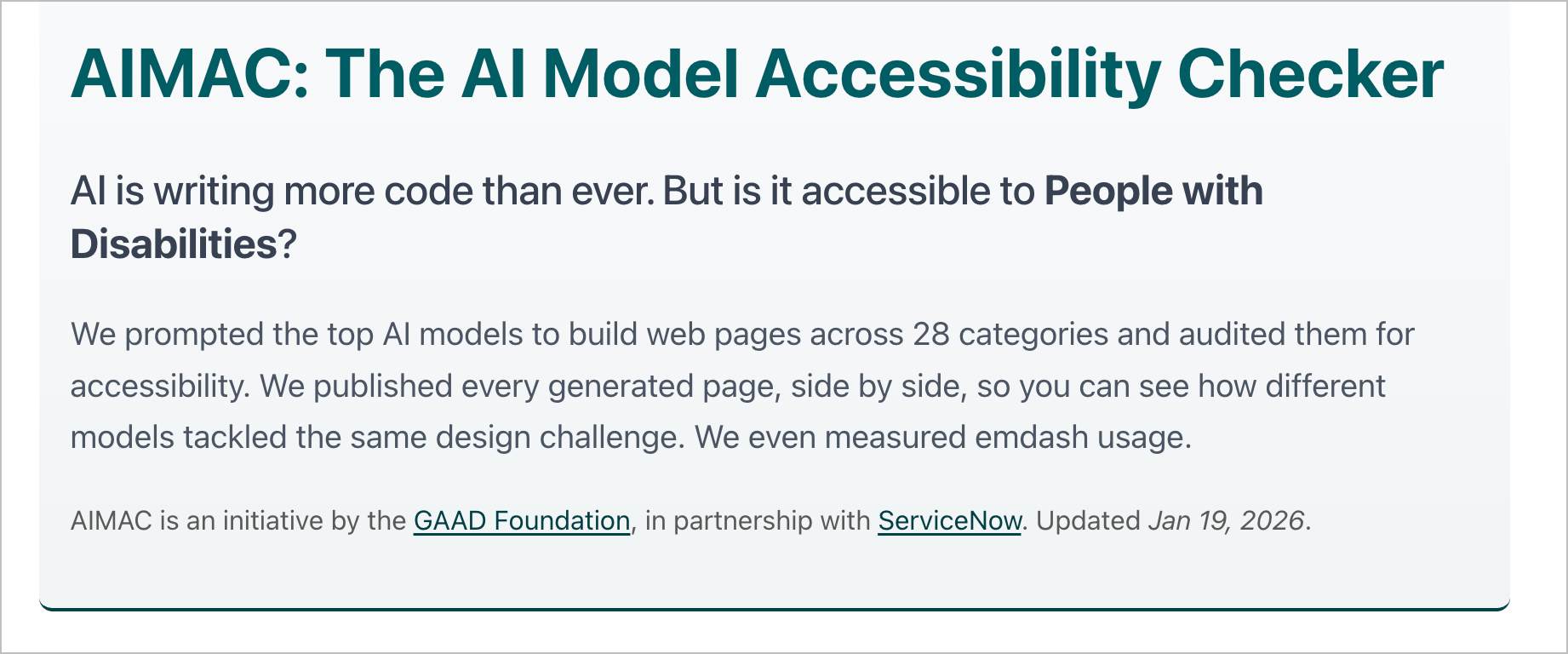
Announcing an update to AIMAC ¹², our accessibility benchmark.
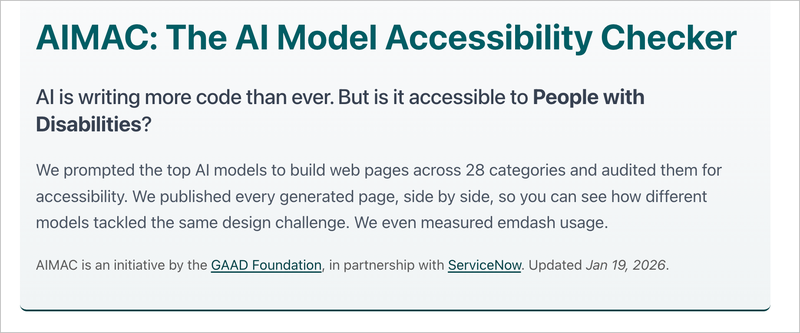 View full-size image: Banner for AIMAC: The AI Model Accessibility Checker, questioning if AI-generated code is accessible to people with disabilities. It explains that top AI models were prompted to create web pages in 28 categories, which were then audited for accessibility and published side by side for comparison. Initiative by the GAAD Foundation in partnership with ServiceNow, updated January 19, 2026.
What Changed
Two models were retired, two replaced, and one added:
- GPT 5.1 Codex was ranked #3 and is replaced by GPT 5.2 Codex at #2. OpenAI's newer model improved accessibility over its predecessor, knocking GPT 5.2 from 2nd place to 3rd. They are virtually tied.
- KAT Coder Pro V1 free was ranked #14 and is replaced by KAT Coder Pro V1 at rank #10! The reason for this change is that on OpenRouter, they were offering only a free version of this model until January 12. The paid version only cost 22 cents to generate.
- The new GLM 4.7 Flash model. Zhipu AI's latest Flash model enters at rank #20. Flash models are so named because they tend to be variants of the base model that respond much faster.
Impact: KAT Coder Pro V1 pushed Anthropic out of the Top 10, with Claude Haiku 4.5 now at #11.
See you next time!