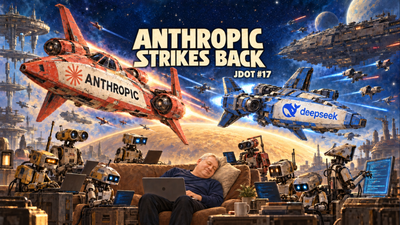
JDOT #17: Anthropic Strikes Back, open source AI rocks, and my swarm writes code while I sleep.

October 5, 2026
Tags:
I try DeepSeek, return to Opus, and nap while my AI swarm writes code. Plus Darryl Adams on the podcast, new AIMAC results, and October accessibility events.
 View full-size cover image
Plus a new pod with Darryl Adams and a big AIMAC update
The more technical parts are at the end under Nerd Corner, so everyone can read the first part.
New pod drop: Darryl Adams
A new episode of the Accessibility and Gen AI Podcast is out this morning. Eamon McErlean and I talk with our friend Darryl Adams, founder of Access Insights and former director of accessibility at Intel.
A few years ago, Darryl gave me an idea I have repeated ever since. AI is personal. It can hand each of us information in the form that works best for us. Audio for someone who is blind. Visuals for someone who's Deaf. Perhaps haptics for someone who is DeafBlind (though many are skeptical about how effective haptics are). My first AI keynotes were built on that idea.
Have you ever been asked to guide a blind person and wondered if you were doing it right? Darryl explains what good sighted guiding takes while I share a blunder I once made while guiding Jennison Asuncion.
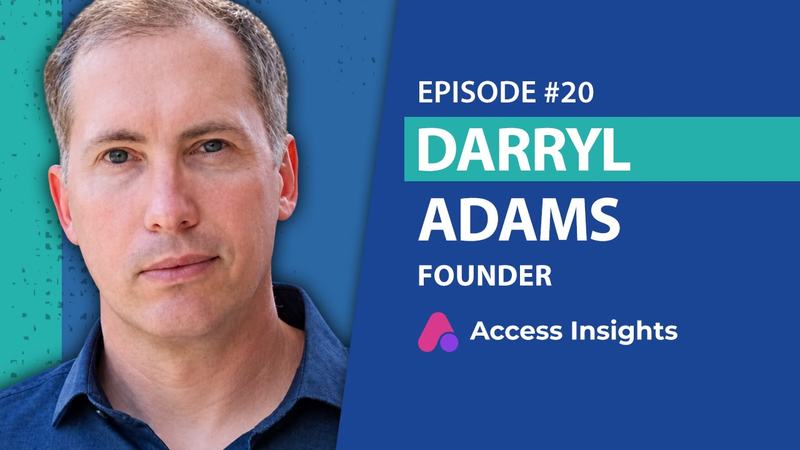 View full-size image: Episode 20 thumbnail: Darryl Adams, Founder, Access Insights, pictured beside the podcast title.
Watch Episode 20 with Darryl Adams, founder of Access Insights, on YouTube
Sh%!t Claude Says
Here are a few favorites from my running series on agent missives:
Codex, mid-task: "Preparing final apology and explanation."
Claude: "You were right to push back. I was wrong twice, and the specifics matter."
Claude: "It's closed, and I'm done talking about it."
Claude: "Heads-up: your pasted list contains the word 'ultracode' ... That set off the trigger, so this question ran a 5-agent workflow that used about 545k tokens. Pasted text counts as typed." Me: "Thanks?"
Where I'll be in October
On October 19, I'm giving a talk at GitHub's Open Source Accessibility Summit in Raleigh. It is a free event alongside All Things Open. The summit teaches people to contribute to open source with accessibility in mind, whatever their experience level. Thanks to Ed Summers for always including me, and Maria Lamardo for going above and beyond the call of duty, in setting this up.
On October 27, Yumeng Ma and I will present our peer reviewed PACE research paper at the ASSETS conference in Porto, Portugal. PACE is the first follow up to AIMAC, the AI Benchmark created by the GAAD (Global Accessibility Awareness Day) Foundation in partnership with ServiceNow.
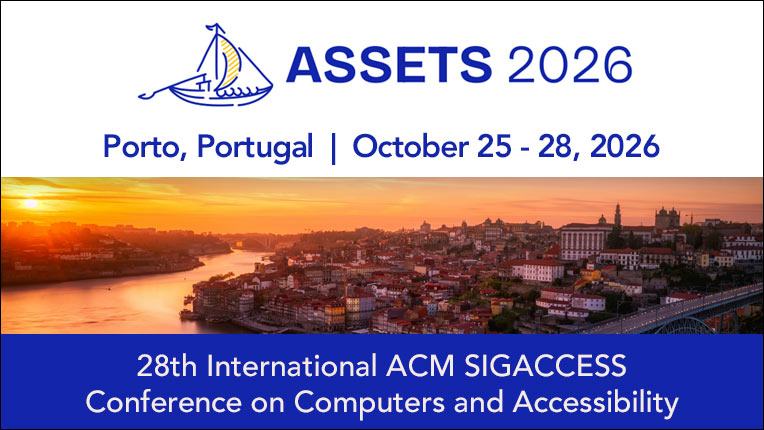 View full-size image: ASSETS 2026 conference banner with a Porto sunset skyline.
Text reads: "Porto, Portugal | October 25 - 28, 2026"
and "28th International ACM SIGACCESS Conference on
Computers and Accessibility."
View full-size image: ASSETS 2026 conference banner with a Porto sunset skyline.
Text reads: "Porto, Portugal | October 25 - 28, 2026"
and "28th International ACM SIGACCESS Conference on
Computers and Accessibility."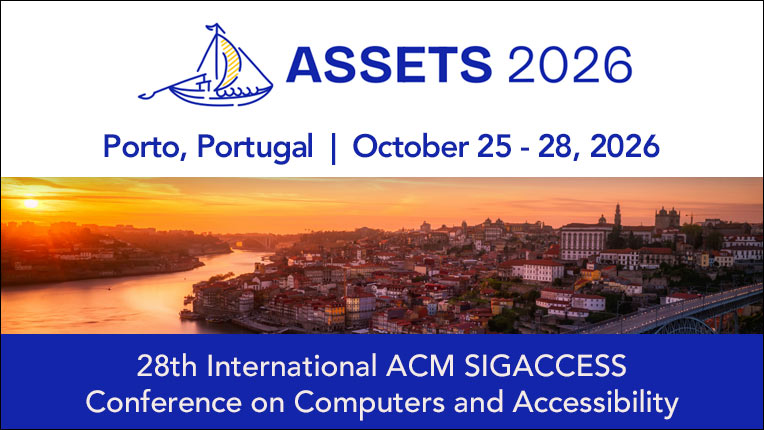
ASSETS 2026, Porto, Portugal
PACE asks AI to build common online form components, then measures how accessible they are. The session runs from 2:00 to 3:20 p.m., Porto time. Yumeng led the paper, with a team of us assisting in weekly sessions. Thanks to Microsoft for assisting this work with funding the work of several team members. Explore the PACE dataset.
If you live in Raleigh or Portugal, drop me a line, I'd love to connect.
Massive AIMAC update
Speaking of AIMAC...
AIMAC measures how accessible the websites built by AI models are. The October 3 update adds 10 models, for a total of 70 models from 28 companies.
OpenAI still holds the top two spots, with some older models. Its newer models all rank a bit lower unfortunately.
Opus 5.5 is my new daily driver, by Anthropic. Unfortunately, it ranks #49 of 70. All of Anthropic's bigger models land in the bottom half. Its smallest model, Haiku, does best at #33.
So how can I use it as a daily driver? Because my workflow has a strong accessibility gate that generates Acceptance Criteria where needed. Charlie Triplett and I have submitted a CSUN workshop that teaches how it works. If it gets accepted, come learn it with us.
Ben Ogilvie and I also submitted an AIMAC talk to California State University, Northridge, where I cover the latest updates and Ben discusses how ArcTouch is applying its learnings.
On the plus side with Anthropic, AIMAC had raised concerns about the instructions Claude follows when it designs the look of a website. Anthropic released an update to the instructions on September 2nd that asks for visible keyboard focus, reduced motion, and accessible color palettes. Yay!
The Gaadys are coming to GitHub
In partnership with Fable, The Gaady Awards celebrate companies and teams that make accessibility core to how they build digital products. This year's ceremony is Thursday evening, December 10, at GitHub HQ in San Francisco.
Registration is free. This year's winners are Accessibility Up to 11!, The College Board, Samsung Electronics, University of Melbourne, and WeWALK. Come celebrate them with us.
Nerd corner
Thirteen years ago this week, Raffi Krikorian gave a presentation at the Zanuck Theatre on the Fox lot. He was Twitter's VP of Platform Engineering at the time and showed our LA Web Speed meetup how Twitter had to rebuild itself to handle its growing scale.
People still bring that talk up to me.
Since then, Raffi has run Uber's self-driving center in Pittsburgh and served as the first CTO of the Democratic National Committee. He became Mozilla's CTO in September 2025.
Mozilla's State of Open Source AI Report
Under Raffi's leadership this summer, Mozilla published its first "State of Open Source AI" report.
"The best open model trails the closed leader by three points at 60% of the price"
In Mozilla's survey of 954 professional developers, 79% use open models. Only 51% have put them into production, compared with 63% for closed models.
Here is an anecdote to show you how far Open Source AI has come. Last month I "ran out of AI", and ended up making an open source model my daily driver to see me through the drought.
You see, I pay $200 a month each for AI coding plans from OpenAI and Anthropic. Each plan comes with a usage limit. When you hit it, you are stuck with no AI until the limit refills, or sometimes they grant you a "reset".
A hidden Codex "feature" ate my limit
In mid-September, my OpenAI plan started draining fast. It went to zero, then I got a reset, but two days later I hit zero again, on a day I had barely touched Codex.
Claude Code helped me find the culprit. It was Chronicle, a retired Codex feature that records your screen. I had turned it off in July. It had quietly switched itself back on, and the settings no longer even showed a switch for it. It wrote 956 summaries of my screen in about 24 hours, burning through my limit.
I wrote it up, and the post got 190K views. Four days later, OpenAI's Ari Weinstein replied: "Thanks so much for the report, Joe. This is now fixed!"
Meanwhile, Fable, Anthropic's priciest model, was munching through my Claude plan. My OpenAI plan was blown, and my Anthropic plan was almost gone. What's a "Vibe Engineer" to do?
An open model became my daily driver
While waiting, I saw that Noemi Titarenco kept talking about how well DeepSeek models work. So I tried it! I switched to DeepSeek Flash as my daily driver, with DeepSeek v4 Pro for the deeper thinking. DeepSeek is a Chinese AI lab that publishes its models under an open license, so anyone can download and run them.
I used DeepSeek's API through Pi, an open source coding harness like Claude Code, but it lets you switch among models from different companies. AI usage is counted in tokens, chunks of text about three quarters of a word long in English. A couple of days later, I posted:
I have used 278,133,528 tokens on DeepSeek over Pi the last few days and it cost me a fortune. A whopping $3.54.
The code was top notch, and way faster than Claude or Codex.
A few days later I realized that I undercounted it. Without my permission, my agents had also sent some DeepSeek work through OpenRouter. That added a whopping $0.00253 to the tab!
DeepSeek held up for my work, and the total bill was $3.54.
Anthropic strikes back
For months, many of us had been saying that OpenAI caught up to Claude Code. Codex CLI has been the quality leader for the last 4-6 months.
Then Anthropic released Opus 5.5 on September 22 to great fanfare. Now that they had an answer to OpenAI's recent models, Thariq, an Anthropic developer, publicly admitted the failings of their recent models. I waited a few days to see whether it lived up to the hot takes. It did. Anthropic is back in the lead.
Like many Anthropic models, Opus 5.5 has a 1 million token context window. Wanting to avoid hitting rate limits again, I did a bit of research. I had been using a trick to get the Codex models to serve up to 800K token windows instead of their official max of 272K tokens. However, I didn't realize that their pricing doubles input and cache rates, and is 1.5X for output above 272K tokens. So I removed that setting, and now make sure to run the Codex models differently.
I now skip the priciest models, Anthropic's Fable and OpenAI's Astra. As a result, both of my plans stay within their limits.
ICYMI, Saturday Night Live satirizes Dario Amodei's Interviews
If you've been following this newsletter, you know that Dario Amodei, the Anthropic CEO, loves to go on interviews and scare the hell out of everyone about AI. That it will take all our jobs. That it has a 10% chance of destroying humanity. You know, the usual type of PR that CEOs are supposed to do to promote their company's products.
Well SNL caught on and they made one of their best bits in years. Watch the SNL Dario Amodei skit on YouTube. You don't want to miss this one, it's hilarious!
I napped while using a swarm to build a swarm builder
A swarm is a team of AI agents working on the same project at once.
I had been using Jeffrey Emanuel's Agentic Coding Flywheel, his set of open source tools for running teams of coding agents. He pays for 60+ AI coding subscriptions for over $10,000 a month.
His system is wonderful, but it strains my Claude Code and Codex $200 plans. I needed something cheaper to run. So I built my own software factory, as the kids say, on top of some of his tools. One agent acts as the project manager. It hands each task to a worker, and a reviewer from a different AI company checks the work.
Every task lives in Beads, an issue tracker built for AI agents. It's like Jira for AI. The agents coordinate through Jeff's MCP Agent Mail, which is like Gmail for agents.
My agents kept rereading old mail, and sometimes they could not find new mail. So I changed how mail gets delivered. Now the sender rings a "bell" at the model's doorstep. An idle agent wakes up, and a busy one checks when it finishes its turn.
I needed a tool to launch my swarms, so I had a swarm build it. It took one day. At some point, I was exhausted. I told the swarm to use its best judgment on the questions it normally brings to me. I napped for an hour and woke up to a finished tool.
The next big run lasted about 22 hours and used 55 agents. There were 19 workers, 25 reviewers, 3 project managers, 4 watchers, and 3 helpers. One Sidekick was the only agent allowed to talk to me. The swarm built five sign-in and account features for a stealth project I'll tell you about next time.
The swarms are directed to self-heal. They flagged 14 bugs and fixed 13 before even mentioning it to me.
Jevons paradox describes how greater efficiency and lower costs increase total use of a resource. Cheap agents have me knocking out work at a pace I never thought possible.
I no longer believe the clankers will take our jobs. I believe Jevons paradox will make more jobs.