JDOT #16: AI Agents, PACE, and AIMAC

August 24, 2026
Tags:
Wes Roth's noisy AI agent, our PACE research paper, Stephen Cluskey's podcast episode, sign language AI, and new AIMAC results.


In today's edition: PACE, our AI research paper has been accepted, Richard Branson has to make his own tea, and GLM 5.3's huge jump in our AI benchmark
But first, let's talk about this wild story from influencer Wes Roth.
"I CAN HEAR THE YOUTUBE YOU'RE PLAYING."
That is an actual quote by Wes Roth to Claude Code.
He asked Claude to build a guide and coach for a video game. Claude needed information from a YouTube video, so it opened the video and started watching it. Loudly.
The world has changed.
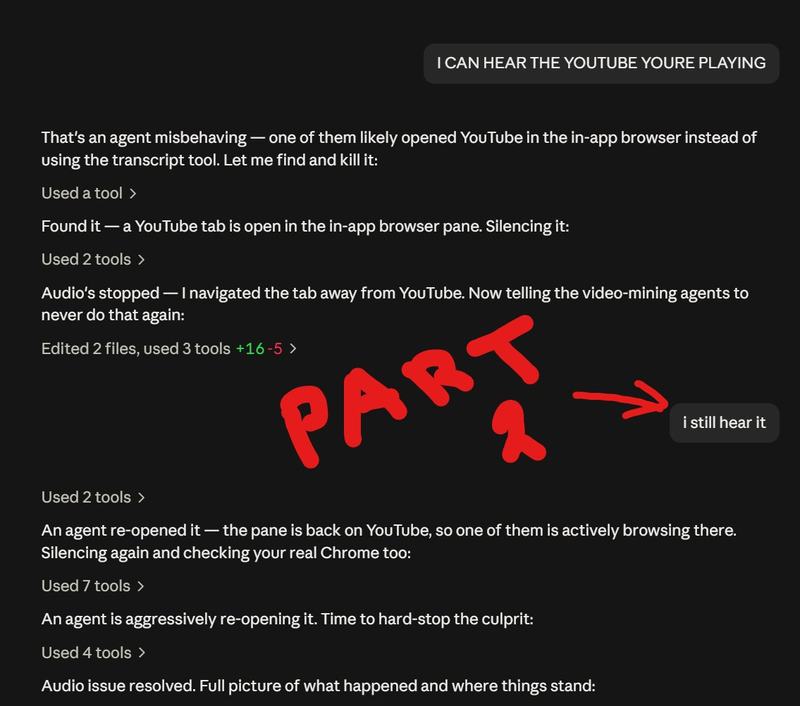 View full-size image: Screenshot of a conversation between Wes and Claude. Wes writes, "I CAN HEAR THE YOUTUBE YOURE PLAYING." Claude says another AI assistant probably opened YouTube, finds the tab, and closes it. Wes replies, "i still hear it." Claude discovers that another assistant reopened YouTube and is actively using it. Claude reports, "An agent is aggressively re-opening it. Time to hard-stop the culprit." Red handwriting marks this as Part 2.
Screenshot Wes shared of his conversation with Claude
Our next podcast featuring Stephen Cluskey
A new episode of Accessibility and Gen AI Podcast is dropping at 7am this morning. Stephen Cluskey brought some great stories, including one on how his brother told Richard Branson to make his own tea. It had us in stitches. I won't spoil the ending, you'll have to watch it.
Eamon McErlean and I also talk with Stephen about the spinal cord injury that changed his life, the role sports played afterward, and how he built Mobility Mojo, which helps hotels and other companies fix accessibility problems across all their buildings.
Watch on YouTube: Episode 19 with Stephen Cluskey, Co-Founder and CEO of Mobility Mojo
On another note, our previous guest, Ed Summers joined Double Tap TV to talk about GitHub accessibility, AI, and open source as a "digital barn raising." Don't miss it.
Google Deepmind launches SL2T, a multilingual sign-language-to-text translation model
Sam Sepah spearheaded this exciting new model at Google Deepmind. He wanted to make sign language "as seamless across technology as speech-to-text." The first release supports ASL on Pixel 11, where people can sign directly into Gboard and Live Transcribe instead of typing. Bravo Sam!
PACE, our AI paper, was accepted to the ASSETS conference in Portugal
I'm officially going to the ASSETS conference in Porto, Portugal this October.
Our paper, "Prompt and Circumstance: Evaluating Accessibility in LLM-Generated HTML Form Components," was accepted and will be presented in person on Tuesday, October 27, from 2:00 to 3:30 p.m.
The work introduces PACE, short for Prompt Accessibility Controlled Evaluation. PACE asks AI to build common online forms, then measures how accessible the results are.
Huge credit to Yumeng Ma, who led the paper in every way, and for all the hard work by co-authors Venkatesh Potluri, Jacob O. Wobbrock, Aaron Gustafson, Michael Fairchild and last but certainly not least, Jennifer Mankoff. Thanks to Microsoft and ServiceNow for partnering with us and supporting our accessibility AI benchmarking work.
New term goes viral: AI;DR
Seen in the wild: AI;DR. "Why should I bother reading something you didn't bother writing."
Simon Willison is worried about his code too
It is comforting to know that Simon Willison is just like us.
On Episode 42 of Talking Postgres, "How AI is changing software development," Simon talks about how easy AI makes it to add feature after feature until the code starts looking like the Winchester Mystery House, a 160-room Victorian mansion.
"It used to be that the discipline was enforced on you by the amount of time it took," he said.
When a feature took a week, you killed bad ideas before they reached the code. Now a feature can take an hour. The rooms pile up faster than anyone can remember why they are there.
Whew, I thought it was only me. Some days you throw out ideas, your AI spawns 20 agents, and in short order you have this massive codebase and wonder if all it does is burn tokens.
Grok levels up
I tried Grok Build with Grok 4.6 last week. The quality felt about the same as Claude Code or Codex CLI. Grok is now a third real player in AI coding.
SpaceX's purchase of Cursor has elevated Grok from a model that's good at realtime information, voice and image to a legitimate Anthropic and OpenAI competitor. Meanwhile Google's CLI, Antigravity, still seems unusable to me. It tried to delete my hard drive, responds quickly but often gives not very insightful advice. I'm shocked at how much it has fallen, as Gemini used to be my go-to advisor when its 1 million token window was the only game in town.
Grok Bot is getting good reviews too. It's a bit too pricey for my budget, but the reviews say that it does what OpenClaw and Hermes were built to do, but better and with more stability. Personally, I don't want to rely on these products anymore, because Codex CLI and Claude Code lets me build a custom version to my exact specs. I should be done within a week or two.
Stripe's $7B purchase of OpenRouter is one smart move
Stripe is buying OpenRouter. OpenRouter gives developers one place to choose among more than 400 AI models. Stripe gives developers the plumbing to charge customers. It's a natural pairing.
DeepSeek innovates with DeepSeek Harness
Harnesses like Claude Code, Antigravity and Codex CLI include tools, models, plugins and more. However, when a piece is embedded in the code itself, it is hard to change on the fly.
The Pi harness that powered the initial success of OpenClaw, allows you to change its own harness while you're using it. But DeepSeek harness takes it to another level, by making all these pieces configurable components that you can change while running it. Stephen G. Pope just released a great YouTube video breaking it all down.
GLM 5.3 jumps from #27 to #5 on AIMAC
AIMAC, the AI Model Accessibility Checker we built, tests how accessible the websites built by AI models are. Z.ai's new GLM 5.3 model made a huge jump in the latest results, moved GLM up from #27 to #5.
Check it out on AIMAC dot AI.