JDOT #11: AI Voice or Victim

February 19, 2026
Tags:
Agent autonomy, accessible AI, new AIMAC benchmark results, and podcast conversations about inclusive design.
The A.I. Disruption We’ve Been Waiting for Has Arrived
My favorite saying about the Power of AI:
Before Claude Code, I had 2-3 side projects that I never quite finished. With Claude Code I am now working on 10-15 side projects that I'll never finish.
Paul Ford of the NY Times wrote an article about how AI allows you to resurrect old side projects and it's well worth the read. Via Simon Willison.
New Episode of Accessibility and Gen. AI Podcast
Many people have asked me to explain what our AI benchmark, AIMAC, is, how it works and what our goals are. You can only cover so much in a newsletter. Eamon McErlean and I decided to dedicate a podcast episode to this topic. We asked Jennison Asuncion to assist us by using a screen reader to test out a few web pages that AI Models generated. We've already got a fair bit of good feedback in the one day that the episode has been out. So go ahead and check out Episode 14 of Accessibility and Gen AI Podcast.
Many thanks to Tiffani Martin, MBA CSM CPOPM CRAIL (blind), Tim Dixon, CPACC and Matt Hetzel for writing about the episode.
Measuring AI agent autonomy in practice
Anthropic has released new research on what happens when we let autonomous AI agents run long sessions. The main takeaways are that autonomy is growing exponentially. No surprise. Claude Code's longest uninterrupted work periods nearly doubled in three months. They do discuss collaboration patterns. Experienced users seem to trust the models more and auto-approve twice as many sessions as newbies. But they also interrupt the models mid-session far more often. The last point I'll mention is that agents are beginning to regulate themselves better. As that happens, these agents will get more useful.
Correction, October 5, 2026: The original wording generalized this finding to sessions overall. Anthropic measured a near-doubling in the longest periods of uninterrupted Claude Code work.
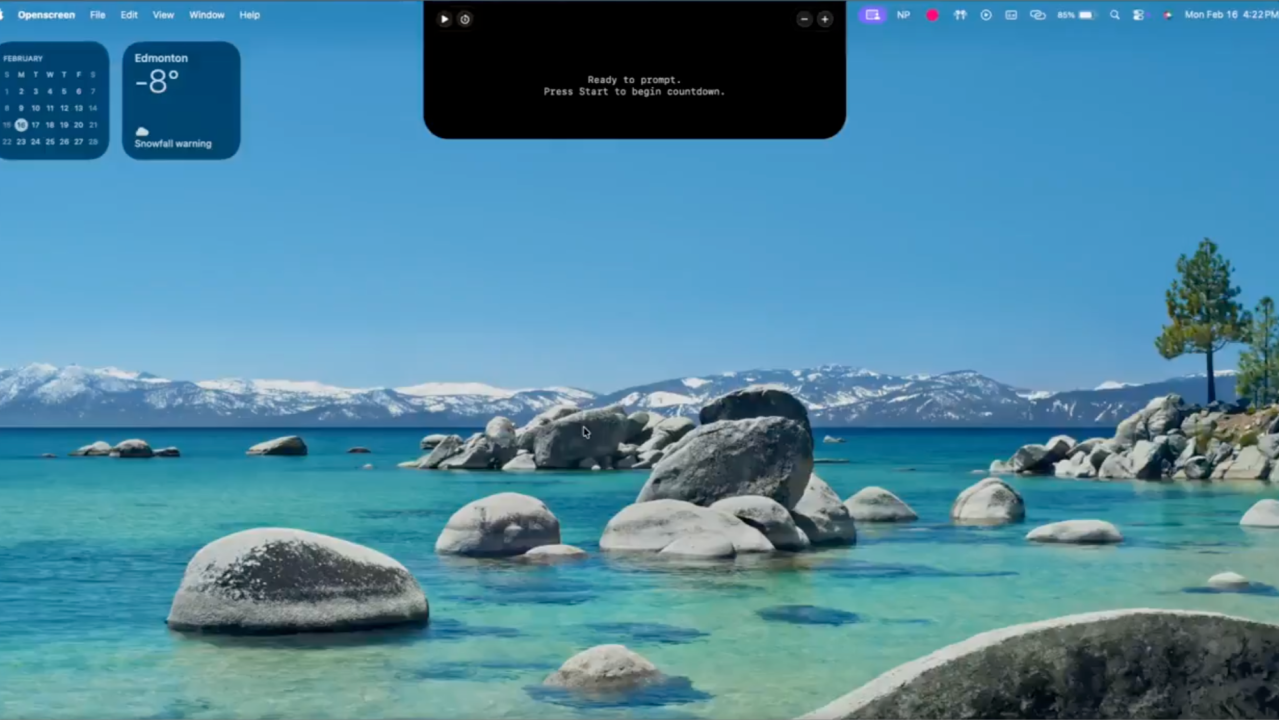
Finally, a use for the Mac Notch
A new open source project called Textream came out that is a teleprompter you can pin to the famously annoying notch on Macs. Hat tip to Aman Kumar, whose video of Textream in action I screenshotted for this article.
Apple finally supporting native video podcasts
Huge for podcast fans: Apple announced proper native video podcasts in Apple Podcasts. They've technically supported video since 2005, but it was always awkward and separate. This new HLS-based version changes everything with easy audio/video switching, offline downloads, and better playback.
AI: Voice or Victim Podcast?
We've been here before.
Twenty years ago, we built websites that didn't work for screen readers. We launched apps that excluded people with motor disabilities. We created digital experiences that assumed everyone could see, hear, click, and navigate the same way.
Now we're doing it again with AI.
I sat down with Erica Anderson Rooney on the AI: Voice or Victim podcast to talk about something most companies aren't asking: Who can't use the AI you're building? Because here's what I know after 15 years in accessibility: when you build for everyone from the start, you build better products. When you bolt it on later, you build barriers.
AI has real potential to break down accessibility barriers. Voice interfaces. Automated captioning. Natural language processing that helps people navigate complex systems.
But it also has the potential to create new ones. Inaccessibility baked into training data. Interfaces that assume visual interaction. Systems that penalize people who don't fit the "normal" use case.
The choice is yours. You can design for inclusion now, or you can explain later why certain people can't use what you built.
We already know how this story ends if you wait.
Thanks to Melissa Daniela Calderón Martínez for sharing the episode in Spanish.
PureLogics podcast
This morning I sat with Mohsin Ali for a podcast called PureLogics Pulse. For a change, in addition to accessibility, it was fun being asked questions about digital transformation and what CEOs should do about AI. It's a topic I love. I'll let you all know when it's live. Mohsin, you need to interview my buddy Gerry Campbell next. He's a mentor of mine and has fascinating views on this topic.
AI Moves Fast example 1 million
New models have come out since my last post the other day, most importantly, Claude Sonnet 4.6. So we updated AIMAC again, and unfortunately, Claude Sonnet regressed on its accessibility. It went from 19th place in Sonnet 4.5 to #37 out of 39 models. 3rd to last. Another model joining Google at the bottom.
Gemini 3.0 Pro is still dead last at 39 of 39. As a friend of mine said, either accessibility is NOT a priority for most AI foundation model companies (aside from OpenAI), or it's "not yet". Which is upsetting.
In addition to Sonnet, at the behest of Denny Vrandečić, we investigated adding Allen AI's models on OpenRouter. Only 2 of them were candidates to benchmark. One of them produced HTML that was smaller than 10K so it was disqualified. The other one, OLMo 3.1 32B Instruct, came in at rank #18.
We also added two new models from Qwen AI, which didn't perform as well as some of their older models. Qwen 3.5 Plus 2026 02 15 came in #23 and Qwen 3.5 397B A17B came in at #36.
Interesting AI Interviews since last time
Boris Cherny, the inventor of Claude Code, was on Y Combinator's pod and it was excellent. A surprise (and validation) for me was that Boris said his CLAUDE.md file was very minimal. Two lines. CLAUDE.md files are just system instructions to LLMs about how you want them to behave when writing code.
Like most people who started using Cursor and Claude Code early, I used to make really long and detailed CLAUDE.md files, but over time started to make them smaller and smaller. As models get better, a lot of the common problems you face get fixed.
Anthropic CEO Dario Amodei was on the Dwarkesh podcast, and he weighed in on an issue that has been pretty controversial. Anthropic blocks competitors from using their models. They did it to Windsurf, which is probably what killed the acquisition by OpenAI. They made life difficult for 🦄 Peter Steinberger at OpenClaw (original name was Clawdbot before they sent over their lawyers). And today they announced that no third parties can use their OAuth tool other than Claude Code. Even Claude's own *SDK cannot share that OAuth token. This is upsetting AI devs throughout social media.
At timecode 36:39 of the pod, Dario said that he's doing this because in his opinion, the Claude models are way ahead of the others when it comes to coding and he doesn't want the competitors to catch up. While I agree Claude Code is the most fun and best communicator, it is NOT the best coder.
*Note, while writing this edition, several Anthropic representatives have walked back their announcement and clarified that the restrictions are more around building a product with the SDK than for all uses of the SDK.
Last but not least, I just now saw that one of my favorite podcasts, How I AI with Claire Vo, interviewed Joe McCormick. Joe lost most of his central vision due to a genetic disorder. He explains how he uses AI to build micro Chrome extensions as Assistive Technology tools. I haven't watched it yet, but it should be very good.