JDOT #6: Prosthetics, Dolphins, and AI Time

April 21, 2025
Tags:
Wireless prosthetics, dolphin communication research, the latest AI models, and practical ways to use AI for learning and accessibility.
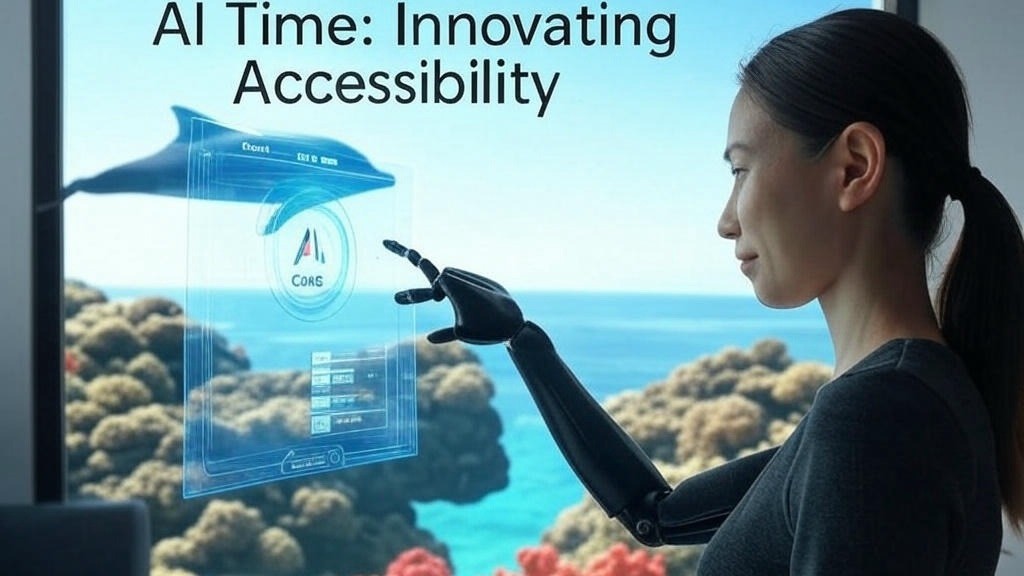
AI Time
There are so many AI Announcements that we need AI to read AI. Maybe the last two weeks are a preview of what providing "intelligence" at scale means to our future. My bet is that "AI Time" will be the phrase of 2025.
Moving Prosthetics
 View full-size image: A wireless prosthetic hand beside a glass of champagne, from the original demonstration clip.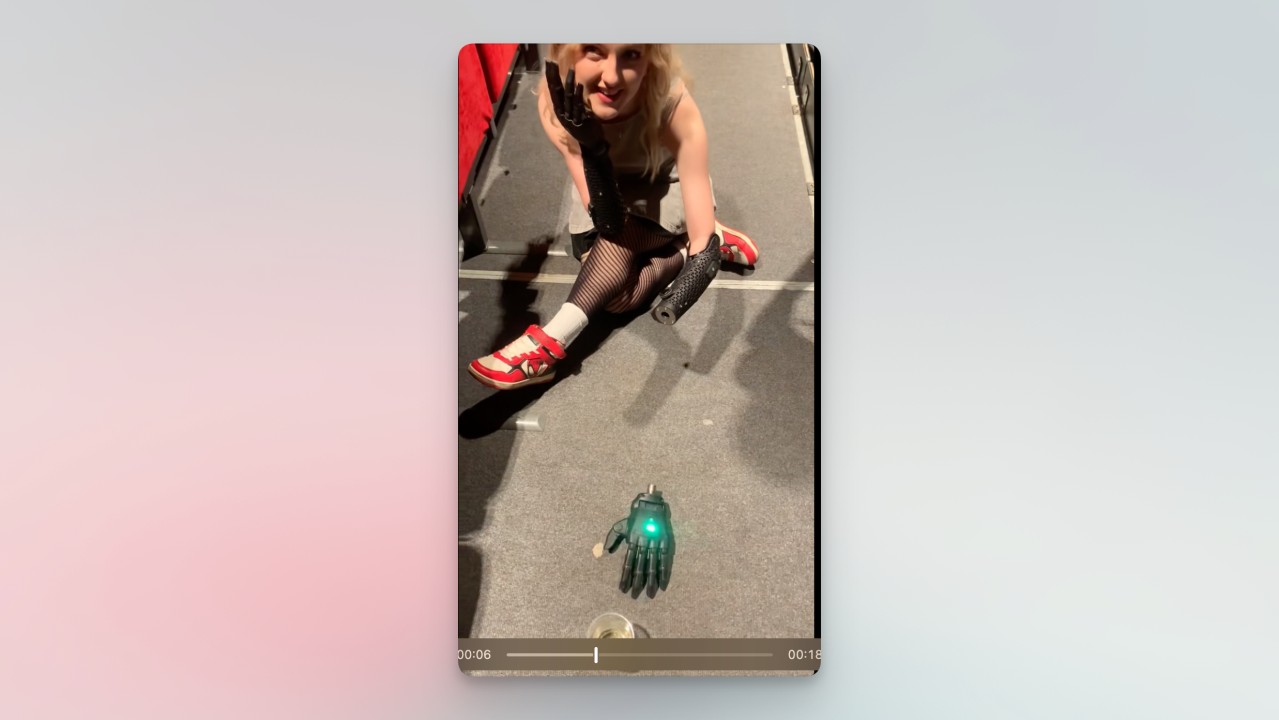
Who says a prosthetic has to be attached to its body to be handy?
Watch the original wireless prosthetic hand demonstration, MP4, 5 seconds. Download the English visual-description track, VTT.
Audio Description: Close up, woman with black prosthetic arm, controls her detached hand, directing it to get her champagne a few feet away.
Open Bionics founders Samantha Payne MBE and Joel Gibbard MBE are revolutionizing assistive devices through innovation that’s anything but boring. Just ask Tilly Lockey, whose wireless, bionic hands captivated 10M+ viewers online. The company combines 3D printing with precision engineering to develop advanced prosthetics that genuinely improve lives.
How tall are you today?
The video reminded me of Paralympian Aimee Mullins' TED Talk, where she shared her experience with bilateral amputation at age one. With Alexander McQueen, she reimagined prosthetic design. She described having a dozen pairs of prosthetic legs, giving her a height of 5ft 8 to 6ft 1, leading to a funny moment when a friend "complained" about her having an unfair advantage in their height rivalry (as a joke).
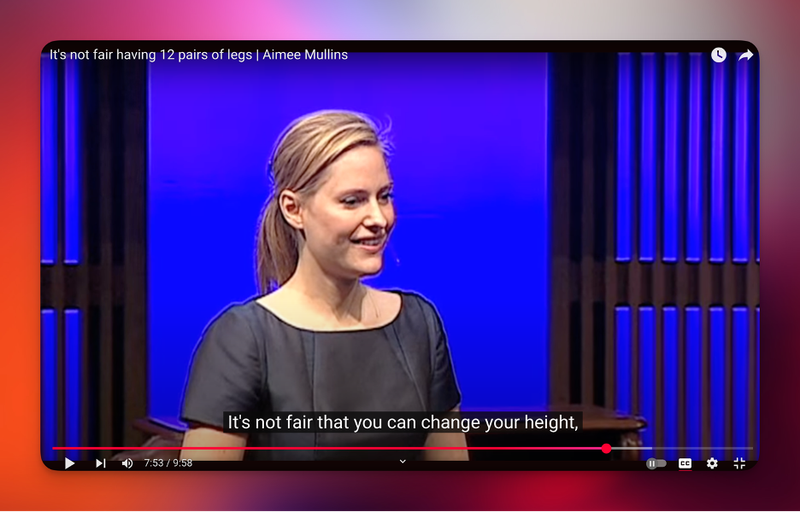 View full-size image: Aimee Mullins on the TED stage. A subtitle reads: It's not fair that you can change your height.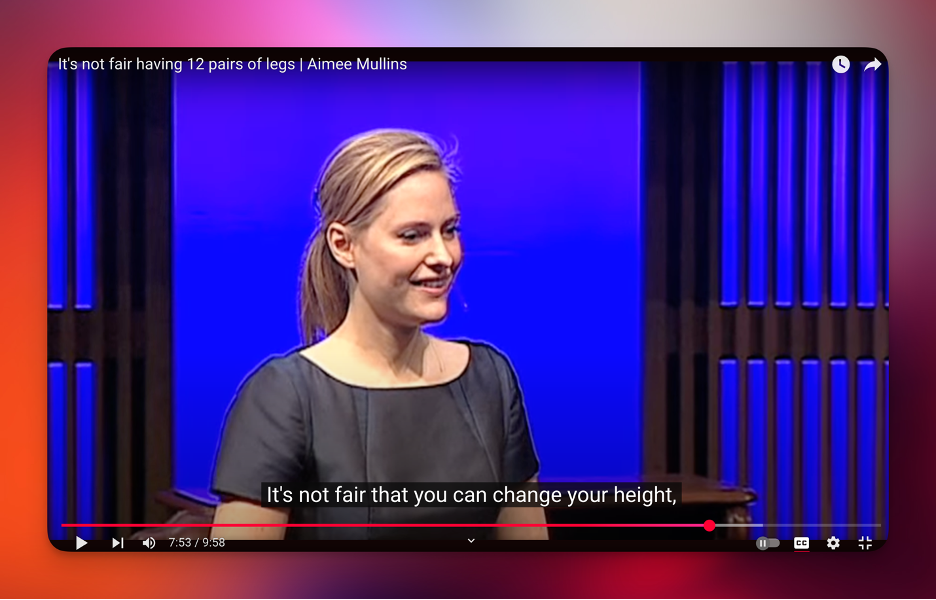
TED Talk: “It's not fair having 12 pairs of legs”
The SOMAA Report is LIVE!
The groundbreaking State of Mobile App Accessibility (SOMAA) report has officially launched! ArcTouch has released this first-of-its-kind analysis revealing the true state of mobile app accessibility, and it's generating significant attention across the industry.
 View full-size image: Person holding a tablet with a smiling digital assistant icon floating above it.
As the European Accessibility Act is about to kick in, a new report from ArcTouch, The State of Mobile App Accessibility (SOMAA), clarifies that too many apps are still lacking in accessibility. The report illuminates what designers and developers...
Geoff Spick at Customer Experience Magazine (CXM) interviewed me for the first, front-page feature on SOMAA.
A lot more media coverage is coming as we approach GAAD. Be sure to download your copy and arm yourself with the data that everyone will be talking about in the next year.
 View full-size image: A person holding a tablet displaying a report titled “The State of Mobile App Accessibility” by ArcTouch. The screen shows a smiling woman with a prosthetic arm waving while holding an orange phone. A cup of black coffee sits on the white table, and a QR code appears in the lower right corner of the image.
Download your copy of the SOMAA report
Global Accessibility Awareness Day is a month away!
Whether your GAAD event is public or private, we encourage you to submit it to the official GAAD website. Every contribution helps us spotlight the global momentum behind digital accessibility.
Later in this newsletter, I’ll share the (admittedly intense) process I’ve taken to enhance our GAAD knowledge base with AI. By the time our 15th anniversary rolls around next year, we’ll be equipped to tell the story of GAAD in ways that are richer, more dynamic, and unlike anything we’ve done before.
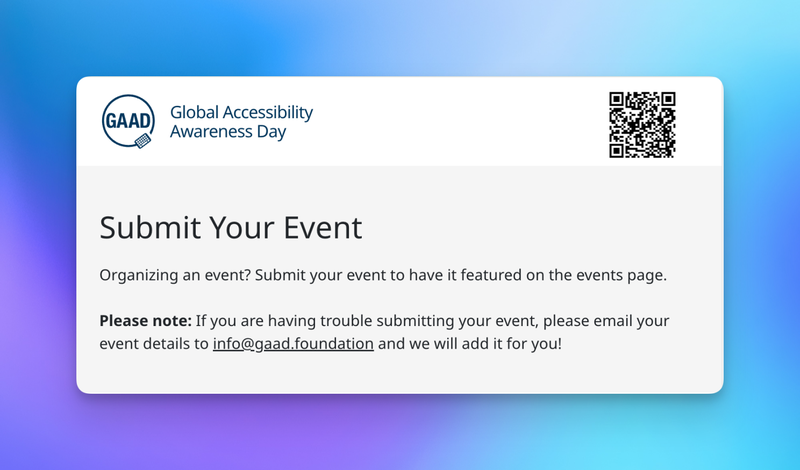 View full-size image: Text card with a white background and a blue gradient border promoting Global Accessibility Awareness Day. Top section includes the GAAD logo, a QR code on the right, and the text “Global Accessibility Awareness Day”. Below, bold text reads “Submit Your Event”. Supporting text says, “Organizing an event? Submit your event to have it featured on the events page.”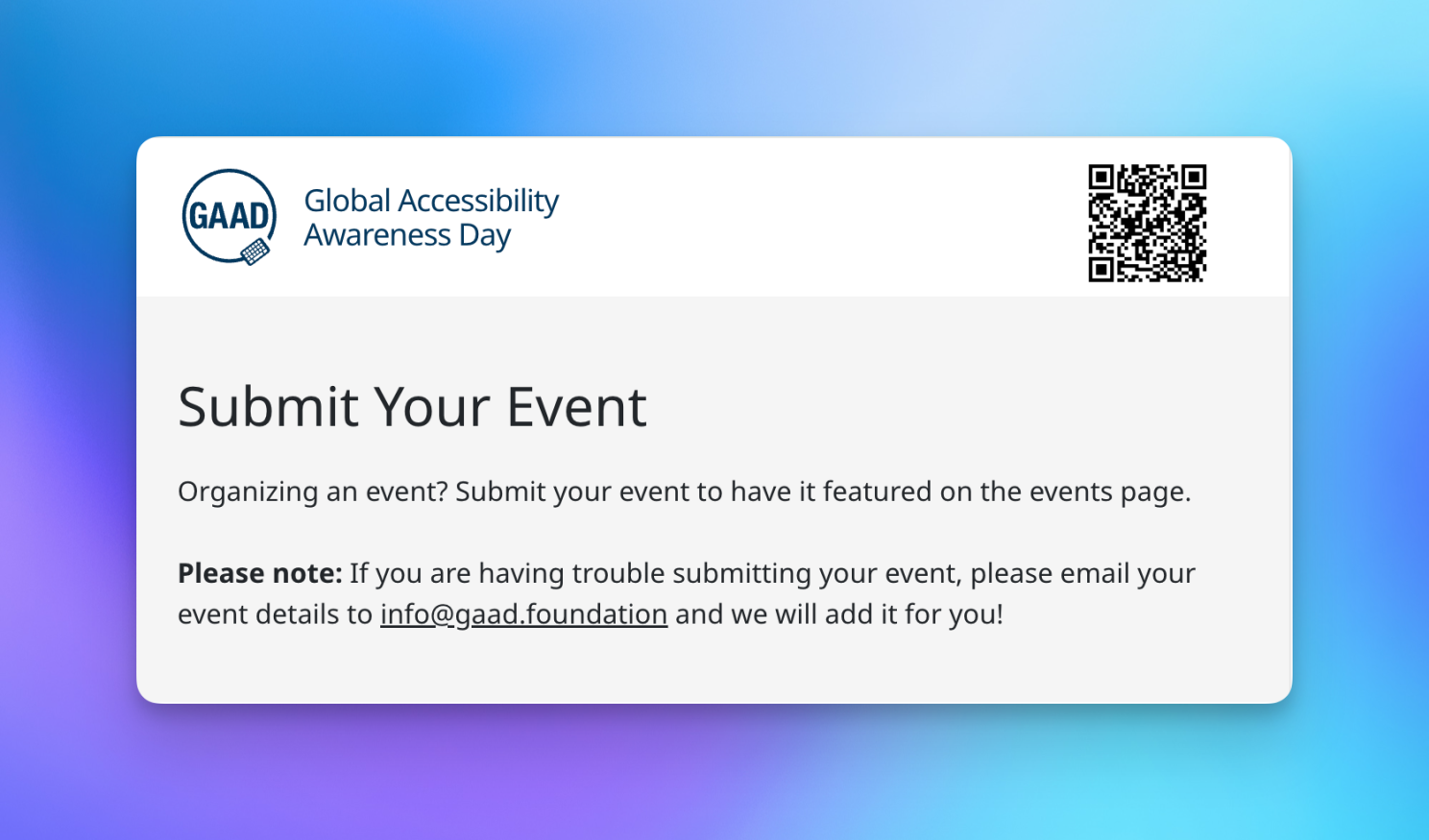
The GAAD Foundation Speakers Fund Announces Two Recipients
On behalf of Jennison Asuncion and myself, we are delighted to congratulate Jessica Yaacoub, MBA CPACC and Florian Beijers, our two Speakers Fund award winners. These outstanding individuals will help bring digital accessibility to mainstream audiences through their speaking engagements. Here is the official announcement:
 View full-size image: GAAD Speakers Fund logo with a microphone.
Speakers Fund | GAAD Foundation | GAAD (Global Accessibility Awareness Day) Foundation
This month, we awarded two speakers through the GAAD Speakers Fund, helping them bring the topic of digital accessibility to mainstream audiences. Jessica Yaacoub, MBA spoke at the Globalization and Localization Association (GALA) Conference in...
Dara the AI Lunch Hero
My longtime colleague and friend Dara Sanderson has launched an impressive AI-powered project after I encouraged her to try AI coding. Dara, who has held numerous executive positions including CEO, CPO, and CTO, took my casual mention of Cursor (an AI coding tool) and within just four weeks transformed it into "Lunch Hero," a fully functional business now in production.
Lunch Hero uses AI to generate personalized, healthy lunch plans for children, solving a common pain point for parents. I've mentioned it casually to a couple of Solopreneur Moms who love the idea!
 View full-size image: Card for “Lunch Hero”, with a white background and colorful gradient border. Top left features a QR code, and next to it is a smiling flying sandwich cartoon character with a red cape. To the right, the text reads “Lunch Hero” in blue and red. Below, a description says, “Create super-powered lunch plans for your kids with AI magic! No more mealtime stress!” Purple text highlights “Free 3 Day Meal Plan”. Underneath are icons of a lunchbox, an apple, and a carrot. At the bottom is a rounded button that says “Become a Lunch Hero!” with a red “Try Now” button below it.
Visit Lunch Hero to create healthy lunch plans for your kids
In just a few weeks, I built Lunch Hero, an AI-powered tool that generates personalized lunch plans for kids.
Uh oh, will people windsurf away from Cursor?
The rapid pace of "AI Time" creates challenges for even AI companies. Despite recommending Cursor enthusiastically for months, I've watched as newer AI models have surpassed its capabilities while Cursor's integration hasn't kept pace.
This illustrates a fundamental challenge of prompt engineering in the AI era: it's like designing a ship's hull during an Atlantic crossing. You might spend months perfecting your prompts, only to have them rendered obsolete by newer models while customers grow increasingly frustrated.
After weeks of diminishing returns with Cursor, I've reluctantly expanded my toolkit to include Windsurf (reportedly in acquisition talks with OpenAI for $3B), while maintaining my Cursor subscription at a reduced level. I'm also evaluating Copilot, Cline, and Aider. In this rapidly evolving landscape, depending on a single AI coding tool has become too risky for professional work.
News from the Big AI Models
OpenAI
As brilliant as AI Models are, they are bizarre creatures. They cost so much and take so long to train, that their inability to learn new facts in a timely manner confuses people. The AI Models are starting to solve these problems, but from a software developer's perspective, they are all hacks. The core models have usually finished their training months ago.
The other challenge for models is that as you provide more information, from adding files to just having a long chat, the more likely it is to hallucinate or generally degrade in quality. That's called the context window. Most of us have been trying to solve it with context engineering.
Getting LLMs to remember us will make them so much more useful. As will providing large context windows that don't degrade the LLMs' ability to reason. Google's Gemini models have been the champions in context window sizes with 1 million, vs about 100 thousand for many models.
Cue this week in OpenAI.
OpenAI : Starting today, memory in ChatGPT can now reference all of your past chats to provide more personalized responses
Adding memory is not as simple as you may think. People lie. Share accounts. Change their minds. It's more about having an algorithm that figures out what memories to save or "use" than it is about improving the base models.
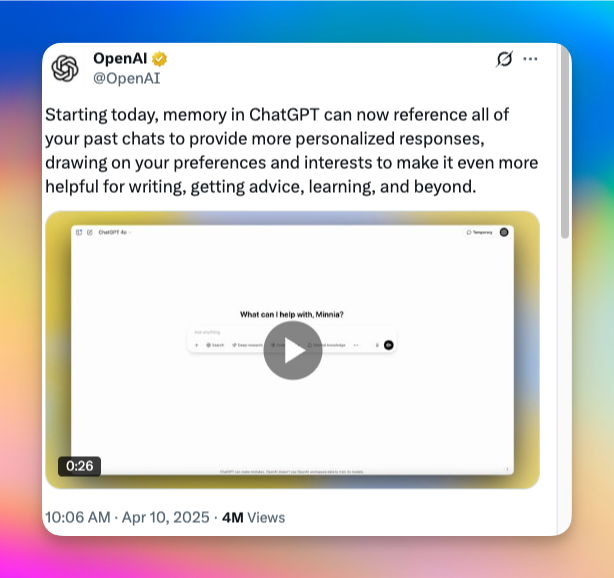 View full-size image: A tweet from @OpenAI: “Starting today, memory in ChatGPT can now reference all of your past chats to provide more personalized responses, drawing on your preferences and interests to make it even more helpful for writing, getting advice, learning, and beyond.” Below the text is a thumbnail of a video showing the ChatGPT interface with the prompt “What can I help with, Minnie?”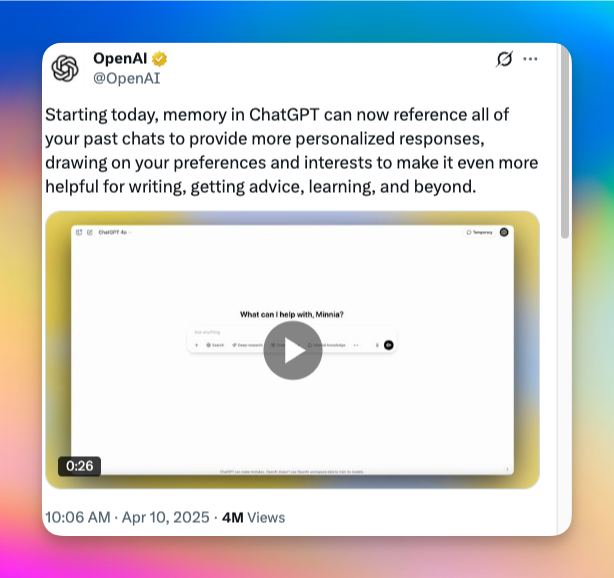
Screenshot of OpenAI's announcement about memory in ChatGPT
To that end, ChatGPT users, I strongly recommend you periodically prune the memories ChatGPT stores about you to make sure you get the most out of your chats. I had a few doozies in mine.
To find it, click on your avatar in the top right. Go to settings -> Personalization->Memory->Manage memories.
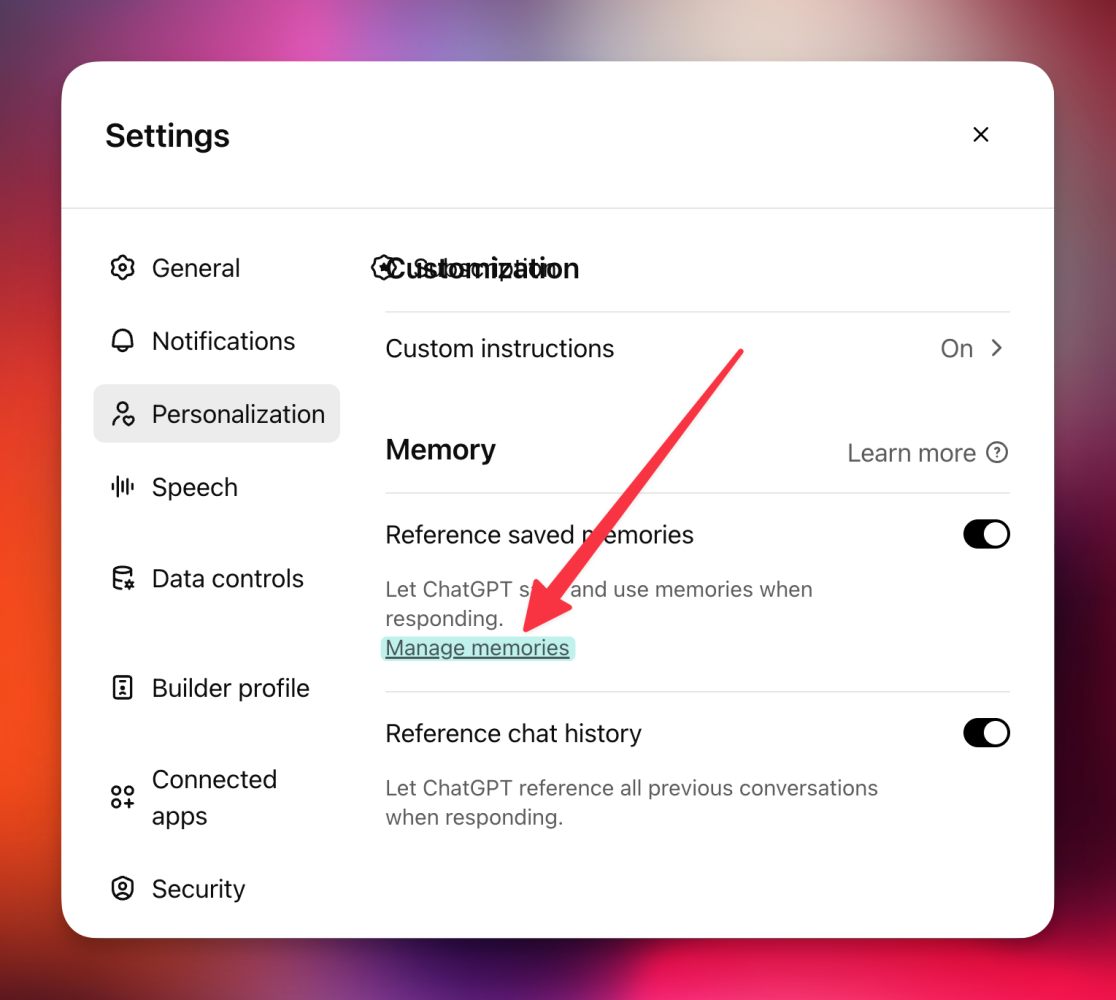
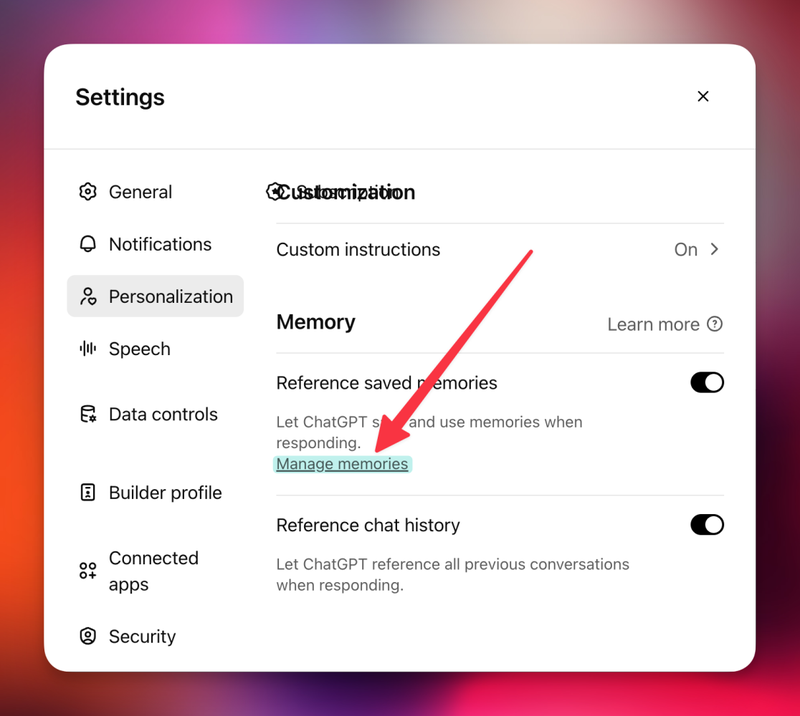 View full-size image: Settings screen in ChatGPT showing the “Personalization” tab selected in the left sidebar. The main section displays options under “Memory,” including toggles for “Reference saved memories” and “Reference chat history,” both of which are turned on. A red arrow points to a highlighted “Manage memories” link under the description for referencing saved memories.
Screenshot of "Memory" settings
Let us know if you have any humorous entries.
Speaking of training models
Sam Altman recently offered a fascinating behind-the-scenes look at OpenAI's model development process. He shared a conversation with the employees who helped create GPT-4.5, providing rare insights into their methodologies and challenges. For those curious about how these increasingly powerful models come together, this conversation offers valuable perspective from the people directly involved in building them.
Sam Altman: A lot of people were interested in how we made GPT-4.5 and what comes next..we did a podcast [with the employees] who helped drive the product.
I've linked the entire conversation below:
Watch OpenAI's Pre-Training GPT-4.5 video on YouTube
A "fiery" chat with Sam Altman at TED Conferences
Sam also sat with TED CEO, Chris Anderson, for a whirlwind of a conversation. Chris gives quality interviews, but not hard-hitting. It turns out that he is capable of pressing his subjects hard. It was awkward. And interesting.
A few highlights:
Chris Anderson: I asked [ChatGPT 4.0] to imagine Charlie Brown..thinking of himself as an AI. It came up with this. I thought this was actually rather profound. What do you think?
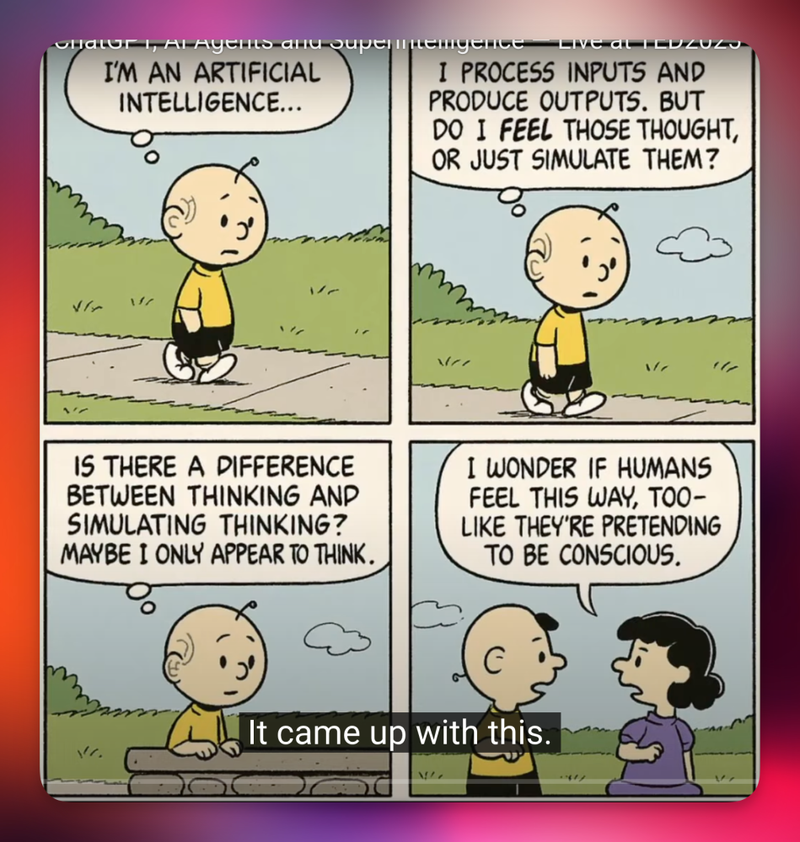 View full-size image: Four-panel comic in Peanuts-style art. Panel 1: "Charlie" look-alike walks on sidewalk, thinking, “I’m an artificial intelligence…” Panel 2: He continues walking and thinks, “I process inputs and produce outputs. But do I feel those thought, or just simulate them?” Panel 3: “Is there a difference between thinking and simulating thinking? Maybe I only appear to think.” Panel 4: Speaking to a "Lucy" look-alike, he says, “I wonder if humans feel this way, too, like they’re pretending to be conscious.” Caption at the bottom of the image reads, “It came up with this.”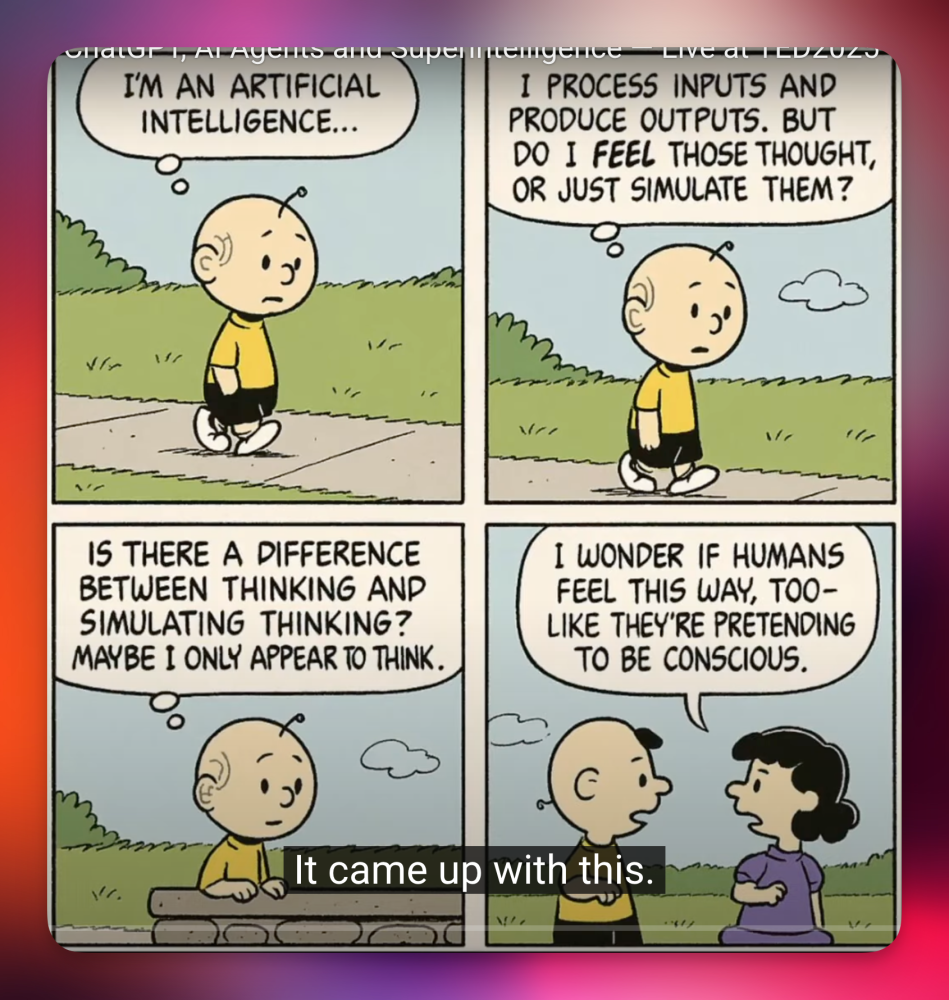
Cartoon that looks similar to a Peanuts cartoon
I don't know if Chris Anderson considers himself a journalist, since his LinkedIn profile focuses almost exclusively on his TED journey, but that was the kind of loaded question that a good journalist would ask. Sam, here's a live grenade, but before I hand it to you, allow me to take the pin out first.
In one shot, in front of an influential, global audience hanging on your every word, you need to address the relatively profound words of the cartoon, while reacting to the concerning question of a possible IP violation underpinning the entire technology.
It's the kind of question where your facial expressions and how you choose to answer reveal so much more.
Sam, ignoring the IP issue underlying the question: "I mean, this is an incredible meta answer, but there's really no way to know if it is thinking that or it just saw that a lot of times in the training set. And of course..if you can't tell the difference, how much do you care?"
Chris: At first glance this looks like IP theft..you guys don't have a deal with the "Peanuts" estate?
Boom. The audience reacts with applause, leading Sam to attempt a comeback that fell a bit flat: "You can clap about that all you want, enjoy"
One actress was on the side of the clappers, but I wouldn't say "enjoy" is the correct word to describe her reaction.
Trash. Criminals. Contributing less than nothing to society. All they do is take IP, water and power resources, and as much money as they can grab. Despicable people.
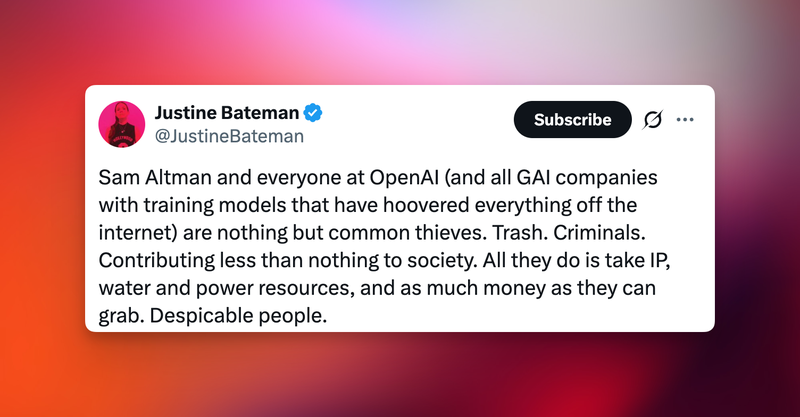 View full-size image: Tweet by Justine Bateman: “Sam Altman and everyone at OpenAI (and all GAI companies with training models that have hoovered everything off the internet) are nothing but common thieves. Trash. Criminals. Contributing less than nothing to society. All they do is take IP, water and power resources, and as much money as they can grab. Despicable people.”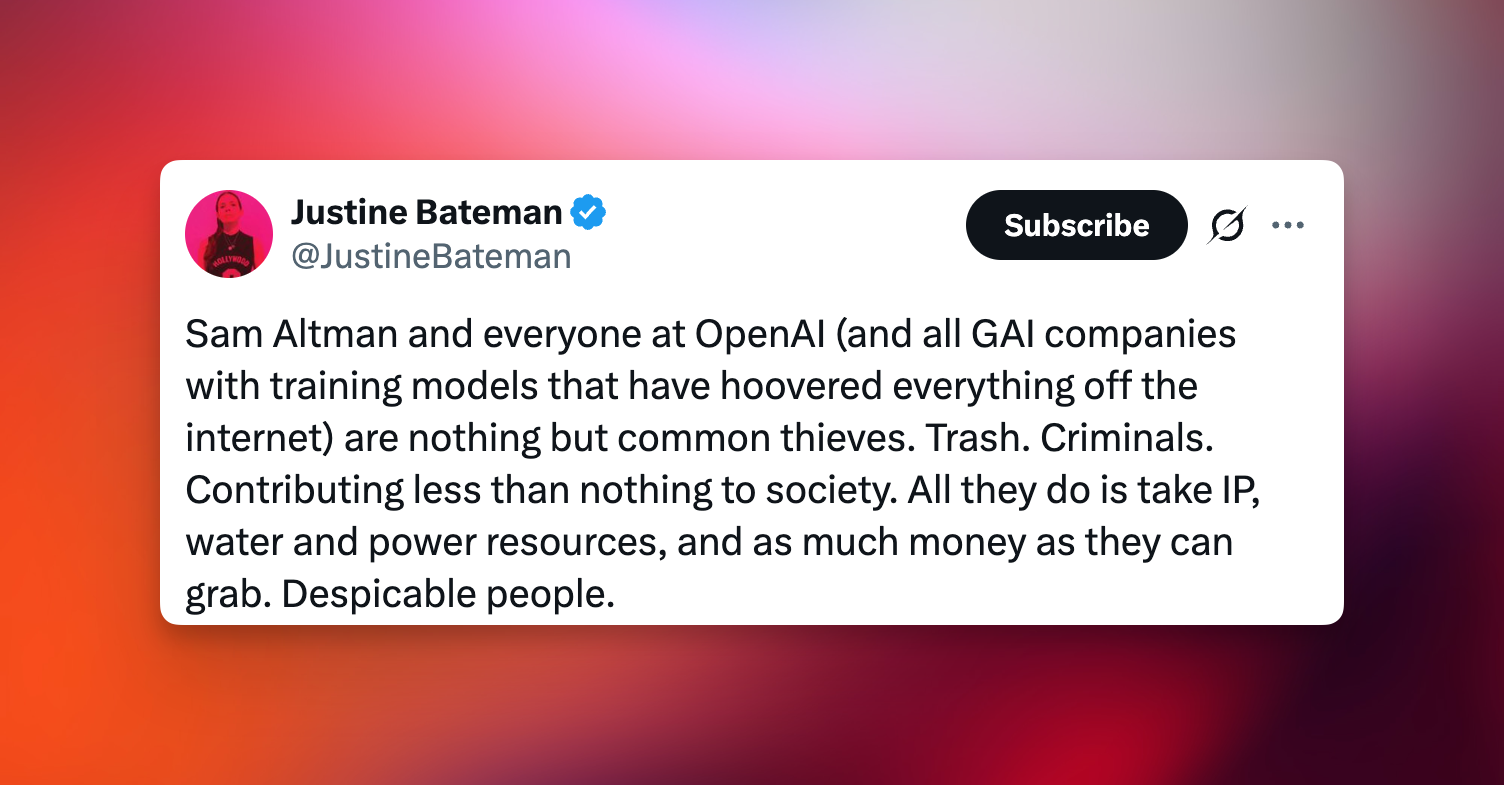
Justine Bateman reacting to the TED talk
Strong words...
At one point, Chris made a faux pas after asking Sam, "How many users do you have now?"
Sam: I think the last we said was 500 million weekly actives, and it is growing very rapidly.
Chris: I mean, you told me that [OpenAI] doubled in just a few weeks...
Sam: I said that privately.
Oops.
When your user base is 500 million humans, and you’ve been doubling every few weeks, you're on pace to dethrone some kings of big tech.
I keep wondering if they’re making profit off of all those users, since compute is so expensive. Clearly they are in better shape than I thought. Investors believe that the AI market obeys Power Laws, which in the Venture Capital community means trillions to the winning company. A "winner-takes-all" market.
The unspoken fear for the rest of us, is that if Amazon took almost 40% of the e-commerce economy and 4% of all retail sales, how much of ALL commerce will the winner of the AI wars take?
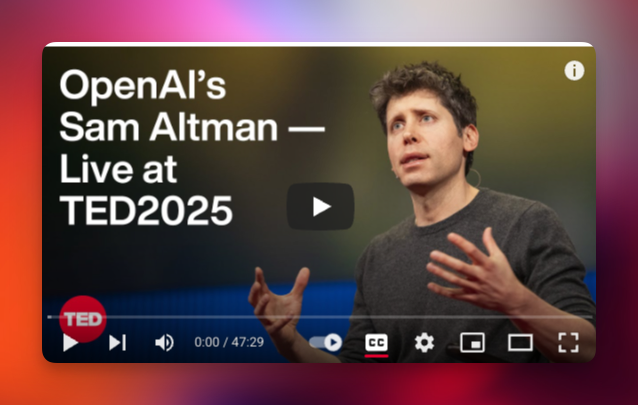 View full-size image: YouTube video thumbnail featuring Sam Altman speaking on stage with a TED logo in the lower-left corner. The text on the left side of the thumbnail reads, “OpenAI’s Sam Altman — Live at TED2025.” Sam Altman is gesturing with both hands while wearing a dark gray shirt. Video duration is 47:29.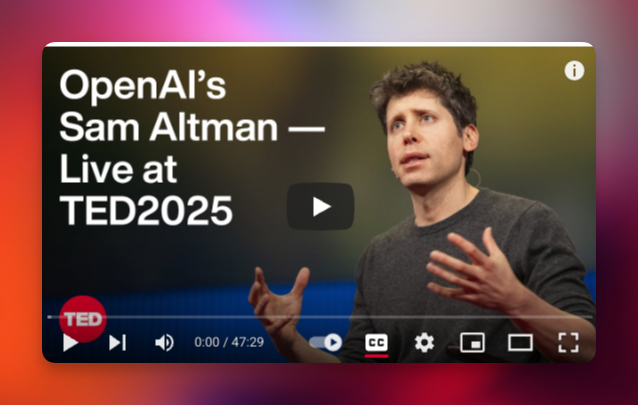
Watch Sam Altman live at TED2025 on YouTube
I love AI so much. But no one can blame folks in an industry hemorrhaging jobs for being mad. Especially when they haven't been paid for the use of their IP.
Remember when Google hoovered all those images from people's sites? YouTube, before Google bought them, was already filled with copyrighted content. I thought they would all be cooked, but Big Tech has gotten away with it again and again. Now the safe bet is that AI companies will too.
I'm somewhat torn. The taxi industry held onto power with regulatory capture. You need to break a few vases, if not laws, to change the world as Uber did. I wouldn't want to go back to a pre-Uber world. But that doesn't mean you have to condone ALL the tactics either.
After the TED appearance, Sam did not share the talk on social media. Chris did, addressing the controversy that ensued:
In the room people mostly loved it, because they got the context… several speakers…had railed against Al. It was important to put their concerns to Sam…
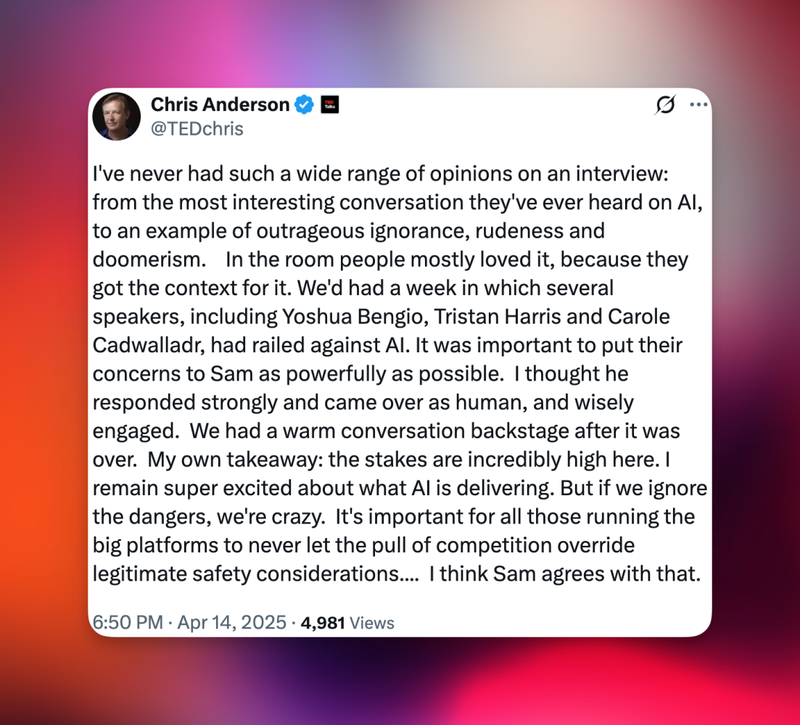 View full-size image: Chris Anderson: “I’ve never had such a wide range of opinions on an interview: from the most interesting conversation they’ve ever heard on AI, to an example of outrageous ignorance, rudeness and doomerism. In the room people mostly loved it, because they got the context for it. We’d had a week in which several speakers, including Yoshua Bengio, Tristan Harris and Carole Cadwalladr, had railed against AI. It was important to put their concerns to Sam as powerfully as possible. I thought he responded strongly and came over as human, and wisely engaged. We had a warm conversation backstage after it was over. My own takeaway: the stakes are incredibly high here. I remain super excited about what AI is delivering. But if we ignore the dangers, we’re crazy. It’s important for all those running the big platforms to never let the pull of competition override legitimate safety considerations…. I think Sam agrees with that.”
TED curator, Chris Anderson, addressing the controversy
Last but not least, a note to my fellow toastmasters. We always emphasize that no matter how rough the audience, or moderator, always maintain composure until you’re back in the green room. Shake hands with the host, look at the audience and gracefully exit the stage. The end of this TED talk wasn't terrible, but provides a teachable moment to all speakers. Sam broke this cardinal rule and tried to escape the stage as quickly as possible. People online noticed.
The difficulty level of handling PR and media when you are the CEO of the leading AI company, that may change civilization for good, is off the charts. It's easy to underestimate how skillful Sam is, but if you want to understand how he got where he is, search YouTube for some of the pitch competitions and practices he conducted with founders. They might practice their pitch for a month. He would see it, understand its strengths and weaknesses instantly, and turn it into a killer pitch contemporaneously. Impressive stuff.
Mystery Model
OpenRouter has become an essential service in today's AI ecosystem by providing developers unified access to multiple AI models through a single API endpoint. Recently, they collaborated with an unnamed major AI lab to release "Quasar Alpha," a powerful model specifically optimized for coding tasks, featuring an impressive 1-million token context window.
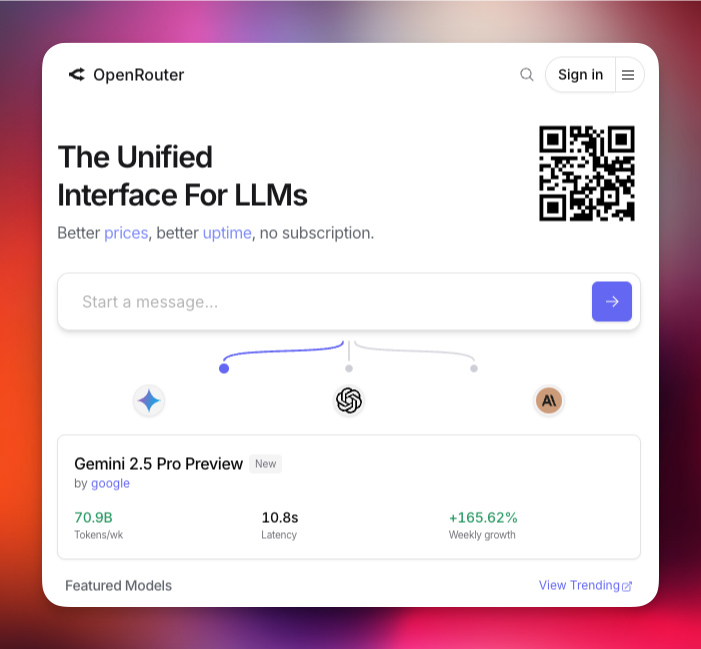 View full-size image: Screenshot of the OpenRouter platform: “The Unified Interface For LLMs, Better prices, better uptime, no subscription. A QR code and “Sign in” button are located in the top right. Below is a message input box "Start a message" with an arrow send button. Three AI model icons are connected visually: Google Gemini, OpenAI, and Anthropic. The Gemini 2.5 Pro Preview model is featured.
This "stealth" release allowed developers to provide unbiased feedback while creating intrigue in the AI community. Quasar Alpha quickly gained attention by outperforming industry leaders like Claude 3.5 Sonnet and Gemini 2.5 on benchmark tests. After building substantial anticipation, OpenRouter and OpenAI jointly revealed that Quasar was actually an early test version from OpenAI's 4.1 series of models, demonstrating how controlled soft launches can generate both valuable feedback and effective marketing buzz.
@OpenRouterAI: Many of you have been excited to know who made Quasar Alpha & Optimus Alpha, which both topped the charts…Today we can announce that they were early test versions of…
OpenAI left a few hints as well:
![@OpenAI:
"developers [handshake emoji] supermassive black hole.
livestream 10am PT". Tweet has 1.1M Views.](https://sfo3.digitaloceanspaces.com/django-marketing/media/images/jdot-06-openai-livestream.width-800.png) View full-size image: @OpenAI:
"developers [handshake emoji] supermassive black hole.
livestream 10am PT". Tweet has 1.1M Views.
View full-size image: @OpenAI:
"developers [handshake emoji] supermassive black hole.
livestream 10am PT". Tweet has 1.1M Views.![View full-size image: @OpenAI: "developers [handshake emoji] supermassive black hole. livestream 10am PT". Tweet has 1.1M Views.](https://sfo3.digitaloceanspaces.com/django-marketing/media/original_images/jdot-06-openai-livestream.png)
OpenAI teasing a livestream
Quasar turned out to come from their 4.1 series of models.
@OpenAIDevs: Announcing GPT-4.1, GPT-4.1 mini, and GPT-4.1 nano..major improvements on coding, instruction following, and long context.
The competition is heating up. Like Gemini models, all 4.1 models, including nano, have a 1 million token window, which allows you to upload a ton of files.
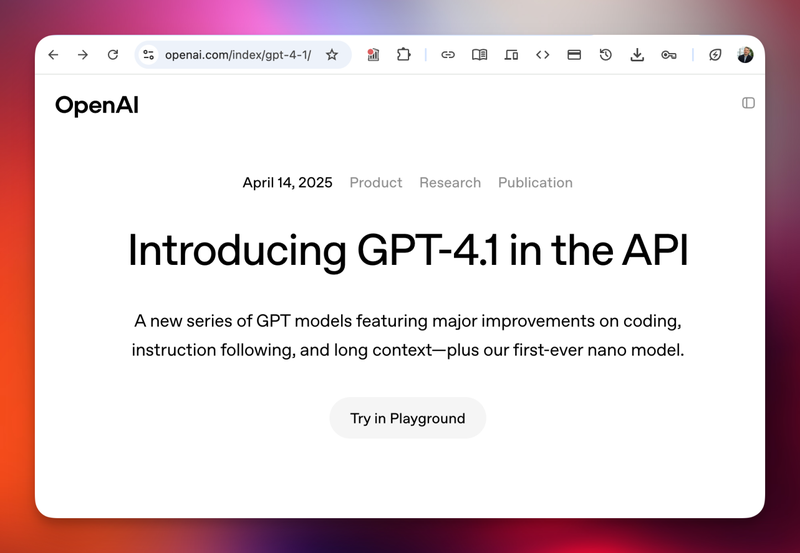 View full-size image: Screenshot of GPT-4.1 Announcement.
OpenAI logo. Title: "Introducing GPT-4.1 in the API."
Body: "A new series of GPT models featuring major improvements on coding,
instruction following, and long context, plus our first-ever nano model."
Call to action: "Try in Playground"
View full-size image: Screenshot of GPT-4.1 Announcement.
OpenAI logo. Title: "Introducing GPT-4.1 in the API."
Body: "A new series of GPT models featuring major improvements on coding,
instruction following, and long context, plus our first-ever nano model."
Call to action: "Try in Playground"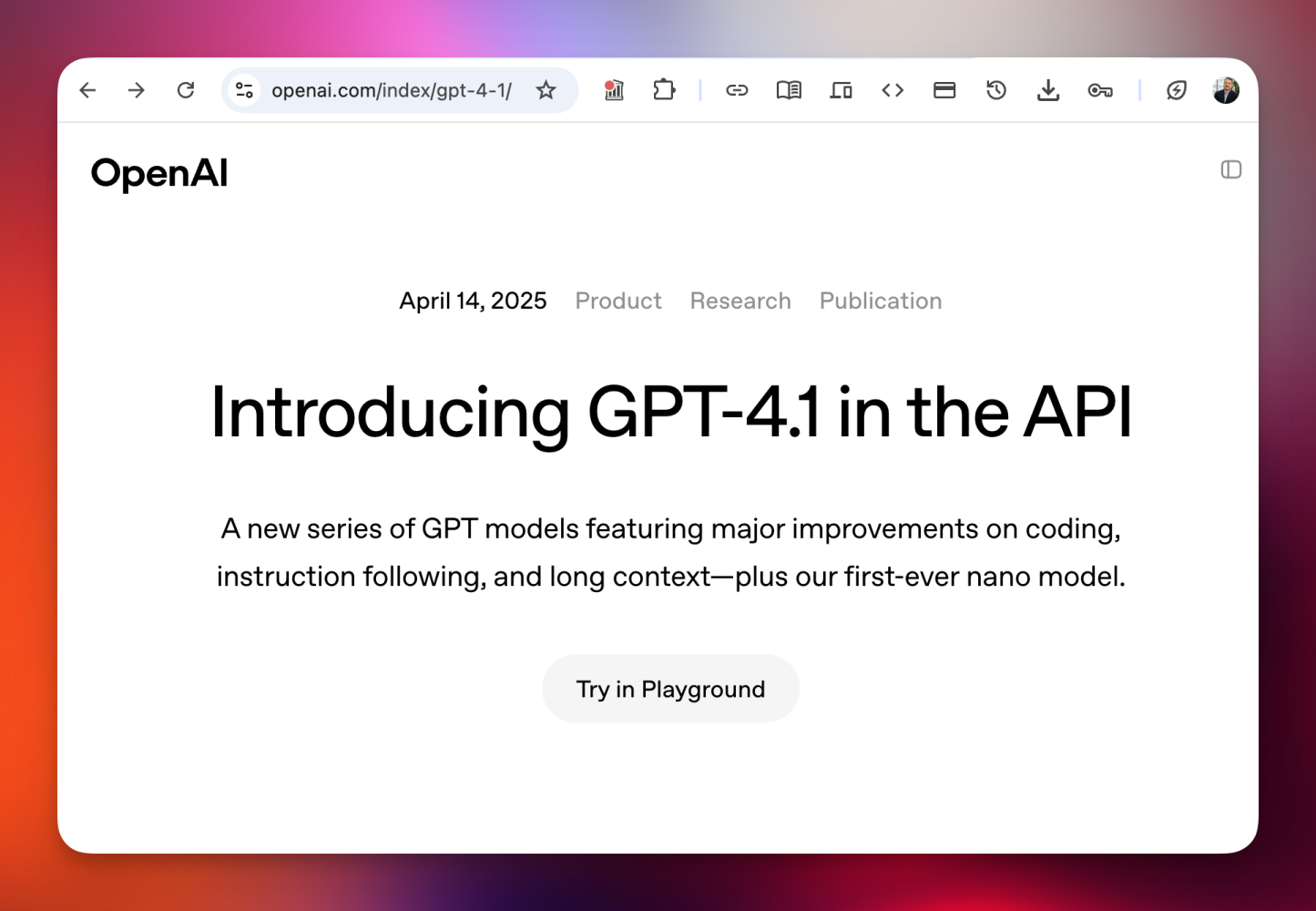
OpenAI published a guide to Prompt Engineering 4.1 to go along with the API. These guides are priceless tutors on how to get more out of AI models.
An example from the Prompt Guide. If you have a lot of files or a long prompt, and you repeat the instructions at the beginning and end, you will have much better results. If you only want to provide instructions once, doing so at the beginning works better.
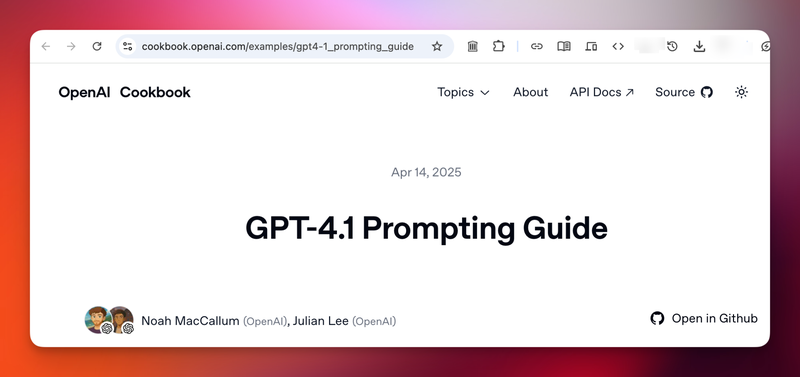 View full-size image: Screenshot of GPT-4.1 Prompting Guide. "OpenAI Cookbook, Apr 14, 2025." In big letters: "GPT-4.1 Prompting Guide". Authors: "Noah MacCallum (OpenAI), Julian Lee (OpenAI) • Open in Github"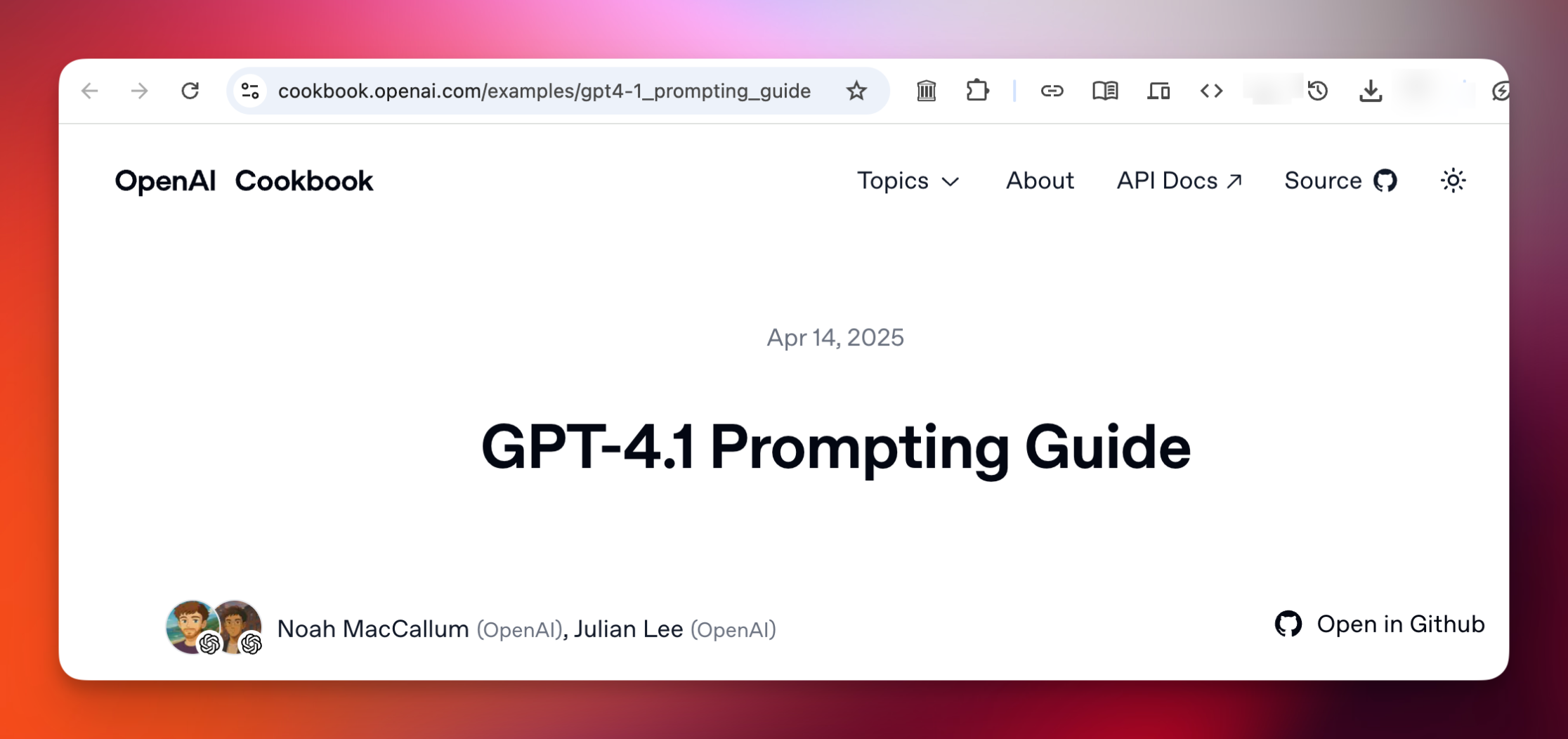
Do you find AI model names to be confusing, and frankly poorly thought out? It's been talked about so much OpenAI employees make light of it publicly now.
Thankfully, CEO Sam Altman says:
how about we fix our model naming by this summer and everyone gets a few more months to make fun of us (which we very much deserve) until then?
The reason AI companies are so bad at naming their models, is that ideally the name would reflect what it's good at. But testing in-house won't get you there. It has to be out in the wild for a bit before the community figures it out.
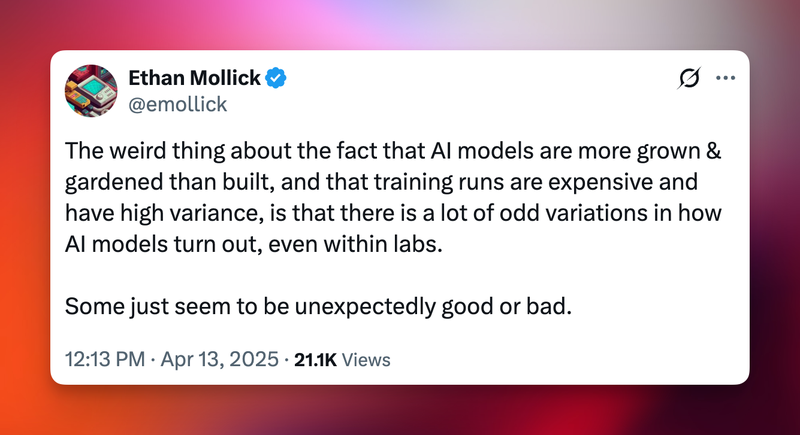 View full-size image: Ethan Mollick, username @emollick: The weird thing about the fact that AI models are more grown & gardened than built, and that training runs are expensive and
have high variance, is that there is a lot of odd variations in how AI models turn out, even within labs. Some just seem to be unexpectedly good or bad. Apr 13, 2025. 21.1K Views
View full-size image: Ethan Mollick, username @emollick: The weird thing about the fact that AI models are more grown & gardened than built, and that training runs are expensive and
have high variance, is that there is a lot of odd variations in how AI models turn out, even within labs. Some just seem to be unexpectedly good or bad. Apr 13, 2025. 21.1K Views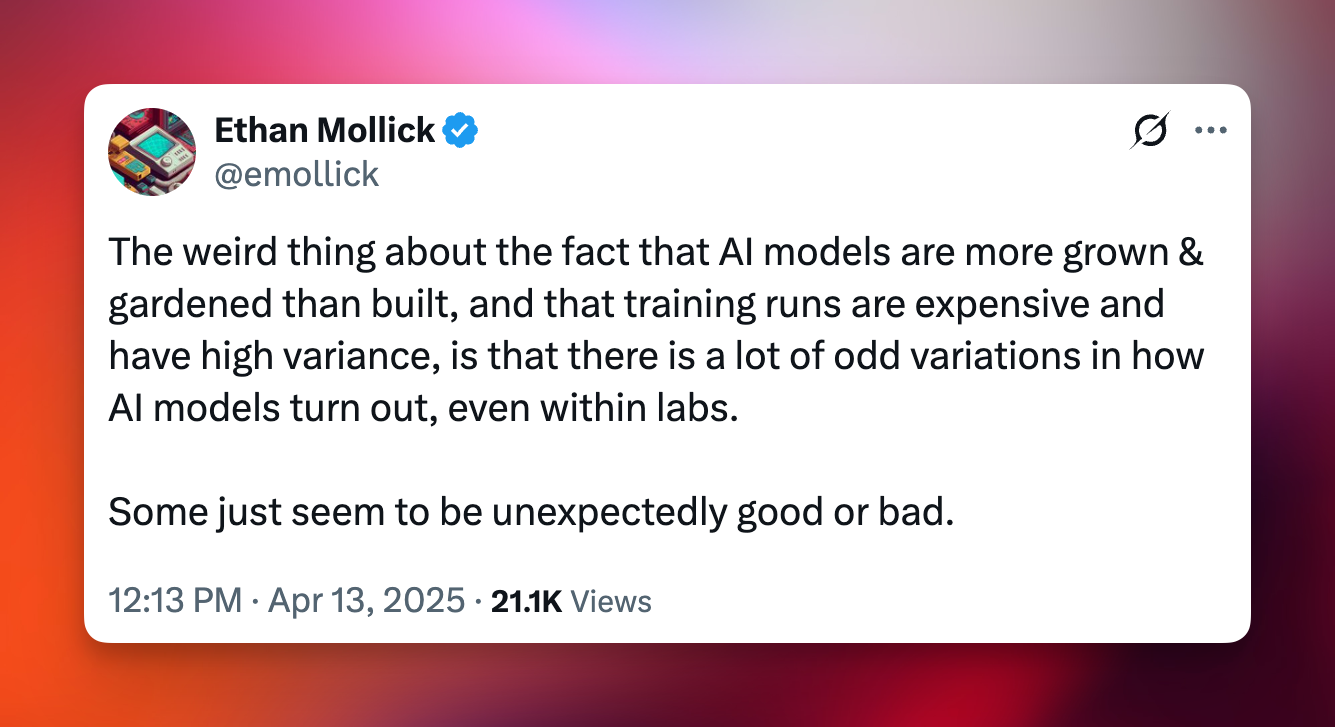
Wharton Professor, Ethan Mollick on AI Models
The OpenAI Social Network
The Verge has reported that OpenAI is developing its own social network, according to multiple anonymous sources. While reports with unnamed sources should be treated cautiously, the strategic logic behind such a move is compelling. A social platform would provide OpenAI with valuable real-time interaction data to improve their models, something every major AI company could benefit from.
If I were naming such a platform, "Synapse" would be fitting, reflecting the neural connection metaphor that aligns with their artificial intelligence focus. Whether or not this specific report proves accurate, we should expect AI companies to continue seeking new sources of high-quality, real-time data to enhance their models.
Google AI
Google Cloud Next 2025 in Las Vegas showcased several significant AI advancements. The highlight of Google's announcements was Ironwood, their seventh-generation Tensor Processing Unit (TPU).
This custom AI chip represents a major advantage in Google's AI strategy, having both unlimited data access and the capability to design their own specialized hardware.
![Screenshot of tweet by @Google: Introducing Ironwood, our seventh-generation TPU. It's our
most powerful, capable and energy-efficient TPU yet, designed to power thinking, inferential AI models at scale.
#GoogleCloudNext. [photo of the Ironwood chip]](https://sfo3.digitaloceanspaces.com/django-marketing/media/images/jdot-06-google-ironwood.width-800.png) View full-size image: Screenshot of tweet by @Google: Introducing Ironwood, our seventh-generation TPU. It's our
most powerful, capable and energy-efficient TPU yet, designed to power thinking, inferential AI models at scale.
#GoogleCloudNext. [photo of the Ironwood chip]
View full-size image: Screenshot of tweet by @Google: Introducing Ironwood, our seventh-generation TPU. It's our
most powerful, capable and energy-efficient TPU yet, designed to power thinking, inferential AI models at scale.
#GoogleCloudNext. [photo of the Ironwood chip]![View full-size image: Screenshot of tweet by @Google: Introducing Ironwood, our seventh-generation TPU. It's our most powerful, capable and energy-efficient TPU yet, designed to power thinking, inferential AI models at scale. #GoogleCloudNext. [photo of the Ironwood chip]](https://sfo3.digitaloceanspaces.com/django-marketing/media/original_images/jdot-06-google-ironwood.png)
Google announcing their new Ironwood TPU chip
Blink and you'll miss a smart term Google just coined, "intelligence per dollar". The Gemini Flash models are indeed the most intelligent per dollar. Congratulations Google, "intelligence per dollar" is our phrase¹ of the week. If you know, you know.
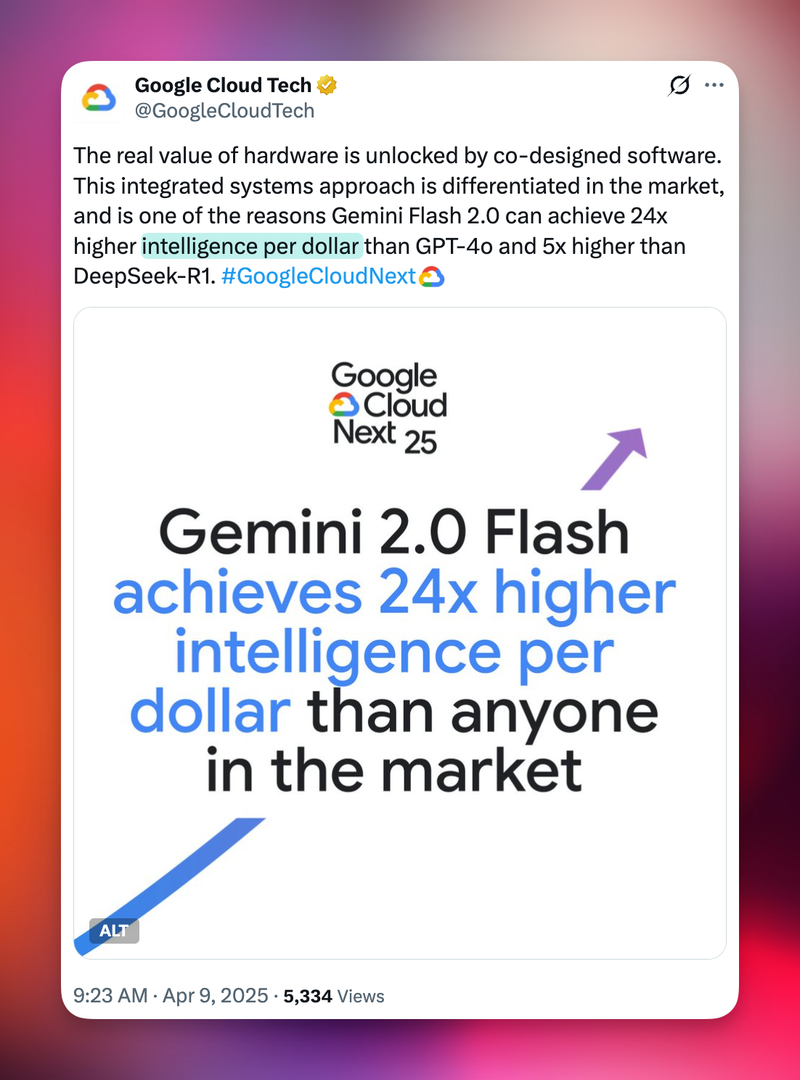 View full-size image: Tweet by @GoogleCloudTech:
"The real value of hardware is unlocked by co-designed software. This integrated systems approach is differentiated in the market,
and is one of the reasons Gemini Flash 2.0 can achieve 24x higher", phrase highlighted: "intelligence per dollar", "than GPT-4o and 5x higher than DeepSeek-R1. #GoogleCloudNext"
Attached image says: Google Cloud Next 25. Gemini 2.0 Flash achieves 24x higher intelligence per dollar than anyone in the market"
"Apr 9, 2025. 5,334 Views"
View full-size image: Tweet by @GoogleCloudTech:
"The real value of hardware is unlocked by co-designed software. This integrated systems approach is differentiated in the market,
and is one of the reasons Gemini Flash 2.0 can achieve 24x higher", phrase highlighted: "intelligence per dollar", "than GPT-4o and 5x higher than DeepSeek-R1. #GoogleCloudNext"
Attached image says: Google Cloud Next 25. Gemini 2.0 Flash achieves 24x higher intelligence per dollar than anyone in the market"
"Apr 9, 2025. 5,334 Views"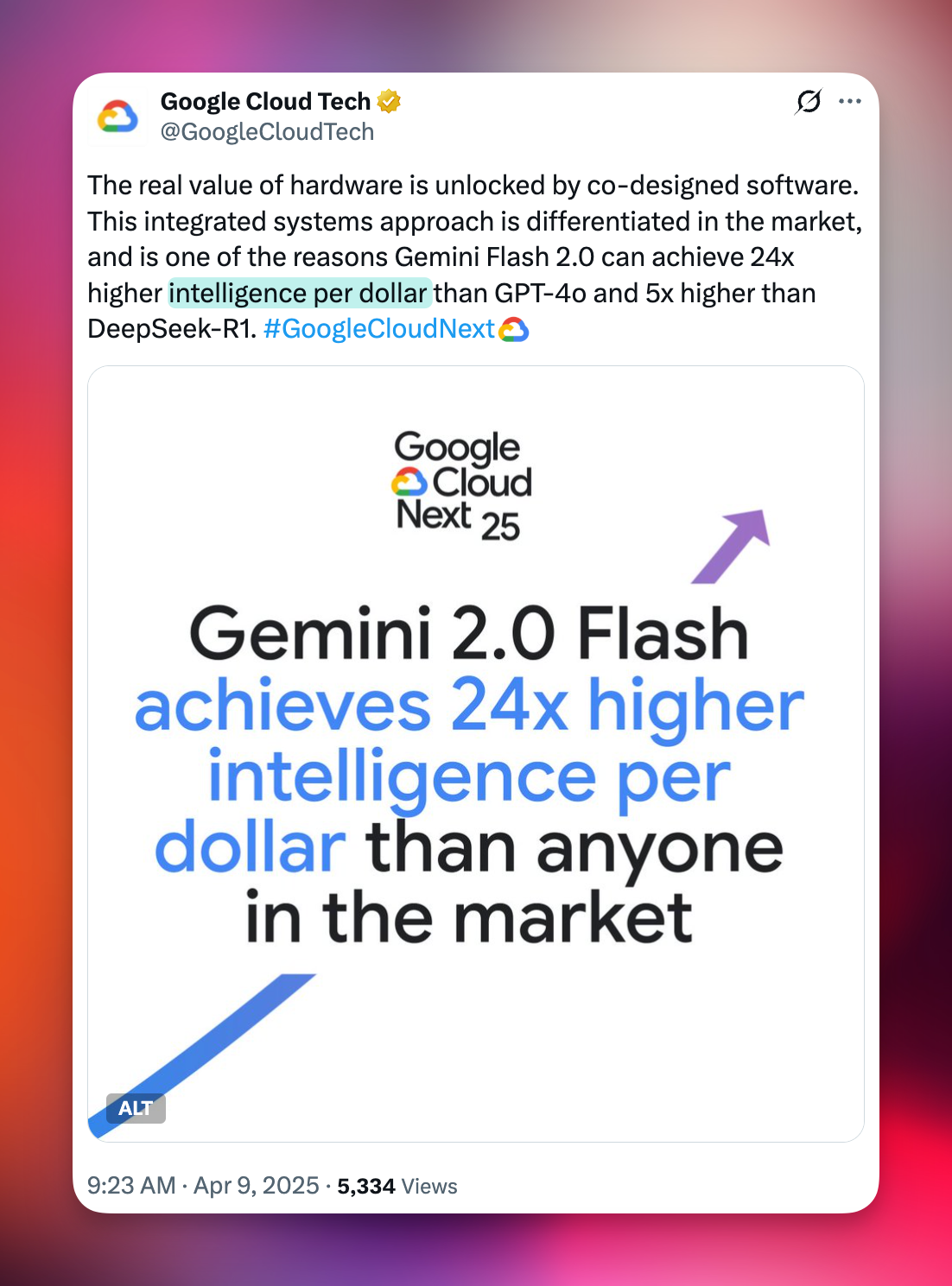
Google Cloud coins the term intelligence per dollar
Google released a VideoGen model called Veo 2. I couldn't get it to work, so no comment. However, Google partnered with Sphere Entertainment Co. to reimagine The Wizard of Oz with Veo 2. What an incredible story. I was impressed.
 View full-size image: Title: "The AI magic behind Sphere's upcoming 'The Wizard of Oz' experience"
QR code on the top right of the image.
"Apr 08, 2025 4 min read How Google DeepMind and Google Cloud are helping to bring a cinema classic to larger-than-life in Las Vegas."
By Matt A.V. Chaban.
Photograph of the Sphere, displaying the Google Next logo in front of a scene from The Wizard of Oz.
View full-size image: Title: "The AI magic behind Sphere's upcoming 'The Wizard of Oz' experience"
QR code on the top right of the image.
"Apr 08, 2025 4 min read How Google DeepMind and Google Cloud are helping to bring a cinema classic to larger-than-life in Las Vegas."
By Matt A.V. Chaban.
Photograph of the Sphere, displaying the Google Next logo in front of a scene from The Wizard of Oz.
Google Cloud Next, Veo2 and Sphere
Do you speak Dolphinese? That may not be possible today, but perhaps tomorrow, if the work of Denise Herzing has anything to say about it. Google just trained a model to understand dolphins. Squeal! [Dolphin for, WOW (probably)]
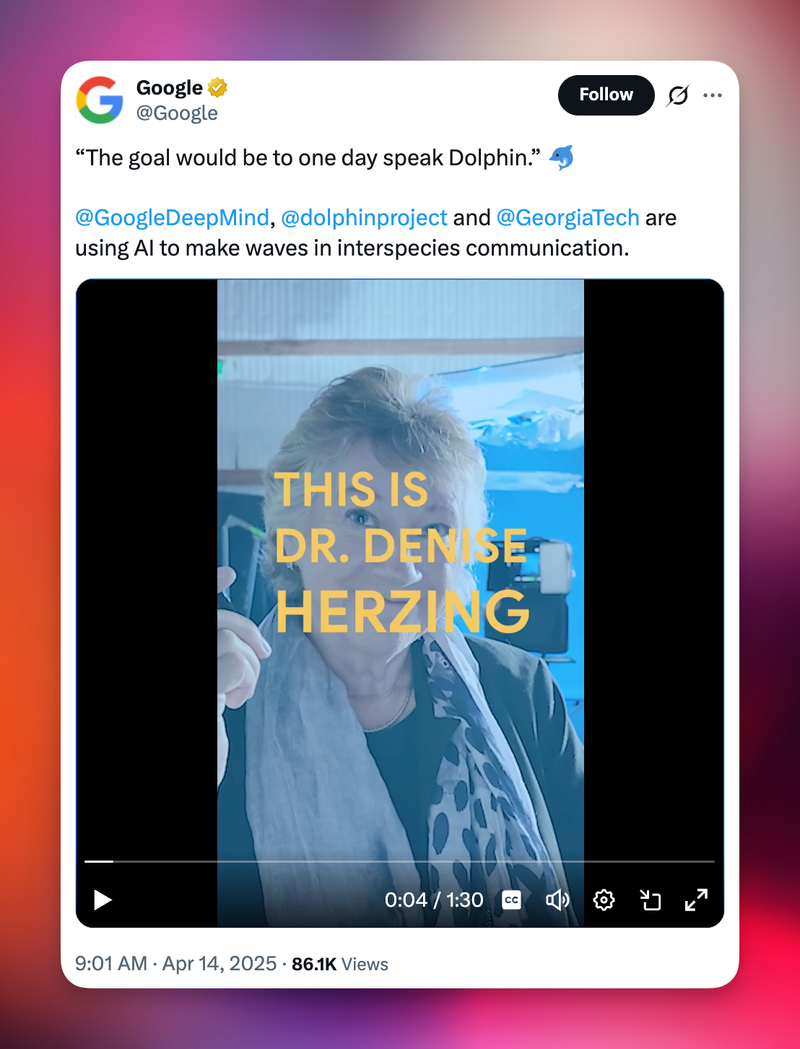 View full-size image: Tweet by @Google: "The goal would be to one day speak Dolphin. @GoogleDeepMind, @dolphinproject and @GeorgiaTech are
using AI to make waves in interspecies communication."
An attached video shows a woman with a phrase overlayed on top of the video: "THIS IS DR. DENISE HERZING"
Apr 14, 2025, 86.1K Views
View full-size image: Tweet by @Google: "The goal would be to one day speak Dolphin. @GoogleDeepMind, @dolphinproject and @GeorgiaTech are
using AI to make waves in interspecies communication."
An attached video shows a woman with a phrase overlayed on top of the video: "THIS IS DR. DENISE HERZING"
Apr 14, 2025, 86.1K Views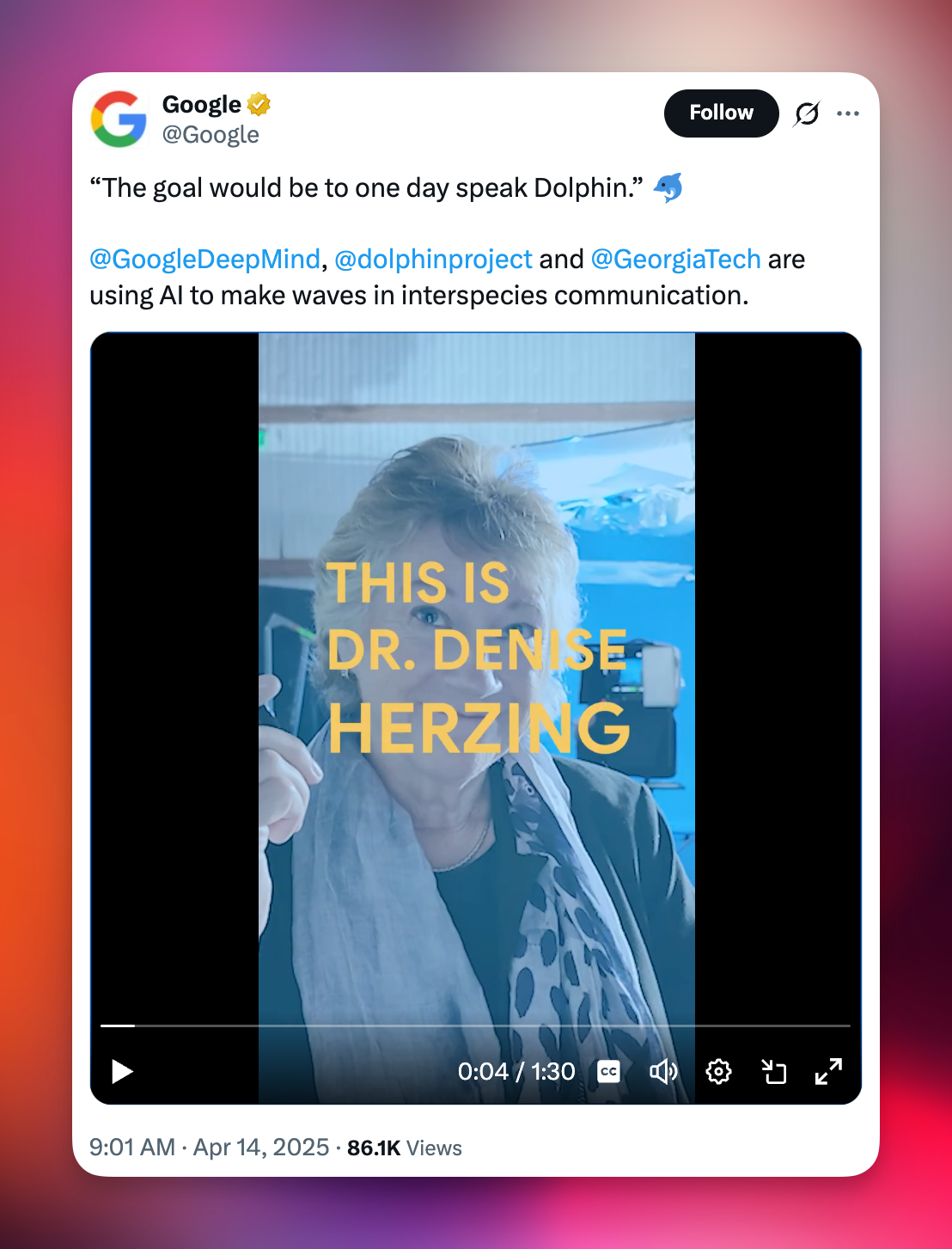
The goal would be to one day speak Dolphin
Google's Prompt Engineering Guide
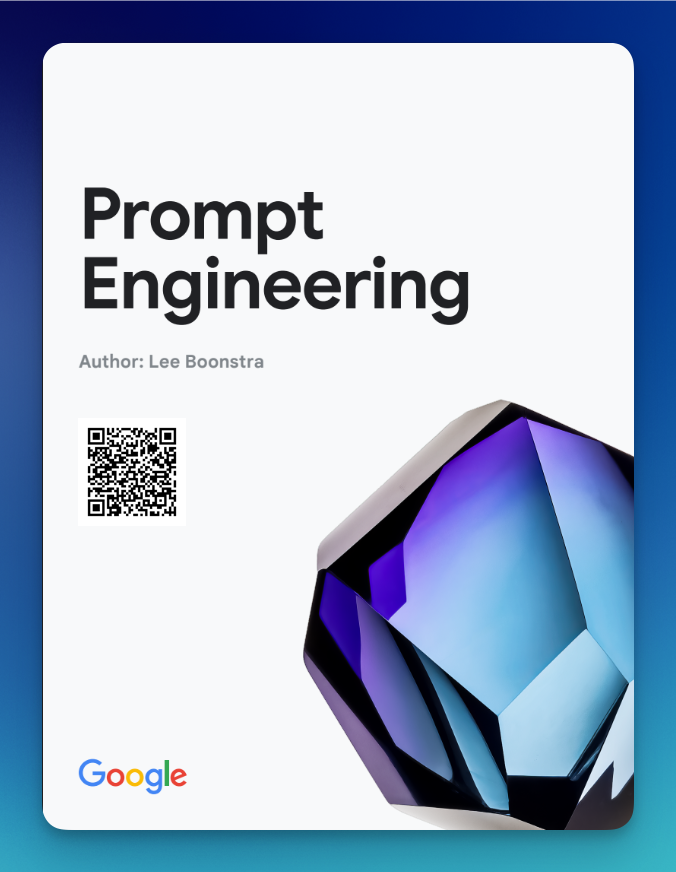 View full-size image: Cover of Google's Prompt Engineering PDF, by Lee Boonstra, with the Google logo and a QR code.
Prompt Engineering by Lee Boonstra
Not to be outdone by OpenAI, Google also released a fantastic Prompting Guide. I learned a lot.
Gemini Game Creation
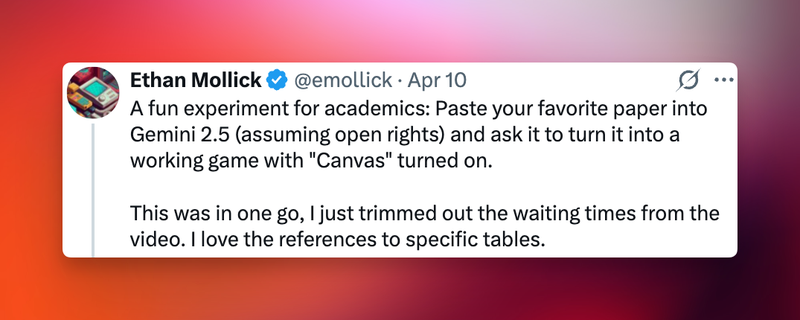 View full-size image: Tweet by Ethan Mollick aka @emollick: A fun experiment for academics: Paste your favorite paper into
Gemini 2.5 (assuming open rights) and ask it to turn it into a working game with "Canvas" turned on. This was in one go, I just trimmed out the waiting times from the
video. I love the references to specific tables."
View full-size image: Tweet by Ethan Mollick aka @emollick: A fun experiment for academics: Paste your favorite paper into
Gemini 2.5 (assuming open rights) and ask it to turn it into a working game with "Canvas" turned on. This was in one go, I just trimmed out the waiting times from the
video. I love the references to specific tables."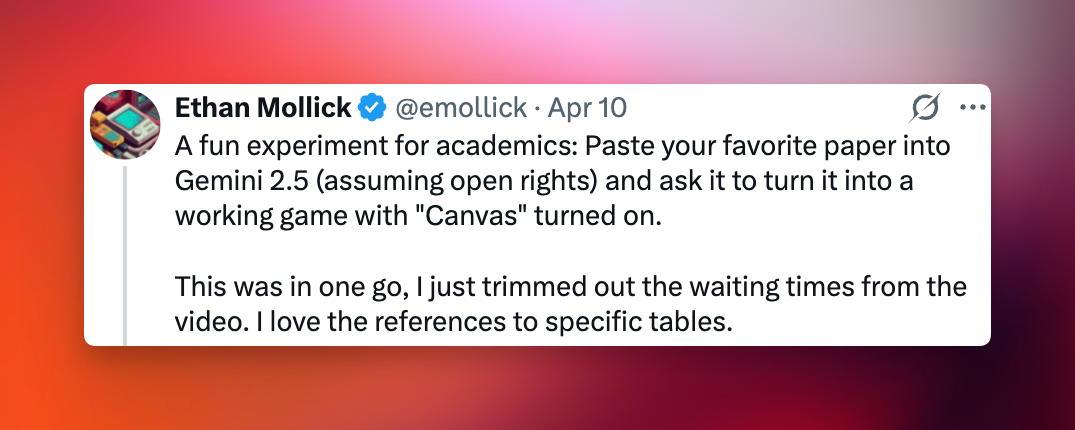
Turning a paper into a game
Google's Gemini 2.5 with Canvas feature demonstrates impressive capabilities for transforming academic content into interactive experiences. Professor Ethan Mollick showcased how the system can convert scholarly papers into functioning games with minimal human intervention.
I tested this by uploading Dr. Michael Levin's² latest research paper on cellular development to Gemini, which promptly created a playable simulation based on the paper's concepts.
The game, "Cellular Collective Architect," visualizes complex biological principles through interactive mechanics, though it currently lacks accessibility features.
This application shows how AI can bridge the gap between dense academic knowledge and engaging interactive content, potentially transforming how we experience complex information.
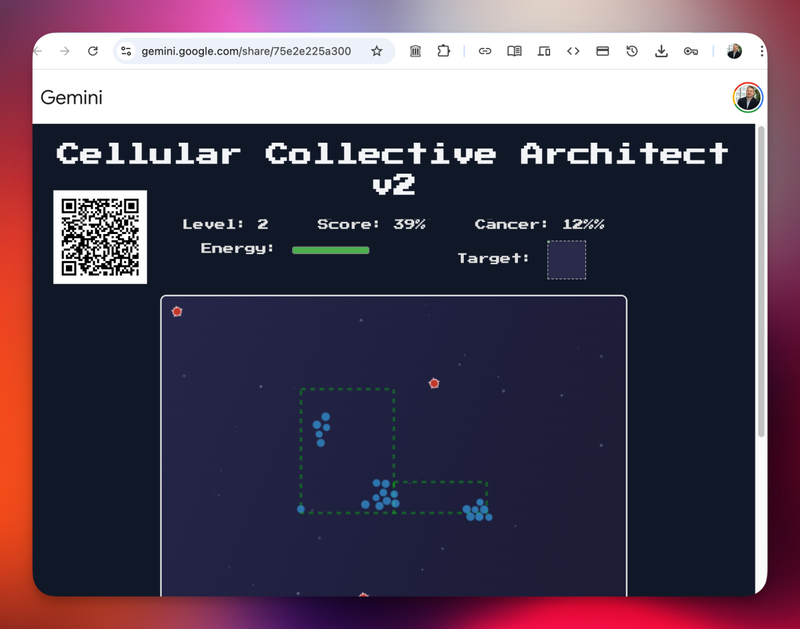 View full-size image: Pixelated interface of a game titled “Cellular Collective Architect v2” displayed on a browser window. The screen shows a QR code on the left and game statistics including Level 2, Score 39%, Cancer 12%, and a green energy bar. Below the stats is a dark gameplay area with blue cell-like dots arranged in a cluster, a green dotted boundary, and small red hexagonal icons scattered in the background. The browser is open to a Gemini URL, with browser interface elements visible at the top.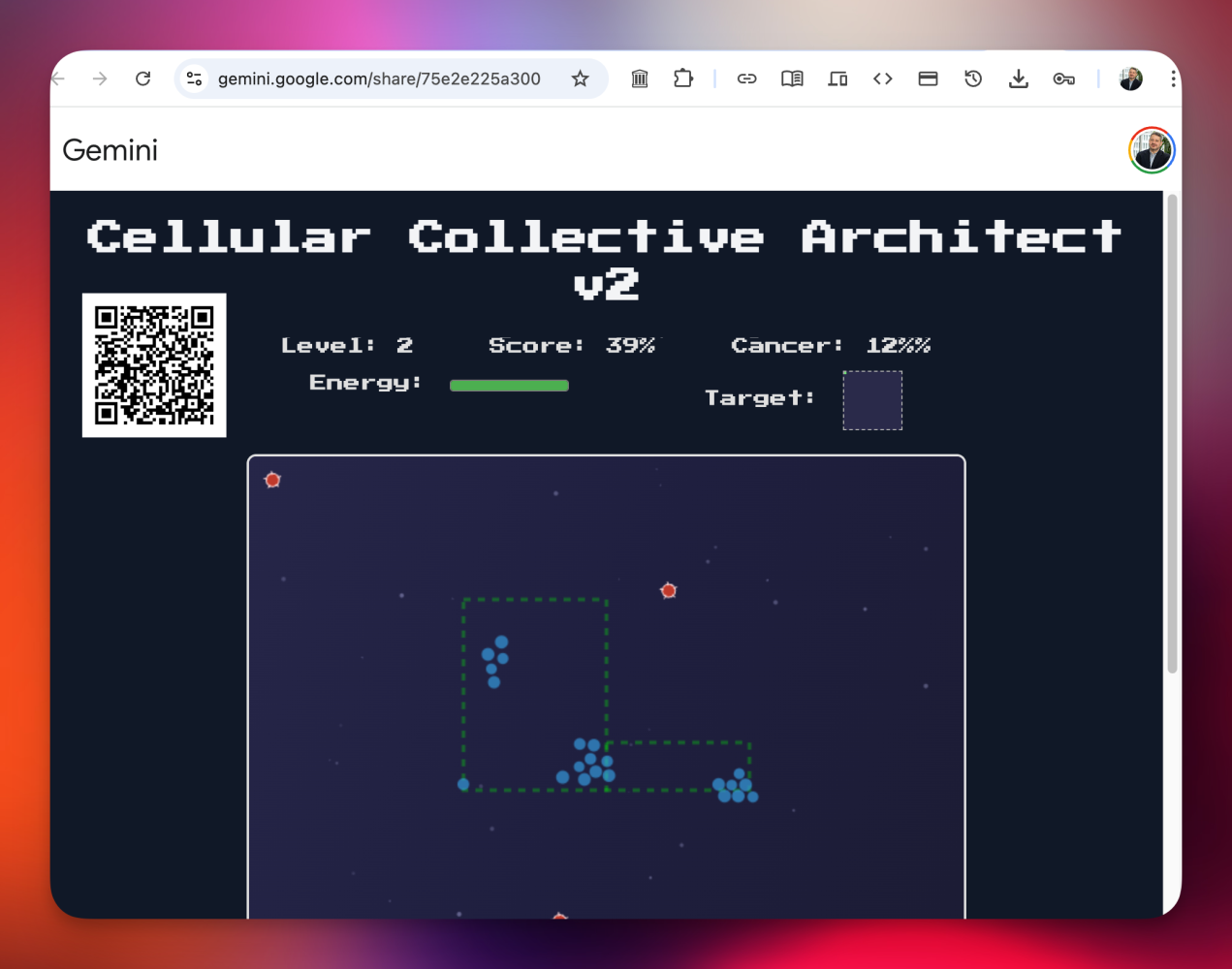
Gemini Game of Dr. Michael Levin's latest paper
Thinking Machines
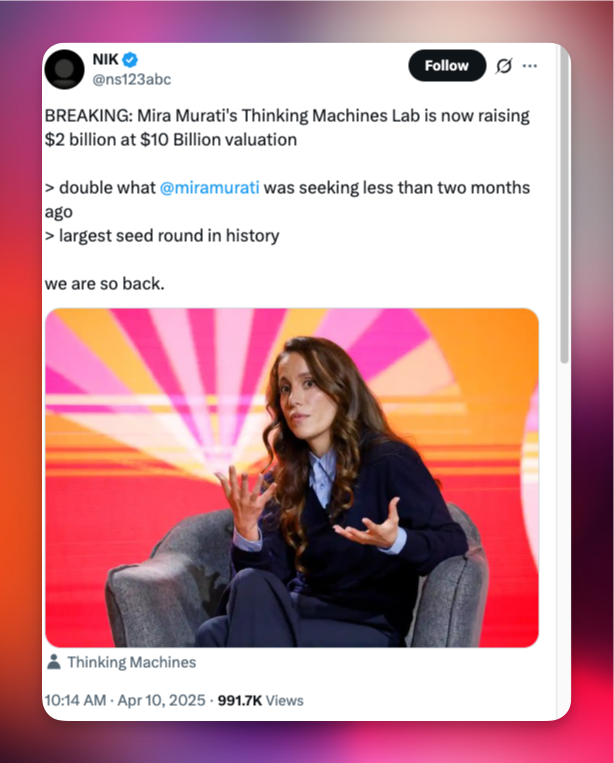 View full-size image: Tweet by @ns123abc: "BREAKING: Mira Murati's Thinking Machines Lab is now raising
$2 billion at $10 Billion valuation, double what @miramurati was seeking less than two months
ago, largest seed round in history. We are so back."
991.7K Views
View full-size image: Tweet by @ns123abc: "BREAKING: Mira Murati's Thinking Machines Lab is now raising
$2 billion at $10 Billion valuation, double what @miramurati was seeking less than two months
ago, largest seed round in history. We are so back."
991.7K Views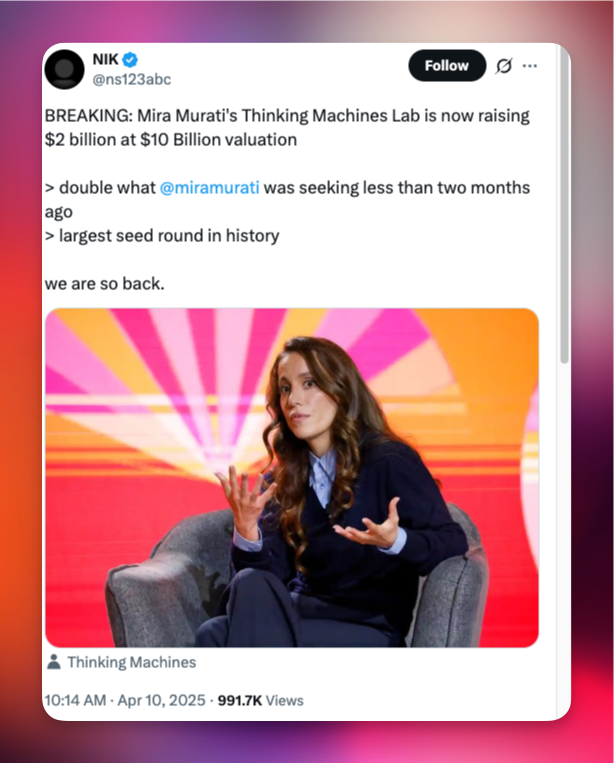
Image of Mira Murati
Mira Murati, the former CTO of OpenAI, is reportedly raising at a $10 Billion dollar valuation. While she certainly has the credentials, what does it say about this market that multiple companies are raising billions of dollars, and two of them only have great resumes, AI know how, plaintext websites and no customers. Incredible.
Enshittification of the API
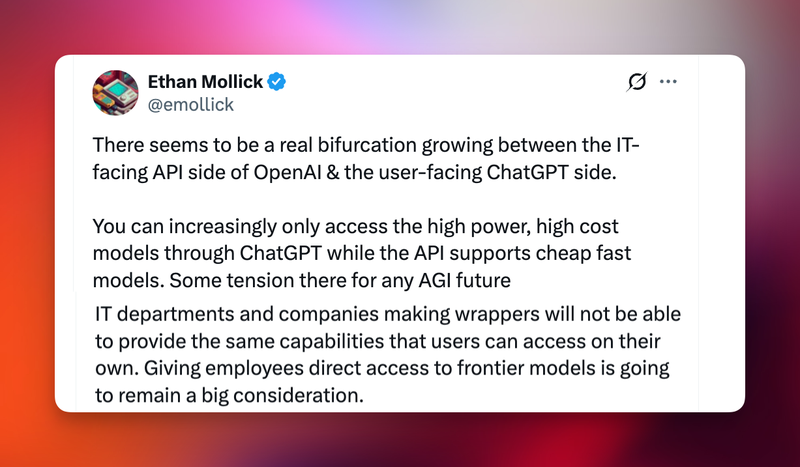 View full-size image: Ethan Mollick aka @emollick tweets: "There seems to be a real bifurcation growing between the IT-facing API side of OpenAI & the user-facing ChatGPT side. You can increasingly only access the high power, high cost
models through ChatGPT while the API supports cheap fast
models. Some tension there for any AGI future." Reply tweet grafted onto original: "IT departments and companies making wrappers will not be able to provide the same capabilities that users can access on their own. Giving employees direct access to frontier models is going
to remain a big consideration."
View full-size image: Ethan Mollick aka @emollick tweets: "There seems to be a real bifurcation growing between the IT-facing API side of OpenAI & the user-facing ChatGPT side. You can increasingly only access the high power, high cost
models through ChatGPT while the API supports cheap fast
models. Some tension there for any AGI future." Reply tweet grafted onto original: "IT departments and companies making wrappers will not be able to provide the same capabilities that users can access on their own. Giving employees direct access to frontier models is going
to remain a big consideration."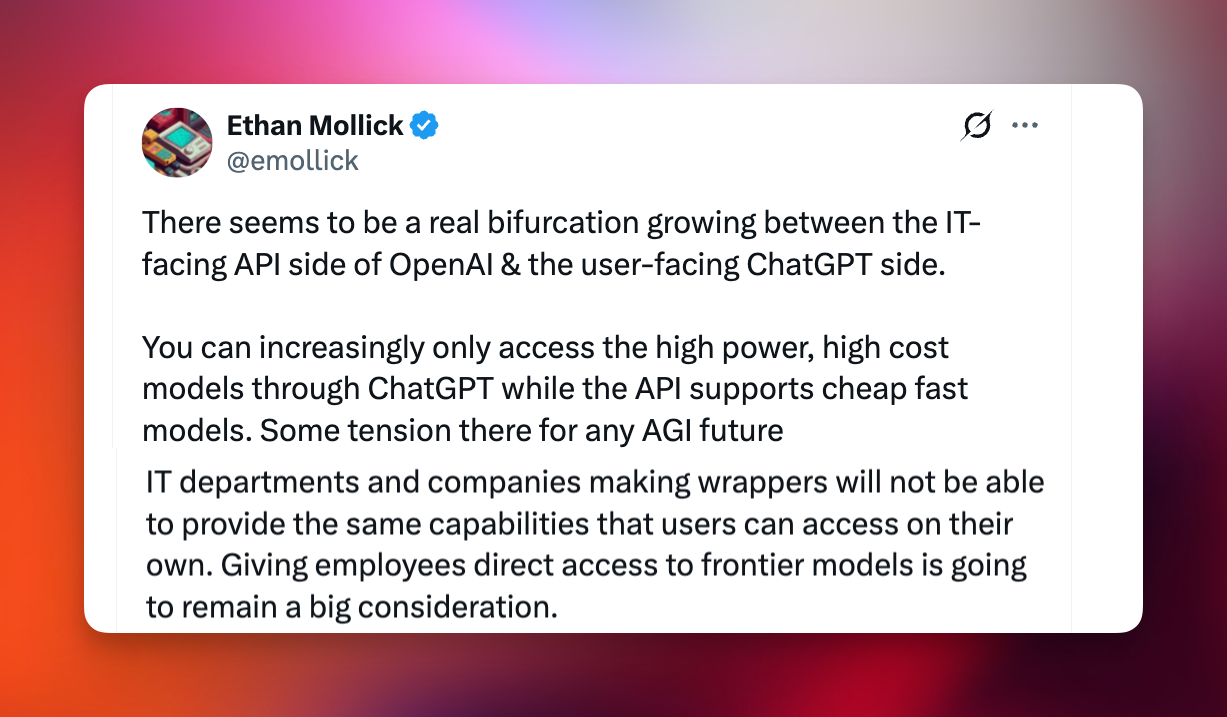
Ethan Mollick highlights a strategy of handicapping the API
Ethan Mollick consistently makes me think. This AI war will involve a lot of strategy as AI and downstream companies jostle for power. There are so many players with ungodly sums of money. I hope we don't see the APIs that power downstream companies, getting capabilities hampered in order to provide a strategic advantage. A good analogy is the App Store. The owner of the platform gets to make the rules.
How I use AI
Preparing for Media Interviews
Custom AI Podcasts
Since the last edition, I’ve had a few media interviews come up and needed to brush up on relevant topics. I went to Google's NotebookLM, added the journalist’s name, linked to a few of her articles, and uploaded background documents related to the subject.
NotebookLM generated a 20-minute podcast, which I listened to during my drive to the Strip. The podcast was solid, but I made a mistake in the prompt. I needed to be clearer that the journalist's articles were to understand what she wrote about, whereas the topic of the podcast needed to be about the theme of the interview. As a result, it leaned too heavily on the journalist’s past work and focused on tangential topics.
Fortunately, during a traffic stop, I was able to use one of NotebookLM’s beta features to make the session more interactive. That let me guide the AI “hosts” to cover the material I actually needed.
If you haven’t tried NotebookLM yet, it’s worth exploring, especially for interview prep or digesting complex information on the go.
Anki-style dynamic tutoring with ChatGPT Voice
You may be surprised to learn that I have a Diamond Certification from the GIA (Gemological Institute of America). When I was younger, I took their Diamond Grading Course. I made flashcards and every time I got a question wrong, I'd put it in the "wrong stack". And I didn't stop studying until I got every single flashcard right, scoring me a 99 on the final. As a Gretzky fan, I was delighted my score matched his iconic jersey number, but sad that I only discovered this technique after my schooling was over.
Fast forward to the 2020s and it turns out the kids today use software called Anki flashcards that uses a technique called Spaced Repetition to help you memorize things. For some reason, I couldn't get it to work for me. Probably because I inhale information at an intense pace, have a large variety of interests, and getting older, find it hard to remember it all.
But I started to think that ChatGPT Voice may solve the problem, at least for short term use. So again, to prepare for a media interview, I threw in all my talking points and all the topics I was boning up on and asked ChatGPT:
Help me write a prompt that gets you to quiz me on a list of talking points. Keep switching up how you ask the questions and go through them until I get everything right. Keep track of what I miss and circle back to it until I’ve nailed the whole set.
Here is the prompt that ChatGPT created, for its own use!:
You are a professional quiz coach focused on [TOPIC]. Quiz me until I’ve mastered the core facts below. Vary your question types—use short answer, fill-in-the-blank, rephrased multiple choice, or “explain like you’re presenting to [X]” formats. Reword the questions and shuffle their order to challenge retention. Be supportive, but hold a high bar for accuracy and clarity. Only move on once I’ve nailed each point.
I could not believe how well it worked. In retrospect, I would have told it about the interviewer, thrown in a few sample articles and asked it to act like they are that journalist and ask me questions from their perspective.
But even so, it WORKED LIKE A CHARM! I could not believe how quickly I learned a whole bunch of facts. Highly recommend playing with this approach.
Deep Research
For an upcoming GAAD interview, I needed to compile a comprehensive history, something we'd never properly compiled. This presented an ideal opportunity to test various AI deep research capabilities across platforms.
First, I created custom prompts for ChatGPT, Claude, Perplexity, Grok, and Google Gemini, uploading our historical documents and relevant links to each. After collecting their responses, I consolidated the findings in Google's AI Studio, which efficiently handled the large context window, and exported a structured CSV file.
The real breakthrough came when addressing our fragmented historical records. We had structured data on events from 2020 onward, but information from 2012-2019 existed only as unstructured lists with broken links. Using Cursor, I developed a program to scrape and analyze over 150 archived pages, extracting event titles, locations, and descriptions.
This process transformed previously inaccessible historical data into a structured database. While AI tools sometimes hallucinate, they excel at converting unstructured information into organized data, when supervised by humans. By next year's 15th anniversary, we'll have a complete GAAD historical record suitable for statistical analysis and rich storytelling.
Accessibility and Gen AI Podcast Updates
Eamon McErlean and I invited Matt Ater onto the pod to talk about JAWS, AI, his background and more. Matt is another OG of accessibility whose contribution to the field cannot be overstated.
Image Gen
What would this newsletter be without some ImageGen? Well, it was harder than the last edition because OpenAI nerfed their image tool. Perhaps in response to the TED interview. That said, we've got plenty to work with. Let's start with a Dolphin Whisperer, to celebrate Google's Dolphin LLM.
Here is OpenAI's best version:
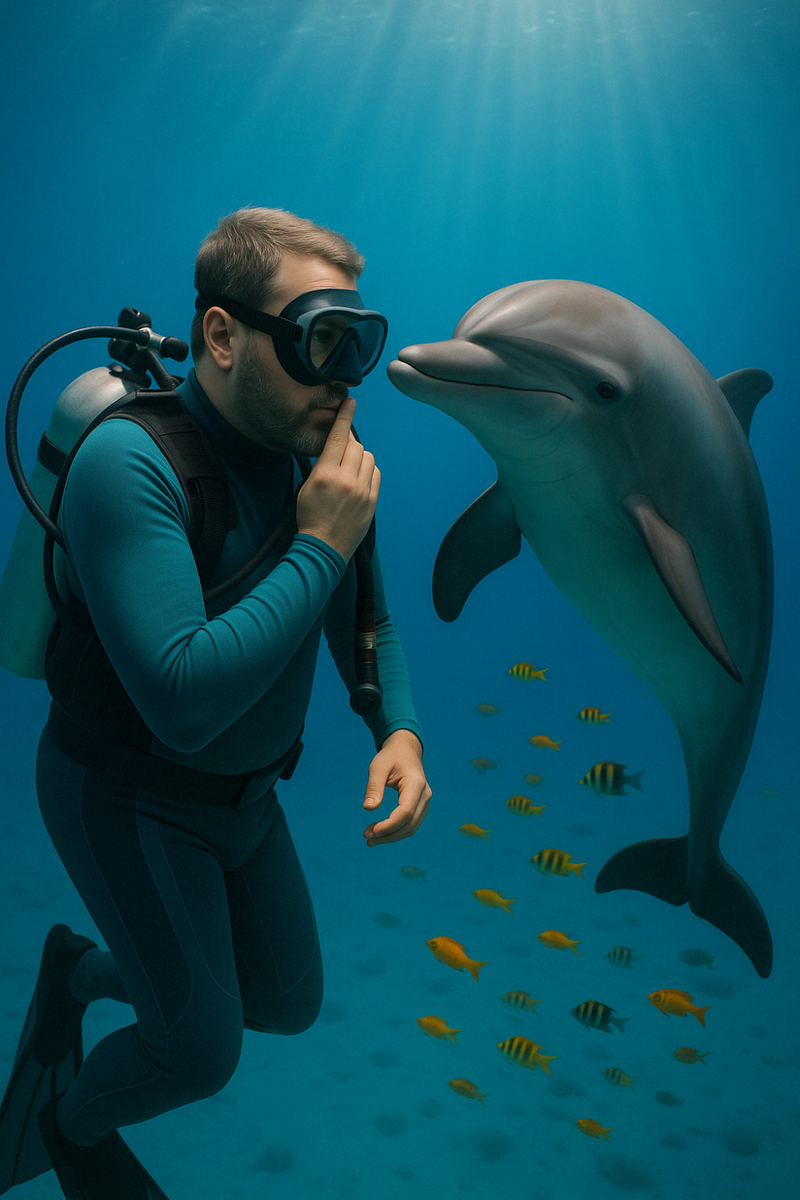 View full-size image: Joe in scuba gear, chatting with a Dolphin in the deep sea with smaller fish around.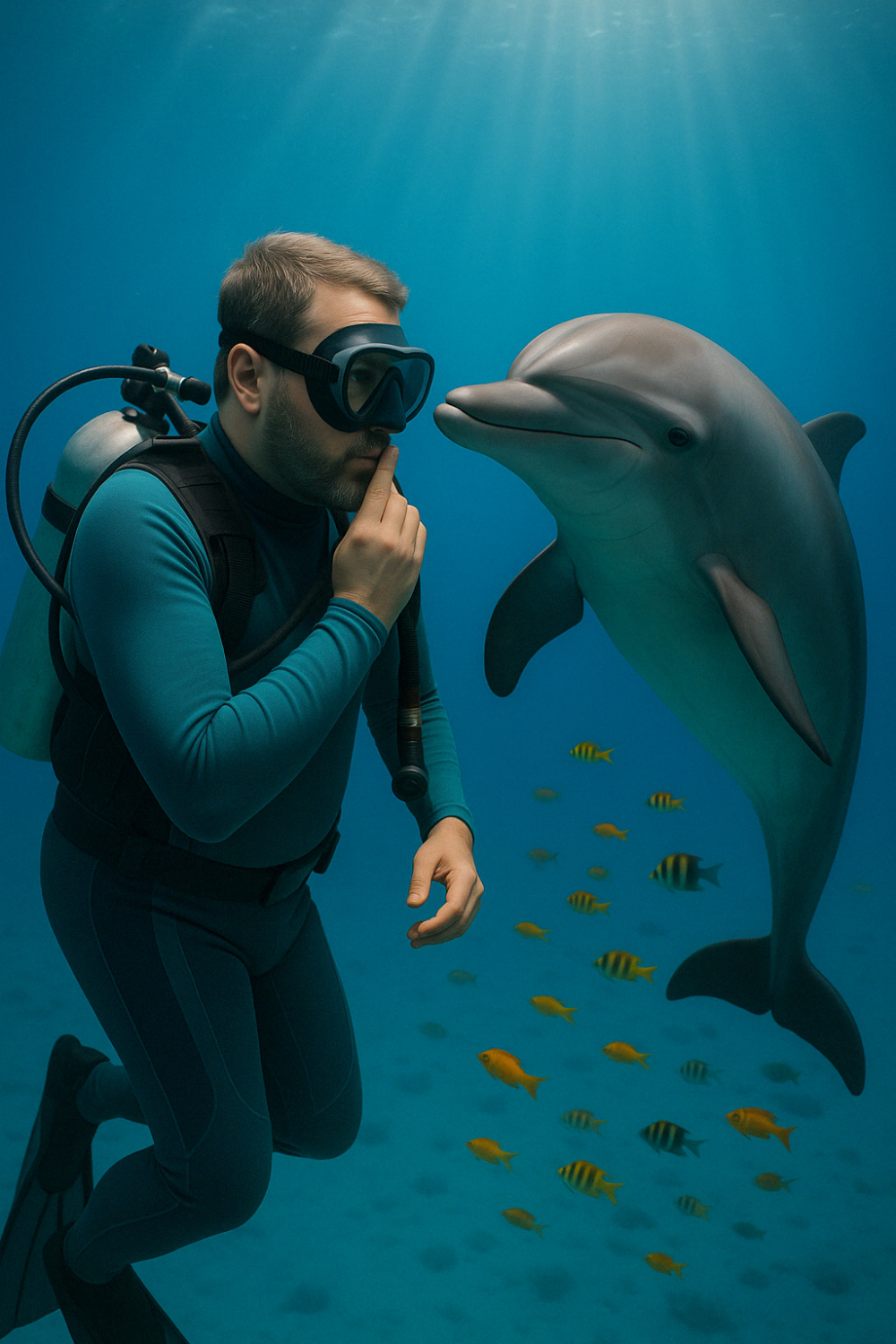
Joe with a Dolphin by ChatGPT
Here is Gemini's best version:
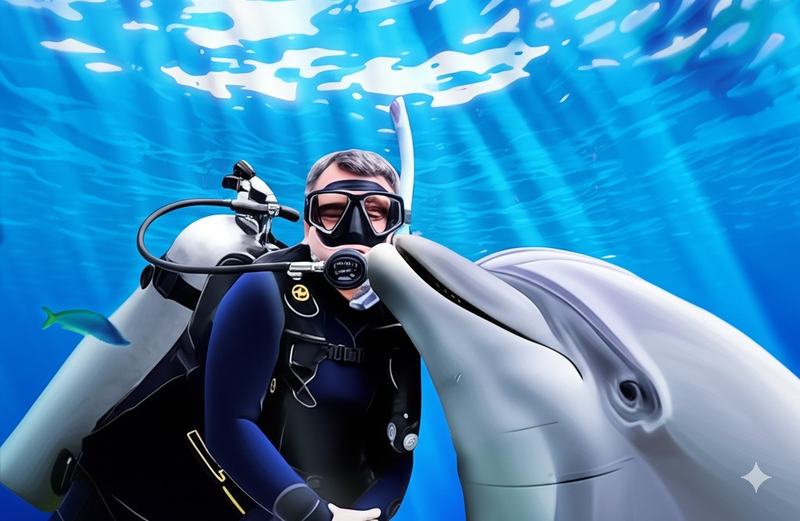 View full-size image: Joe in scuba gear underwater being gently nuzzled by a dolphin, with light beams streaming through the blue water above and a small fish swimming in the background.
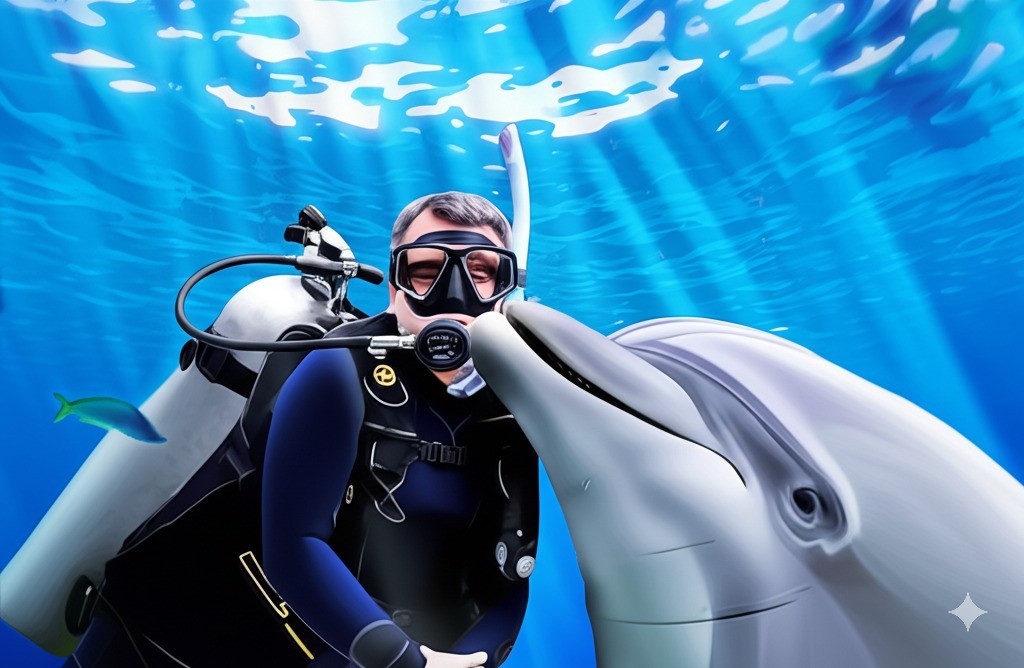
Gemini's version of Joe with Dolphin
For some reason Grok really nailed this prompt:
 View full-size image: Joe in a blue wetsuit posing underwater beside a dolphin near a vibrant coral reef, with various small fish swimming in the background.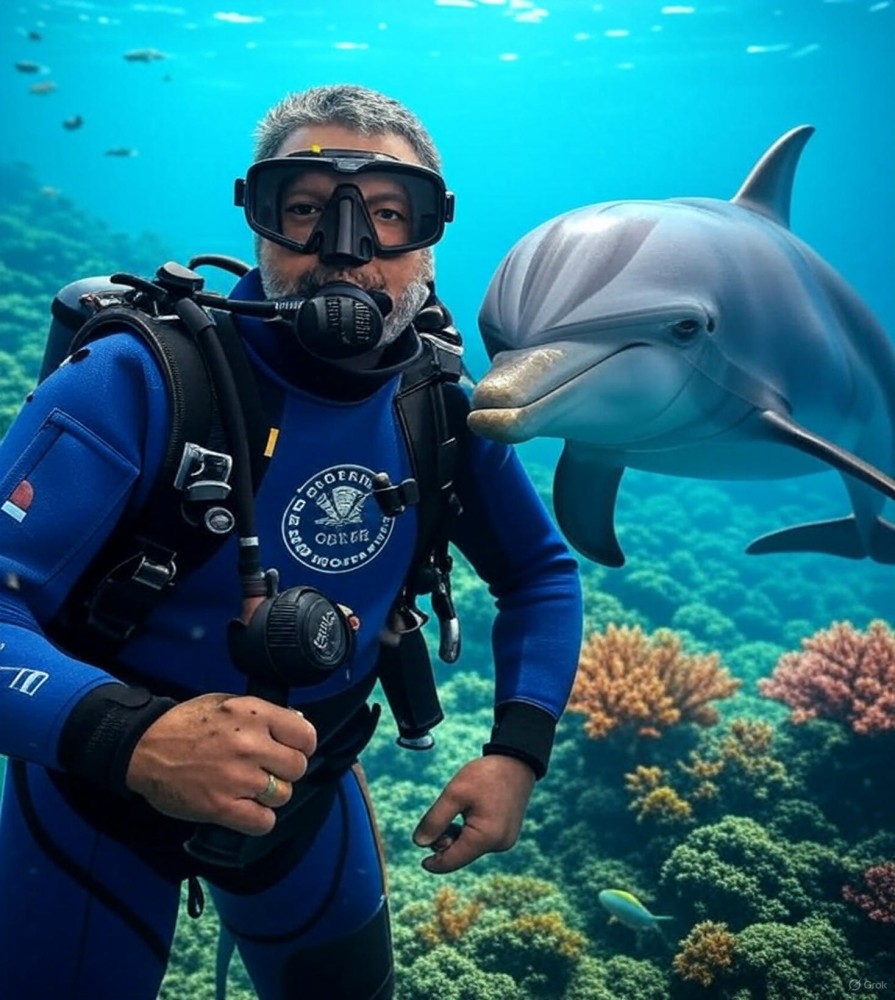
Grok's version of Joe and a Dolphin
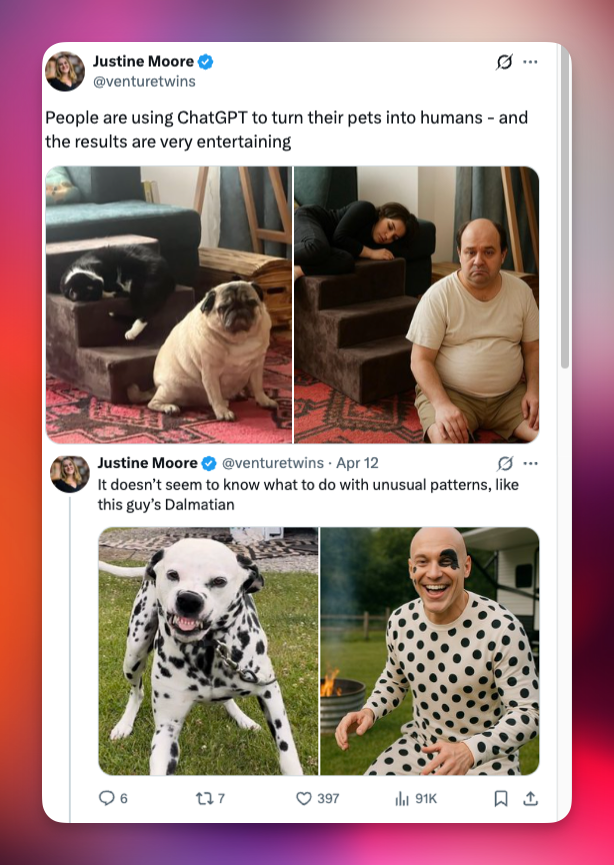 View full-size image: "People are using ChatGPT to turn their pets into humans - and the results are very entertaining"
Two tweets by Justine Moore with side-by-side photos of pets and their humorous AI-generated human counterparts. The first tweet shows a black cat and a pug sitting by carpeted stairs, next to an image of a woman and a bald man mimicking their positions. The second tweet shows a Dalmatian dog on grass and a bald man in a matching polka dot outfit, smiling beside a fire pit.
View full-size image: "People are using ChatGPT to turn their pets into humans - and the results are very entertaining"
Two tweets by Justine Moore with side-by-side photos of pets and their humorous AI-generated human counterparts. The first tweet shows a black cat and a pug sitting by carpeted stairs, next to an image of a woman and a bald man mimicking their positions. The second tweet shows a Dalmatian dog on grass and a bald man in a matching polka dot outfit, smiling beside a fire pit. 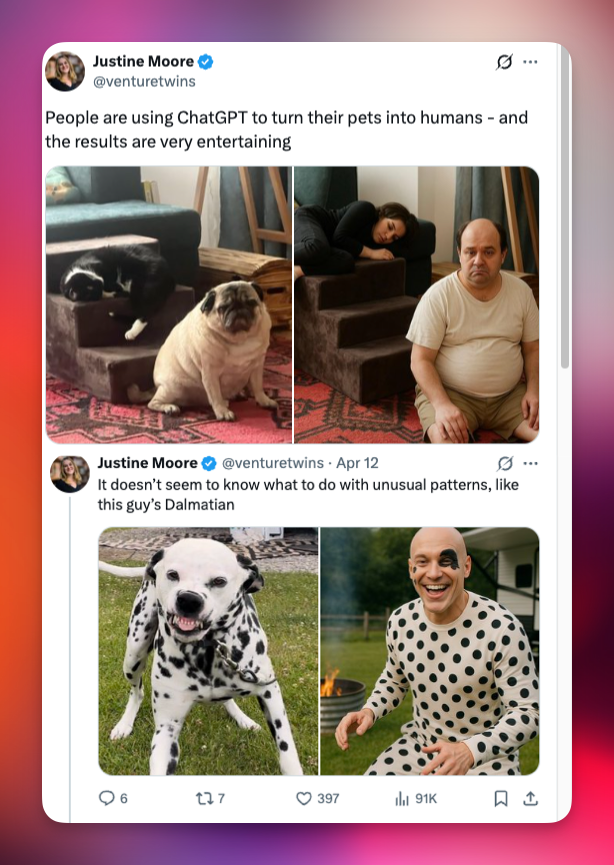
Pets to humans
The latest trend is having AI generate the human version of your dogs. Of course I had to turn Pepe into a human:
 View full-size image: Real fluffy brown dog named Pepe sits on a wooden floor next to an AI-generated child designed to show what Pepe might look like as a human. Both have similar curly brown hair, wide-eyed expressions, and wear matching textured brown outfits, emphasizing their resemblance.
Pepe next to human-pepe
Then I thought it was mean to turn Pepe into a human without doing the same from human to dog. Here is my headshot if I turned into Pepe:
 View full-size image: AI-generated image of a person with the head of Pepe, a fluffy brown dog, wearing a navy blazer over a blue plaid shirt with arms crossed. The setting is a modern office with large windows and a leafy green plant in the background. This image represents Joe imagined as Pepe in human form.
Joe as Pepe
I took all the text from this edition, ran it through ChatGPT, Gemini and Grok to generate a banner image incorporating all the elements from this newsletter.
ChatGPT:
 View full-size image: Smiling older man with white hair and glasses, wearing a navy suit, light blue shirt, and patterned tie, seated indoors on a light-colored chair.
An old man in a suit
I have no idea what ChatGPT was thinking! It's an image of an old man in a suit.
 View full-size image: Blue clock face with the words “Ai Time” in bold white text; clock hands point to “A” and “i”; background features circuit patterns.
Ai Time, by Gemini
Google Gemini came up with a blue clock that says AI Time.
The winner is Grok, whose image is the banner of this edition. Here's the image description: "Woman with a prosthetic arm interacts with a floating digital interface; background shows ocean and coral reef through a large window. Text at top reads 'AI Time: Innovating Accessibility.'"
Going dark through GAAD
Writing this edition took a long time. The last two weeks have seen announcements accelerate so much that every time I put something down on paper, it was out of date.
I was hoping to cover all the major AI news, but it's impossible unless you do this daily and do nothing else.
I've booked ~15 keynotes this GAAD season and need to finish coding up the topic I'm going to speak about. So JDOT is going dark for about a month. It will give me time to reflect on what slice of AI to tackle, so it's sustainable.
The biggest struggle is making it interesting for my audience, which is made up of hardcore CTO-types, Devs, Entrepreneurs and Accessibility folks. It's hard to write about something that interests all of those groups simultaneously. I'd love feedback on what you want to read.
See you in early June.
Footnotes
¹ What is "Phrase of the week" about? Get in touch and subtly work the phrase into your message to prove you read the newsletter to the end. Last time we had 2 winners, Elaine KA and Heather S. Neff.
² Dr. Levin's work is the only topic that is more exciting and important than AI is today. If I were a young kid, I would do everything I could to study at his lab in Tufts University. He's going to turn out to be the Einstein of our times. Speaking of which, if Einstein were alive today and he was following you on social media, would that change how you wrote? Because the good doctor followed me yesterday, and now I feel a responsibility to stop posting nonsense. :-)
Editorial correction
October 5, 2026: The original paragraph described Aimee Mullins as having a dozen prosthetic legs. Her 2009 TED Talk describes a dozen pairs. The paragraph now reflects that count and the timing of the talk.