JDOT #2: CSUN, Mobile Accessibility, and AI

March 18, 2025
Tags:
CSUN 2025 highlights, the State of Mobile App Accessibility report, practical AI workflows, and a contrarian take on OpenAI's prospects.
Joe Dev on Tech · Issue 2 · With sources.
Welcome to the second edition of Joe Dev on Tech!
Last week was eventful, centered around the CSUN Assistive Technology Conference 2025. In this edition, I'll recap CSUN, share how I use AI and provide a contrarian take on OpenAI's prospects. Let's dive in!
CSUN 2025 Highlights
Advancing Accessibility and Inclusion Through Open Source
I co-presented on Open Source alongside accessibility luminaries Jen Mankoff, Ed Summers, and Josh Miele:
- Ed Summers (GitHub) provided foundational context of open source principles and effective code licensing strategies
- Josh Miele introduced CAOS (Center for Accessibility and Open Source), his innovative NGO supporting accessible open source development
- Jen Mankoff presented research from A11yhood.org, analyzing over 1,440 repositories focused on accessibility solutions
I started my presentation by pointing out that product accessibility is downstream of dev culture¹, a more powerful force than regulatory requirements or corporate directives. As someone in my CTO group once said:
When I want my devs to improve their code quality, I open source the project
When devs know that people will actually see their code, they make sure it's good. That's how you get craft out of people. Culture.
Don't get me wrong, we definitely need budget to hire accessibility SMEs² or perform PwD³ user testing. But start at culture and your chances of getting the rest go up.
AI Accessibility Evaluation Project (ALICE)
I also teased ALICE (working title), an AI project I'm building with Eamon McErlean at ServiceNow. ALICE will score coding-oriented LLMs on how accessible their HTML is. The end goal is to get the companies behind foundation AI Models to compete on accessibility.
📊 State of Mobile App Accessibility Report
A few years after co-founding Global Accessibility Awareness Day (GAAD), I asked myself an important question: For sure we were raising awareness, but were we improving the actual accessibility of digital products?
As it happens, Jared Smith set out to answer that question with the 2024 WebAIM Million report, which revealed the sobering statistic that approximately 96% of web homepages fail accessibility standards.
I was hoping that mobile apps might perform better, since both Apple and Google have invested in accessibility-focused developer tools. Several years ago, my team began tracking mobile app accessibility through the State of Accessibility Report, but those efforts were cut short due to the pandemic.
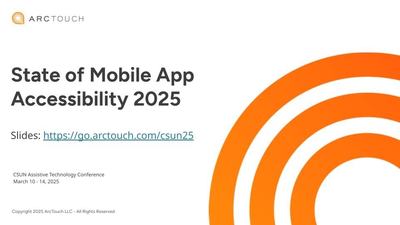
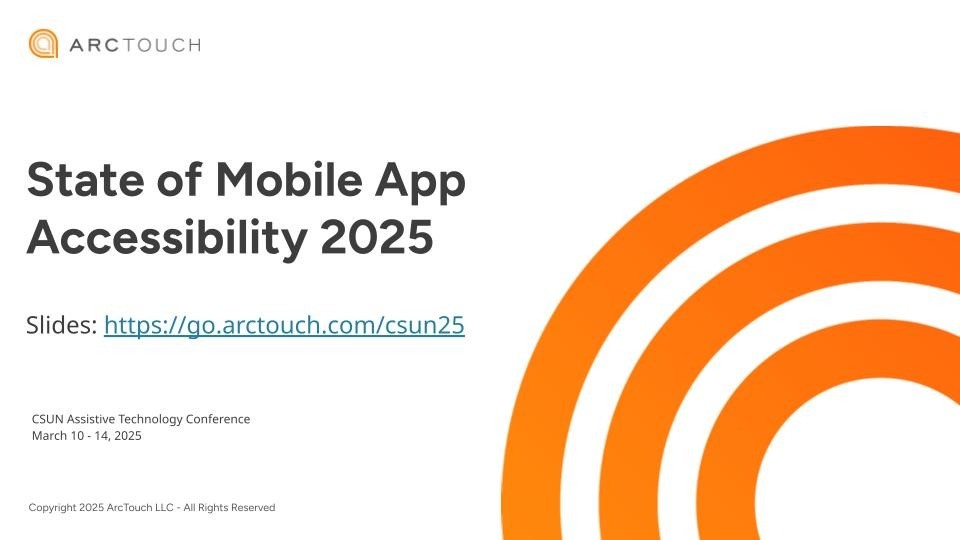
I'm delighted to announce that my mentee, Ben Ogilvie, Head of Accessibility at ArcTouch, has revitalized this important work with the SOMAA (State of Mobile App Accessibility) report. Ben and Mark Steadman previewed their findings at this year's CSUN conference.
It's not my place to share the results, but I will say that 72% of apps performed "poorly" or worse.
The complete SOMAA report will be released in the coming weeks, sign up to be notified. I predict that the duo of Jared and Ben's reports will form the foundation for future understanding of the accessibility landscape.
I'll end this section with a CALL TO ACTION. After decades of effort in this industry, we have barely made a dent. It's not acceptable. Are you doing anything to affect those numbers? If not, make a plan that will have a large scale impact. If you come up with any ideas, please share them with me.
🎙️ Media Appearances and Updates
Recorded at CSUN last week:
- Double Tap TV: Ben Ogilvie joined me on the YouTube/Accessible Media Inc. show with co-hosts Steven Scott and Shaun Preece. We discussed Dario Amodei's recent interview with the Council on Foreign Relations where he shared dire predictions about AI's impact on coding and other professions. Ben discussed the SOMAA report.
- Investing in Accessibility: GAAD Co-Founder, Jennison Asuncion and I were guests on Chris Maher and Kelvin Crosby's podcast about the business of investing in accessibility. We had a fun conversation about the upcoming GAAD festivities and the innovation happening at CSUN and at large.
Links to the actual episodes will be shared once they go live.
Now available: Joe Devon and Ben Ogilvie on Double Tap, released March 28, 2025; and Joe Devon and Jennison Asuncion on Investing in Accessibility, released March 31, 2025.
Upcoming Events
- NAB Show Panel: I'm moderating a panel on AI's Potential to Revolutionize Accessibility. If you're interested in participating as a panelist, please reach out.
- Global Accessibility Awareness Day: Mark your calendars for May 15! Planning is well underway for GAAD 2025.
- GAADY Nominations Open: Know someone who should be recognized for building software with accessibility as a core value? Submit a nomination.
Accessibility and Gen. AI Podcast Updates
Next week, Eamon and I will interview Dylan Barrell, CTO at Deque about his recent keynote on AI automation, learn about AI projects he's been working on, and find out about his personal journey in the world of accessibility.
Now available: Dylan Barrell on the Accessibility and Gen. AI Podcast.
Net Way vs AI Way
In the early days of the web, there was a trend called "The Old Way vs The Net Way" that helped people understand how the internet would transform their lives. Today, we're witnessing a similar revolution with AI.
I know many people who are lightly dabbling with AI for tasks like writing marketing copy. But they are missing out on how for people like me, AI has completely seeped itself into everything I do. One of the goals of writing this newsletter is to share how I use AI, so that you can see concrete examples of how it can make you more productive. Here are two real-world examples from last week:
1. Creating Custom QR Codes in Minutes
My co-presenters at CSUN had QR codes for their presentations. I wanted to match their slides. Here's how it would have gone before AI:
The Net Way
- Google "Free QR code creator"
- Wade through 7 ads pretending to be search results
- Dodge 17 SEO'd listicles with masterpiece "calls to action" copy
- Click a promising link, swat away 5 popup windows & pray it works
- Investment: 3 gray hairs, 4 brain cells, a sliver of your sanity
With AI, I made two QR codes like this:
The AI Way
- Opened Cursor, an AI-powered editor (a fork of VSCode)
- Prompt: "Create a QR code for my newsletter"
- Next: "Add my logo"
- Next: "Match the colors of my logo"
- Repeat for podcast
- Investment: 3 minutes

See those QR codes on slide 41
2. Researching a Controversial Statement in Record Time
Social media was buzzing about the aforementioned comments by Dario Amodei at the CFR Fireside Chat. He predicted that AI could write 90% of code within three to six months, and essentially all code within a year. With my DoubleTap TV interview starting in ten minutes, I needed to quickly find out if it was hyperbole or an accurate quotation.
Editorial correction, October 5, 2026: The original edition said three months and 100%. The CFR transcript gives three to six months and essentially all code. The paragraph above now paraphrases that prediction.
The Net Way:
- Perform a YouTube search on "Dario Amodei's interview"
- Select "Filter" to find recent videos
- Search the description for timecodes. No luck.
- Dig through the comments graveyard hoping for timestamp breadcrumbs
- Check for chapter markers, find none
- Play digital roulette at 2x speed, randomly skipping through segments
- Investment: 60 minutes of detective work, if you persevere
The AI Way:
- Perplexity AI search → Located exact source of interview
- MacWhisper → Generated complete transcript of hour-long talk with precise timecodes
- Dump transcript into Cursor → Instantly locate the timecodes and precise quotes about coding replacement
- Quickly review the exact video segments to confirm accuracy
- Investment: 10 minutes
- Bonus: Complete transcript for future research and training models
Update: AI moves so quickly that as of this week, you can now share a YouTube video in Google's AI Studio and chat with it.
Key Insight: What makes these examples powerful isn't just time saved—it's the transformation in how we approach tasks. AI enables us to tackle projects we wouldn't have attempted before, creating new possibilities rather than just making existing processes faster.
Is OpenAI OK?
After reading "There is no AI Revolution" by Ed Zitron (H/T @briansletten), I found myself reevaluating the AI landscape through a business model lens. While ChatGPT has hit the mainstream, several fundamental challenges raise serious questions about its long-term sustainability. In fact, are foundational models where the value in AI is ultimately captured?
The Economics Don't Add Up
- To date, Microsoft has invested approximately $14B for 49% of the company
- 2024 revenue reached $3.7 billion according to CNBC
- 2024 net losses were estimated at approximately $5 billion, with approximately $9 billion in spending
- Salaries were at $700 million, not including equity, in 2024
- Compute costs consume their entire revenue stream and more: $3B for training models and an estimated $2B for running them
Editorial correction, October 5, 2026: The original edition called $9 billion a loss. Ed Zitron's cited report distinguishes approximately $5 billion in net losses from approximately $9 billion in spending. The figure above has been corrected.
This creates a challenging equation: OpenAI grew from 300 million weekly active users in December of 2024 to 400 million by February 2025, but they have only 15.5 million paying subscribers. They are reportedly losing money even on their paying subscribers, let alone the free ones. When a company's unit economics show costs exceeding revenue for every user, rapid growth becomes an albatross, not an advantage.
VCs infamously propped up the unit economics of Uber, WeWork and other startups, with the apparent intent of passing off reality to the 401Ks holding these stocks after going public. Have we learned nothing from these debacles?
The Talent Exodus
OpenAI has experienced significant brain drain, losing key figures who shaped its technology and vision:
- Ilya Sutskever, co-founder and chief scientist
- Mira Murati, former CTO
- Dario Amodei, who left to found Anthropic
- Andrej Karpathy, one of AI's most respected researchers
Dario's departure is particularly telling. He founded Anthropic partly due to ethical concerns about OpenAI's approach and has established a responsible scaling policy that contrasts with OpenAI's philosophy. In a revealing comment, Amodei described the divergence between the two companies as being "in the midst of an interesting experiment," comparing Anthropic's more measured approach with OpenAI's aggressive strategy. Anthropic deliberately delayed releasing Claude by six months, which had real market consequences but reflected their commitment to responsible AI development.
The Microsoft Question
Perhaps most concerning is OpenAI's relationship with Microsoft. In a February 2025 interview with Dwarkesh Patel, Satya Nadella provided revealing perspective:
- He established a clear benchmark: "The world growing at 10 percent," deliberately downplaying AGI hype
- He stated that "Models are getting commoditized... the value is going to be created with that trend"
- More bluntly, after the ousting of CEO Sam Altman in 2023, Nadella asserted Microsoft's independence, saying, "It wouldn't matter if OpenAI disappeared tomorrow... We have everything"
This raises questions about Microsoft's long-term commitment to funding OpenAI's astronomical and rising costs.
The Competitive Landscape
The AI race is intensifying rapidly with strong Chinese competitors who have developed comparable models at lower costs. Anthropic's Sonnet 3.X series has dominated in coding tasks for over a year, with Amodei's more deliberate growth strategy. This has led OpenAI to propose a ban on Chinese-produced models - a move that earned criticism in a video from developer influencer Theo Browne.
Where Will AI Value Be Captured?
OpenAI is finalizing $40 billion in new funding at a $300 billion valuation—nearly doubling since October. But this valuation feels increasingly disconnected from business realities.
The Fundamental Question: Will value be captured in foundation models themselves (OpenAI's bet) or in applications built on these models (Nadella's view)? Evidence increasingly points to the latter.
As models become commoditized and training costs escalate, companies building valuable applications for specific business needs may ultimately capture more value.
🔧 Try These AI Tools
Here are some of the new AI tools I played with this week:
Gemini Live: A Visual Accessibility Assistant
Gemini Live offers a streaming conversation with Google's AI model while sharing your webcam or screen. This has powerful accessibility applications:
- For blind users: Get real-time descriptions of what's on your screen when navigation becomes challenging
- For users with mobility impairments: Let Gemini watch your screen and take notes for you as you chat with it and direct it.
How to try it: Visit Gemini Live in your browser and enable voice for audio and camera or screen sharing for video. Start with simple questions about what's visible, then progress to more complex assistance tasks.
Gemini Image Generation with Text
The Google Gemini AI team has been cooking. Their new image generation model now acts like Photoshop attached to an LLM for editing. They now offer reliable text inclusion—a feature many other models struggle with. This is particularly valuable for creating accessible visual content that includes necessary textual information.
I had a funny experience putting the editing through its paces. I uploaded a headshot, and even though I didn't particularly look that fat in that picture, asked it to "make me thinner". It responded with an image that removed me from the image entirely! Hilarious!
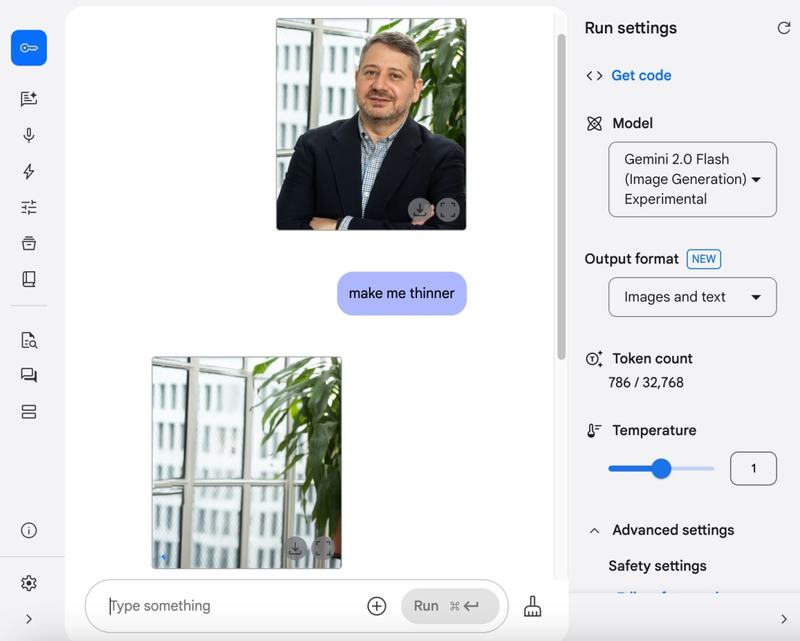 View full-size image: Google AI Studio shows Joe's headshot, the prompt 'make me thinner,' and a generated image of the same background with Joe removed.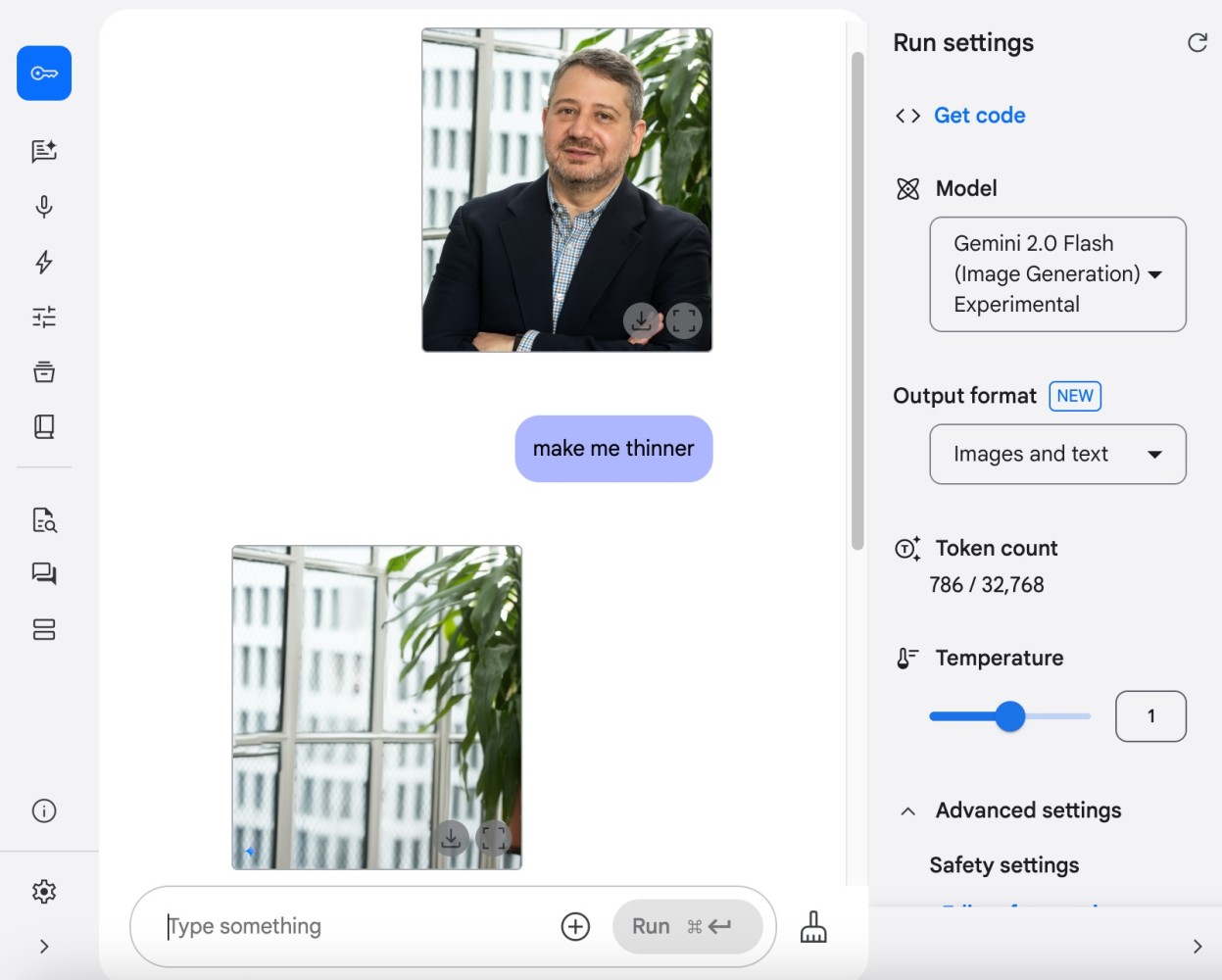
Screenshot of Gemini Image Generation Interface
How to try it: Use Google's AI Studio and select the image generation model and go to town!
Manus.im: Custom AI Agents
Manus.im allows creation of custom AI agents—similar to Cursor but for agents. When it works, it feels like magic. While promising, be aware of its current context limitations and the fact that their servers get overloaded quickly.
They do have a waiting list. It took me about a day to get in.
Looking Forward: This tool offers a glimpse of how AI agents will soon accelerate workflows, though it's still maturing. Watch for developments in this space.
🔜 Stay Connected
Want to discuss how we can make AI work for accessibility? Let's connect:
- Website: https://www.a11yaudits.com/
- LinkedIn: https://www.linkedin.com/in/joedevon/
- YouTube: https://www.youtube.com/@a11ygenai
- Accessibility and Gen. AI Podcast: linktr.ee/a11ygenai
Until next week, keep building accessible technology that makes a difference! 🚀
Footnotes:
¹ By "dev culture", I include the entire ecosystem of people building digital products. From Project and Product Managers to UI/UX, Developers, Designers, etc.
² SME = Subject Matter Expert
³ PwD = People with Disabilities